
Money Research Collective’s editorial team solely created this content. Opinions are their own, but compensation and in-depth research determine where and how companies may appear. Many featured companies advertise with us. How we make money.
Starbucks’ Pumpkin Spice Latte Now Costs 99% More Than It Did at Launch
By Adam Hardy MONEY RESEARCH COLLECTIVE
A hot, 16-ounce pumpkin spice latte costs about $6.66 this fall. That’s huge jump from the original PSL price.

With baristas already slinging pumpkin spice lattes as of Tuesday, Starbucks has ushered in the unofficial start of autumn a month early.
A hot, 16-ounce — that’s “grande” in Starbucks lingo — pumpkin spice latte typically costs $6.66 in 2026, according to average menu prices across several U.S. cities. That’s a 16-cent increase from $6.50 last year.
Must Read
- 10 Smart Ways Seniors Are Earning Extra Money
- Your Social Security Number Isn’t 'Suspended' — That Phone Call Is Probably a Scam
- Silver Is Up 70% Since This Time Last Year — and These Gold IRA Companies are Handing Out Up to $25,000 of It
Since the drink’s inception more than two decades ago the cost has nearly doubled, up 99% since 2005 (the first year for which Money found prices).
Starbucks’ pumpkin, cinnamon, nutmeg and clove-infused latte has rocketed in popularity, spurring copycats, candles and offshoots like pumpkin cream cold brew and pumpkin-flavored chai. The drink has also sparked a lot of backlash, becoming a lightning rod of public disdain over seasonal creep, overconsumption and capitalism in general.
“I will be subject to its tyranny no longer,” Last Week Tonight host John Oliver proclaimed in a 2014 tirade against the flavor. “It stops here.”
Except it didn’t. Twelve years later, the pumpkin spice latte lives on. Actually, it’s thriving.
The PSL, as fans refer to the drink, remains Starbucks’ most popular seasonal beverage, according to the coffee chain. And Starbucks relies on it to get people in the door: Visits to the store spiked 27% the day PSL launched last year, according to the business-intelligence firm Placer.ai. And foot traffic tends to stay elevated throughout the week.
More broadly, Starbucks has begun to rely on major seasonal menu launches, saying that about 10% of annual sales come from seasonal items.
But will price-conscious Americans be willing to shell out over $6 for the (in)famous latte again this year?
Must Read
- Retirees Are Doing These 10 Things to Add to Their Monthly Income
- Your Social Security Number Isn’t 'Suspended' — That Phone Call Is Probably a Scam
- Warren Buffett on Market Volatility — and 3 Ways You Can Take Advantage
Pumpkin spice latte prices over the years
Money charted the cost of the PSL over the past two decades, finding that as the drink’s popularity exploded, so did its price.
While the pumpkin spice latte was created in 2003, it wasn’t released nationally until the following year.
Money’s earliest price estimate begins in 2005, when a hot, grande PSL cost $3.35.
Since 2005, Money estimates, the cost of that same autumn latte has risen approximately 99%, far outpacing inflation. By contrast, overall prices have increased 68% from September 2005 to today. Over that same period, roasted coffee prices grew 84%.
Here’s a closer look at prices for hot, grande-sized PSLs.
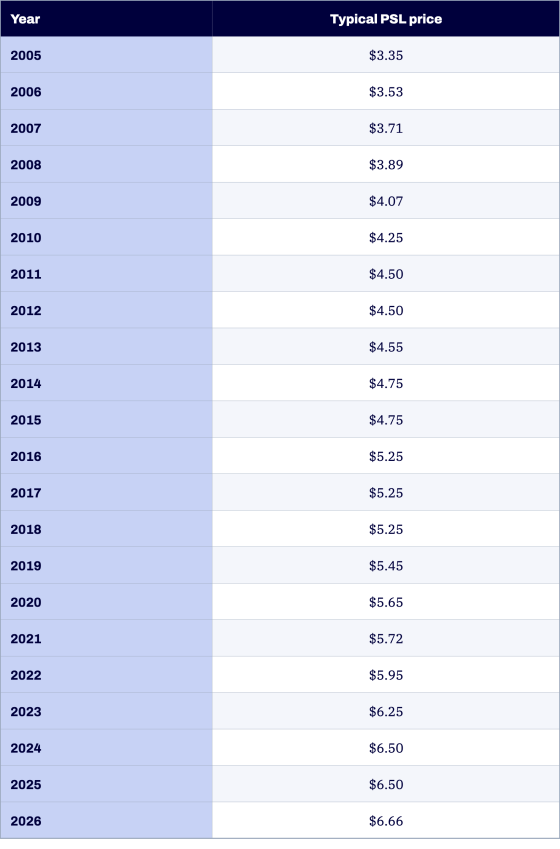
Price estimates are based on two dozen sources, from archived news stories to customer receipts, reviews and Starbucks menu prices across various cities.
Adam Hardy is Money's lead data journalist. He writes news and feature stories aimed at helping everyday people manage their finances. He joined Money full-time in 2021 but has covered personal finance and economic topics since 2018. Previously, he worked for Forbes Advisor, The Penny Hoarder and Creative Loafing. In addition to those outlets, Adam’s work has been featured in a variety of local, national and international publications, including the Asia Times, Business Insider, Las Vegas Review-Journal, Yahoo! Finance, Nasdaq and several others. Adam graduated with a bachelor’s degree from the University of South Florida, where he studied magazine journalism and sociology. As a first-generation college graduate from a low-income, single-parent household, Adam understands firsthand the financial barriers that plague low-income Americans. His reporting aims to illuminate these issues. Since joining Money, Adam has already written over 500 articles, including a cover story on financial surveillance, a profile of Director Rohit Chopra of the Consumer Financial Protection Bureau and an investigation into flexible spending accounts, which found that workers forfeit billions of dollars annually through the workplace plans. He has also led data analysis on several of Money’s marquee rankings, including Best Hospitals, Best Credit Cards, Best Places to Live and others. In 2025, Adam was named a Goldschmidt Data Journalism Fellow by the Society for Advancing Business Editing and Writing (SABEW). As part of the fellowship, he received hands-on training from SABEW, the U.S. Census, U.S. Federal Reserve Bank, Bureau of Labor Statistics and other federal government agencies in Washington, D.C. Adam also holds a multimedia storytelling certificate from Poynter’s News University and a data journalism certificate from the Investigative Reporters and Editors at the University of Missouri. In 2017, he received an English teaching certification from the University of Cambridge, which he utilized during his time in Seoul, South Korea. There, he taught students of all ages, from 5 to 65, and worked with North Korean refugees who were resettling in the area. Now, Adam lives in St. Petersburg, Florida, with his pup Bambi. He is a card-carrying shuffleboard club member.