Expect changes to your worship service when IL churches reopen from coronavirus shutdown
Many Illinois residents will be shouting “Hallelujah” when Gov. J.B. Pritzker loosens coronavirus-related restrictions and allows them to return to church, but worship services won’t be the same.
Pastors planning for the gradual reopening are saying “no” to hymnals, handshakes and crowded pews and “yes” to masks, hand sanitizer and social distancing. Those who once prided themselves on open-door policies are even considering reservation systems to keep from having to turn people away when sanctuaries reach initial 50-person limits.
“It’s a very different way of thinking than what we’re accustomed to,” said the Rev. Grant Armstrong, senior pastor at St. John’s United Methodist Church in Edwardsville. “To think that we might have to, for the sake of safety and responsibility, limit who enters at a given time ... That is a difficult hurdle for the concept of grace.”
Some churches plan to project bulletins on screens instead of handing them out at the door. Others will ask members to donate online or by mail so deacons won’t have to pass offering plates.
Eden Church in Edwardsville, which is loosely affiliated with the United Church of Christ, has ordered communion kits with individually-wrapped grape juice and wafers.
“Our youth leaders have been at events where they were used,” said the Rev. John Roberts, senior pastor. “My guess is that it was a niche item out there, but now it’s something everybody wants because they can’t do communion in the regular way.”
Even the wisdom of congregational singing is being questioned.
“Singing might not be feasible in the beginning stages because the particulates or droplets that you exhale can travel up to 12 feet, which surpasses the social-distancing regulation of 6 feet,” said the Rev. Zachary Lysdahl, pastor of First United Presbyterian Church in Collinsville.
Some churches are looking into buying thermal scanners that could take temperatures at the door and flag those with fevers.
Another issue is whether pastors would wear masks, given that some people already have trouble hearing sermons and do a certain amount of lipreading. Lysdahl floated the idea of clear face shields, similar to those worn by hospital workers.
“The Pope has a Popemobile,” he said. “You could have a pulpitmobile with plexiglass on three sides.”
Services may resume in late June
Illinois churches have been closed for two months under Pritzker’s stay-at-home order, which was designed to slow the spread of the coronavirus that causes the respiratory disease COVID-19. It has infected more than 1.6 million people and killed more than 95,000 in the United States.
Earlier this month, the governor announced a regional, five-phase plan for reopening with dates based on the percentage of coronavirus tests that come back positive, available ICU beds and other downward-trending statistics.
“It is vitally important that we follow a safe and deliberate path forward to get our Illinois economy moving,” the introduction states.
Southern Illinois is expected to enter Phase 3 by the end of May with the reopening of nonessential businesses, including offices, manufacturing plants and retail stores, albeit with social distancing and crowd limits. But churches are more concerned with Phase 4, which could take effect in late June and allows gatherings of up to 50 people.
Some county boards are encouraging immediate reopenings, in defiance of state regulations, but many churches are bound by rules of their conferences, which are sticking with Pritzker’s timeline.
“We would like to meet sooner rather than later, but right now we’re looking into the insurance implications and the legal implications,” Roberts said. “How do you determine which authority to follow and what are the consequences?”
Pastors also are eyeing the experiences of churches that already have reopened, including a Georgia congregation that started meeting on April 26, only to stop two weeks later when several members tested positive for the coronavirus.
Finally, pastors are seeking guidance from their flocks. Eden mailed out a survey last week, asking members of the congregation how comfortable they feel about returning for worship services.
“We have people who, if we could meet in person on Sunday, they would be there, and others who would be more cautious, especially older people with underlying health conditions,” Roberts said.
“Cautious anticipation is probably the best way to describe what people are feeling (at First United Presbyterian),” Lysdahl said. “We’re eager to worship in person, but we want to do so when we can have a little more assurance of safety.”
Technology allows group worship
Most metro-east churches have been offering virtual worship services during the coronavirus pandemic, thanks to video technology and social-media apps.
Some staffs record sermons, musical performances, readings and skits separately at home then edit them together and post them on websites or Facebook pages. Others gather key players on pulpits to shoot video. Lysdahl uses Facebook Live to deliver weekly messages.
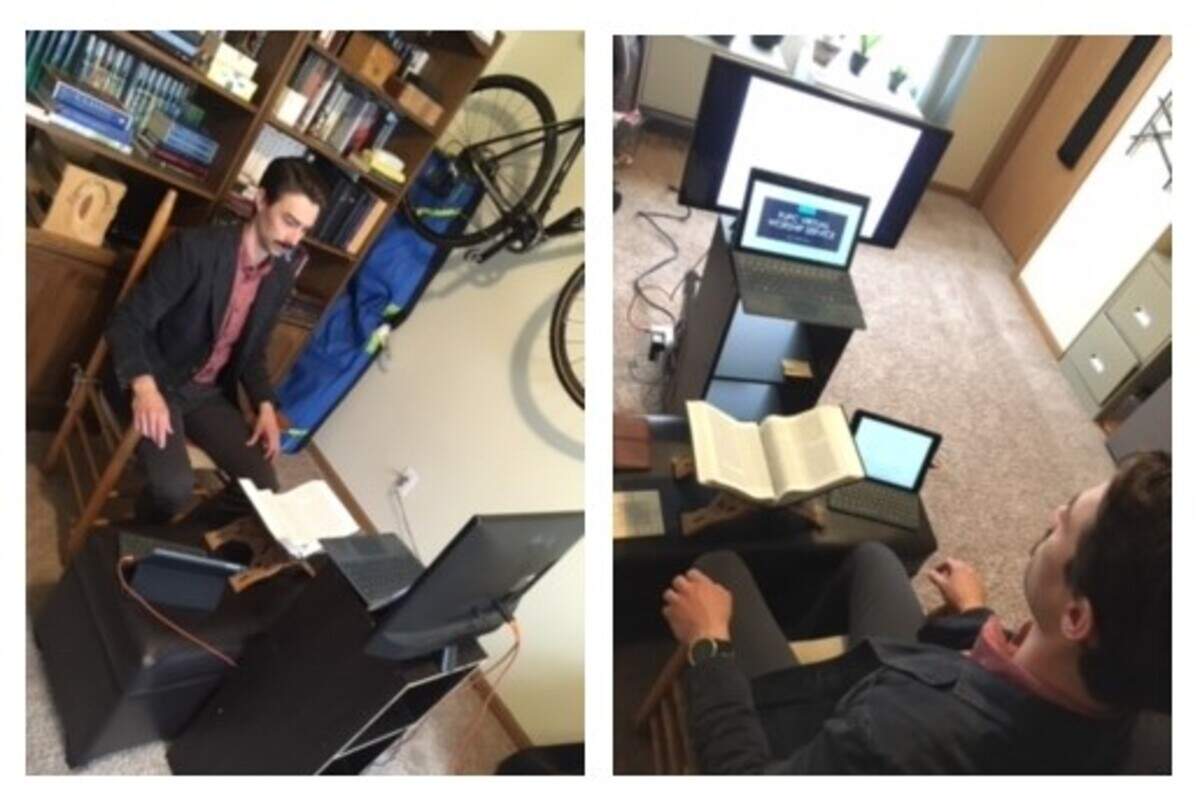
“Our spare bedroom has become a makeshift broadcast studio and sanctuary, so you get a glimpse of my home if you tune in on Sunday mornings for worship,” he said.
The backdrop is a bookshelf. Lysdahl’s bicycle hangs on the wall.
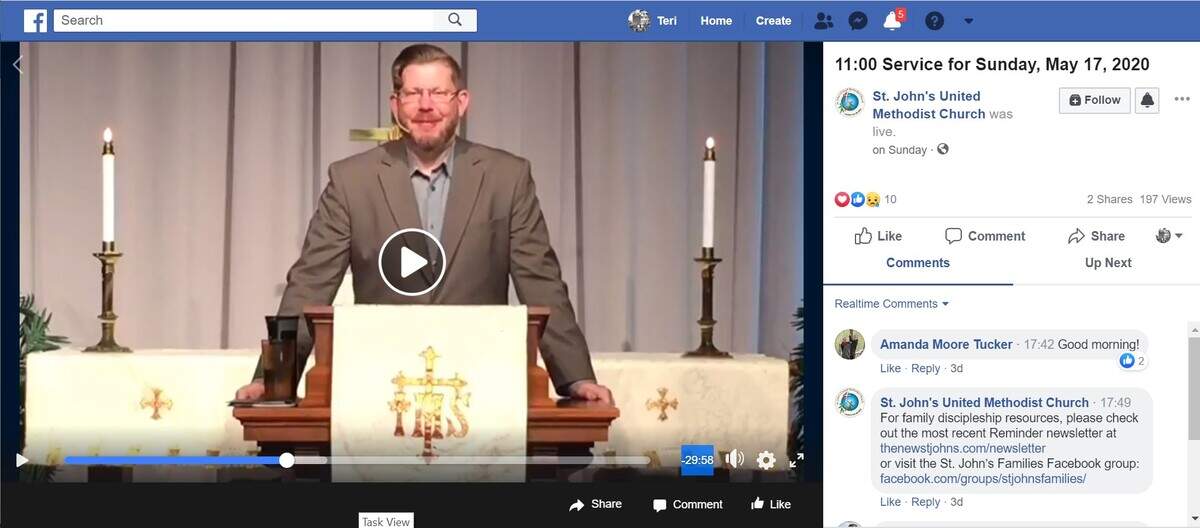
Armstrong produces two worship services for St. John’s each week, one traditional and one contemporary, with help from his 15-year-old daughter, Lilli, who serves as technical director, audio operator, graphics coordinator and one of two Facebook Live hosts.
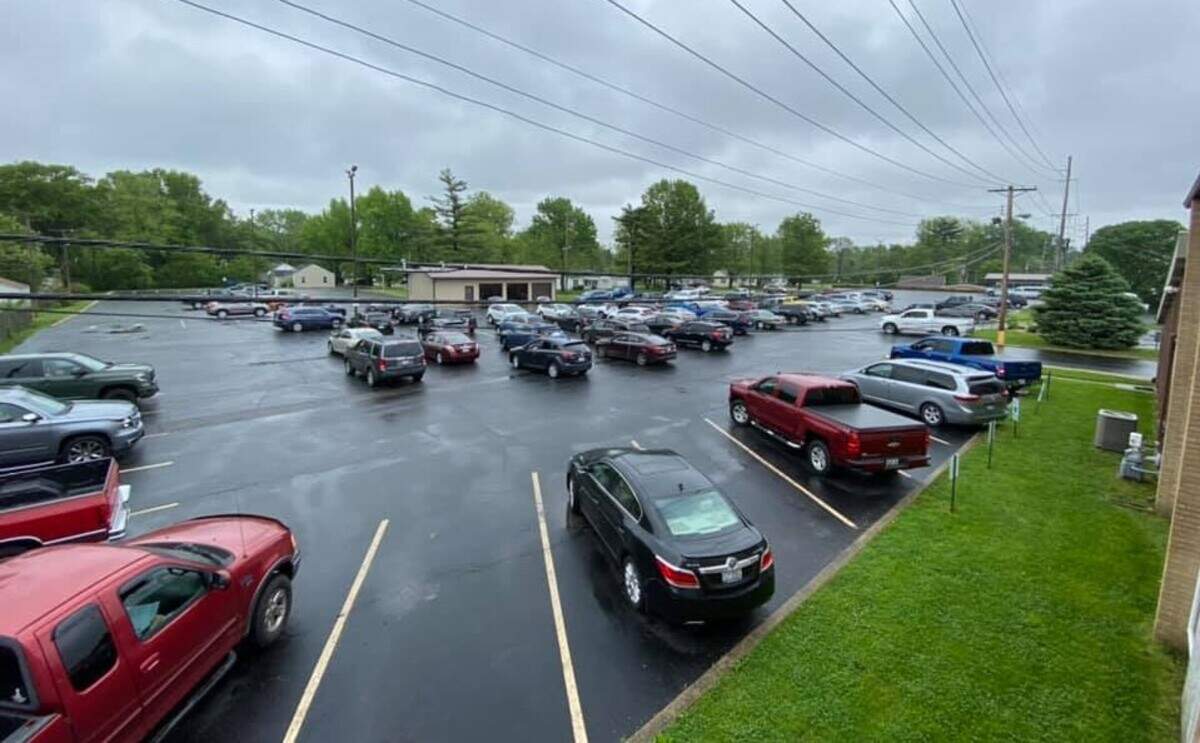
Last Sunday for the first time, First Baptist Church of Fairview Heights held a drive-in service in the church parking lot, despite drizzling rain. The staff set up sound equipment and musical instruments in a three-bay garage with open doors. Members sat in cars with windows rolled up and listened by tuning their radios to a designated FM frequency.
“It worked fantastic,” said the Rev. Jim Kerr, senior pastor. “People were just thrilled because, even though they were in their vehicles, they kind of got to see each other and wave and honk at each other. ... They thoroughly enjoyed it.”
Eden is posting worship services on Facebook, but the church also has increased use of a conference-call option it has been offering for years. People with no internet can listen in real time.
Worship services aren’t the only activities benefiting from technology. Some churches have moved Bible studies and business meetings online with Zoom or Google Meet. Eden has used its conference-call system for small prayer groups.
Church staffs also have worked to come up with new and creative ideas to keep members connected while following state regulations on social distancing.
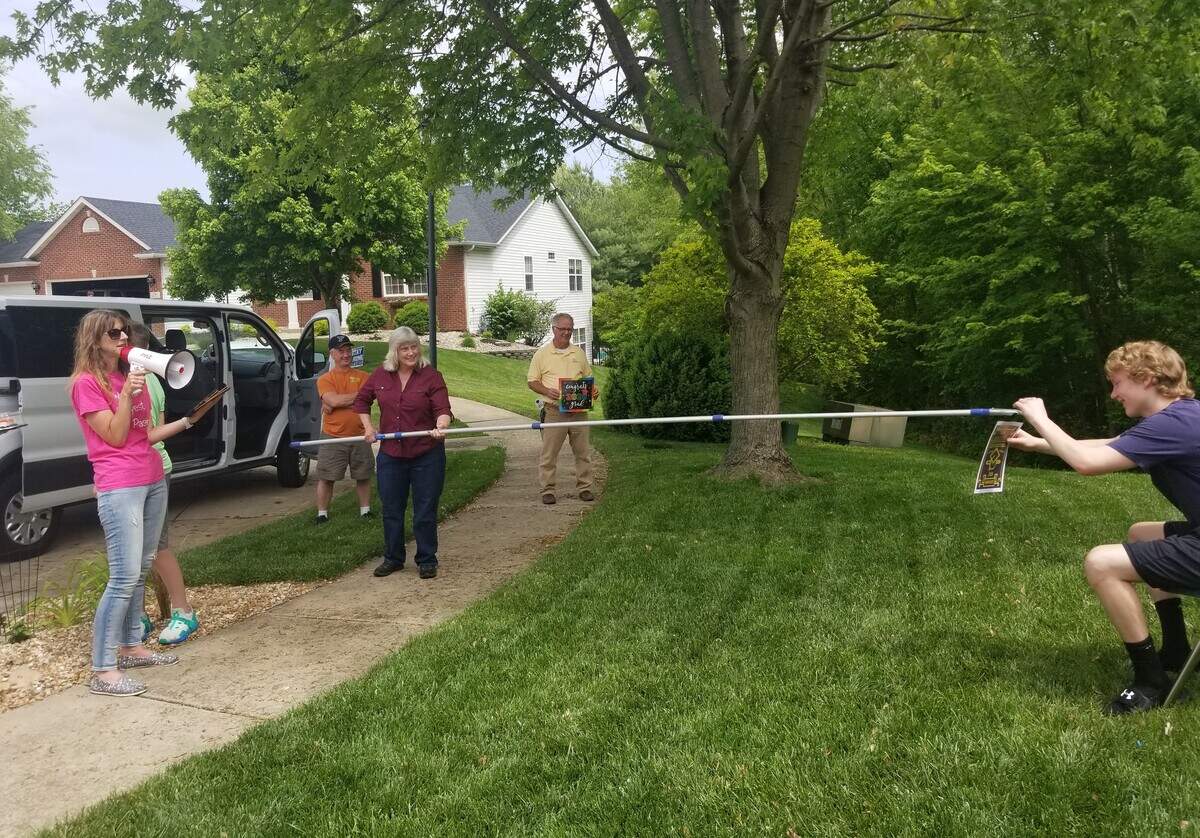
A merry band of Eden members are driving to the homes of high-school graduates, delivering cakes and making presentations in front yards. St. John’s volunteers have worked in its community garden, made masks and helped out at Glen-Ed Pantry.
“When people can’t come together and just run into each other, the way we build relationships has to be much more intentional,” said Armstrong, who’s been going through the church directory and checking on members by telephone.
Catholics release detailed plan
Bishops on the Catholic Conference of Illinois board have developed perhaps the most detailed plan for a phased reopening of churches. Belleville Bishop Edward K. Braxton presented it last week, emphasizing that it was done in consultation with Pritzker’s office and state health officials.
In a cover letter, the bishop acknowledged “mixed feelings” among Catholics, with some believing it’s dangerous to reopen as the number of coronavirus cases continues to rise and others arguing that restrictions have been too severe in Southern Illinois, which has lower infection rates than Chicago.
“Others have written to me indicating that, as people of faith, we should have greater trust in God and confidently assemble for Mass trusting that Jesus Himself will protect us from harm,” Braxton wrote. “But we must always remember that God has given us the great gifts of intelligence and reason and He expects us to use these gifts to make wise and prudent decisions.
“As your Bishop, it has been my responsibility to ask and to do everything possible to follow faithfully the best available disease-mitigation practices to contain the pandemic’s rampage through our communities.”
The Catholic plan requires each parish to recruit “non-vulnerable” volunteers willing to undergo training and help the pastor with implementation and protocols such as cleaning and sanitation.
Phase I allows parishes to hold weddings, funerals, reconciliations (confessions) and baptisms with up to 10 attendees. Phase IA allows for private prayer and adoration with the same limit. These activities could begin as early as Saturday for Phase I and May 30 for Phase IA.
Masses would return during Phase II with dates and number of attendees based on state guidelines.
“Reopening of the churches is much more than the pastor taking the key and unlocking the door,” said Monsignor John Myler, diocesan spokesman. “It’s something that every parish and the members of that parish are going to have to work together to do.”
Myler expects the reopening schedules of Catholic churches to reflect differences in number of parishioners, building capacities and leadership, noting some priests may be more vulnerable to COVID-19 than others due to age and health.
Armstrong predicts the same variety of plans with other denominations.
“I think you’re probably going to find unique responses from every church,” he said. “There are churches that are champing at the bit to reopen and churches that are probably going to be even more cautious than St. John’s is being.”
Some face logistical challenges
Large churches may have an easier time seating people 6 feet apart to slow the spread of the coronavirus than small churches, and those with individual chairs that can be moved around will have an advantage over those with stationary wooden pews. The initial 50-person limit could prompt churches with only one Sunday morning service to add a second or third.
Eden has the technology to seat 50 people in its sanctuary while others watch a live feed of worship services from the fellowship hall and other rooms.
“We’ll make sure that our ushers and greeters are directing people where to sit so that we’re adequately spread out,” Roberts said. “We might even get one of those thermal scanners and scan people’s foreheads.”
Kerr expects it to be awhile before First Baptist offers child care during worship services since that involves changing diapers and holding babies and toddlers, and he’s assuming most parents will want to keep children close at hand.
Kerr can’t foresee forcing people to wear masks during worship services unless it’s required by law, but he plans to make them available. The church sanctuary has several entrances, and song lyrics are already projected on the wall so there’s no need for hymnals.
“Whatever I decide today will be wrong tomorrow,” Kerr said. “We can plan and hope that our plans work well, but we have to be willing to change them if that’s what’s needed.”
Some pastors see silver linings to the changes forced on them by COVID-19. First Baptist had talked about livestreaming worship services last year but never got around to it. Now the staff plans to make it a permanent option after seeing how much it benefits members who are sick at home or traveling.
First United Presbyterian has seen its average Sunday morning attendance go from 90 people on-site to 125 online. Some “newcomers” are actually former church members tuning in from Michigan, Florida, Nevada or Missouri.
“It’s kind of cool because now we have this larger network of people joining us,” Lysdahl said. “And it’s given the church an opportunity to show that it’s relevant and adaptable.”
It’s also demonstrated to some members, particularly senior citizens and parents with small children, how easy it can be to attend church when they don’t have to venture out in bad weather, rush around to get everyone ready on Sunday morning or commute a long distance.
Roberts believes the pandemic will have a lasting positive effect on American culture, even though it’s been horrible living through it.
“I think the whole arrival of this, and the fact that you have to wear masks when you’re out shopping and all that, I think it’s also caused people to sense their own vulnerability and mortality, and actually, I think that’s a good thing,” he said.
“It gets people thinking about, ‘Where did I come from? Why am I here? Where am I going?’ It gets them thinking about God and the importance of God in their lives. You stop taking friendships and neighbors and other interpersonal relationships for granted. For me personally, I’m cherishing more those opportunities for interacting with people.”
This story was originally published May 22, 2020 at 5:00 AM.