As COVID cases soared in Missouri, more from southwest IL went to visit, data shows
Laura Schubert didn’t have the luxury of working from her Nashville, Illinois, home when the coronavirus pandemic hit earlier this year.
After the 60-mile commute to downtown St. Louis, where she does regulatory compliance for the U.S. Paint Corporation, she stays put — no going out to lunch, no happy hours after work. She knows cases are worse in Missouri than in her southern Illinois hometown.
While she has been careful, she knows people who cross the Mississippi River to take advantage of lax rules in certain Missouri counties that reopened quickly after cases dipped in early May.
“Especially when Missouri opened up before Illinois did, people were coming over to Missouri just so they could have a drink at the bar and sit down and eat a meal,” Schubert said.
It’s a truism that the highly contagious viruses don’t recognize borders. But public health researchers have just started to identify exactly how and why COVID-19 in particular spreads in border communities.
Unlike Schubert, who commutes out of economic necessity, most metro-east residents crossing into lenient Missouri counties — and possibly exposing themselves and their Illinois border communities to the virus — are likely not going to work, but to play.
Regardless of the reason, people move unless there’s something stopping them, pandemic or not, says Marynia Kolak, a health geographer at University of Chicago. Because the Trump administration decided to leave coronavirus response up to governors, the United States was divided into a patchwork of policies based on political preferences.
“Unless there’s a physical or policy barrier, people are moving. People move all the time trying to take advantage of different policies,” Kolak said. “... The lack of a coordinated federal response adds more confusion to all of that: local leaders providing different information from state leaders, and even from nearby cities.”
COVID and border behavior
Traveling across borders is a fact of life for residents who live near state lines. Illinoisans already do it to buy cheaper gas in Missouri, or to go to work in St. Louis, like Schubert.
But most people who commute from the metro-east to Missouri head to St. Louis city or county, which have similar rules to Illinois, such as mask mandates and business restrictions.
Yet traffic doubled from metro-east to the Missouri side of St. Louis from July 2019 to July 2020, according to an analysis of smart phone tracking data by Saint Louis University researchers. They looked at travel from St. Clair, Madison, Monroe, Calhoun and Jersey counties in the metro-east to St. Louis city, St. Louis County, Jefferson and St. Charles counties.
Two counties accounted for the biggest increase in travelers: St. Charles and Jefferson counties, which don’t have mask mandates and allowed businesses to open in May.
“This is highlighting the arbitrary borders our infectious diseases don’t care about,” said Enbal Shacham, associate director of the Geospatial Institute at Saint Louis University. “We’ve seen this in STDs and HIV and now we’re seeing this even worse, I would say, in COVID because of the activity and how easy it is to transmit.”
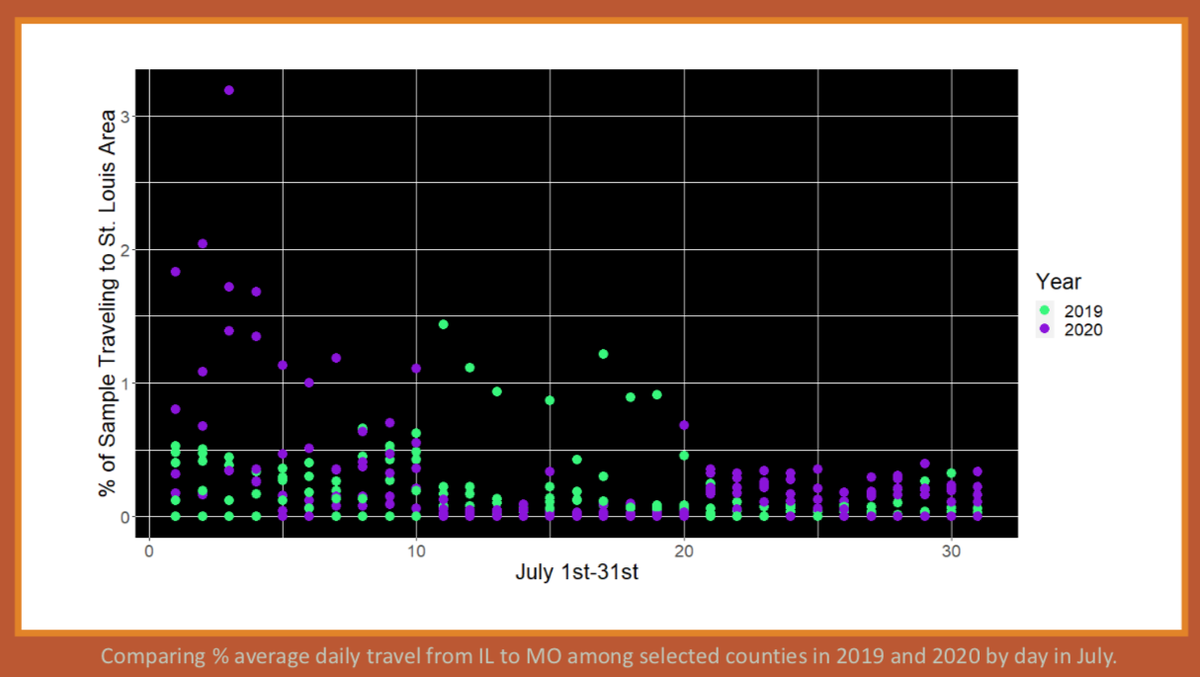
The data did not show exactly where the people were going or what they did, but the increase in visitors was likely from people going for fun. Only a small percentage of metro-east residents commute to St. Charles or Jefferson counties for work, according to American Community Survey data.
Just 3.4% of Illinoisans from counties the researchers analyzed commute to St. Charles County, and less than 1% commute to Jefferson County, while 44% commute to St. Louis County and 49% to the city.
In other words, a day of freedom from masks in downtown St. Charles or at a Fourth of July celebration equated to increased risk of community spread, according to research from the Saint Louis University geospatial team.
They analyzed infection rates from July 14 to 28 in the St. Louis region and found in infections slowed in St. Louis city and county, which have mask ordinances, while rates in St. Charles County continued to rise, Shacham said.
Additionally, the average number of cases per 100,000 residents in counties bordering Missouri was double that in counties that shared no borders with other states, according to an analysis of U.S. Census and Illinois COVID-19 data.
As of Wednesday, the average number of COVID-19 tests coming back positive, or the positivity rate, and the number of new tests coming back positive were as follows, along with the number of new cases per 100,000, according to state and local health department data:
- St. Charles County, Mo.: 12.7%, 16.6
- Jefferson County, Mo.: 11.9%, 17.5
- St. Louis County: 6.4%, 21.1
St. Louis City: Insufficient data, 20
Monroe County: 9.7%, 157
- St. Clair County: 8.6%, 175
- Madison County: 6.6%, 131
- Calhoun County: 6.2%, 1
- Jersey County: 4.8%, 46
Those who must travel to work suffer some of the worst consequences. Unlike Laura Schubert, a white collar professional who says her company has gone beyond requirements to keep employees safe, food service workers have paid a steep price, Saint Louis University’s research showed. Usually working for hourly wages without hazard pay or union representation, they can’t afford to stay home.
“I think about the servers in those spaces a lot,” Shacham said of the findings. “I think they’re a perfect example of how we’re not identifying them as essential but they probably have higher risk than everybody else.”
On Wednesday, St. Louis Mayor Lyda Krewson announced the city would implement new restrictions on bars and restaurants that serve alcohol — reducing capacity from 75% to 50% and implementing an 11 p.m. closing time.
Similar border trends have been observed throughout the country, Kolak said. A coronavirus outbreak at a meat processing plant in southwestern Kansas spread into the Oklahoma panhandle and northern Texas. In the Mississippi Delta region, cases have spread between Tennessee, Mississippi and Louisiana, Kolak said.
It can’t all be blamed on metropolitan areas, she added. Slowly but surely, COVID-19 reached southern Illinois and other rural areas of the state.
“The thing that defines the (rural) community is social gatherings to support each other,” Kolak said. “That’s one of the hardest thing to get past. How can we reimagine better ways to do that in a way that protects that community?”
Residents in rural communities in southern Illinois were some of the loudest and earliest skeptics of Gov. J.B. Pritzker’s strict response to the pandemic, and now downstate regions are seeing the worst of the state’s resurgence in COVID-19 cases. This is due to community spread across the border, but also to domestic travel, large private gatherings, restaurants and crowded bars, said Brenda Fedak, a spokeswoman for the county health department.
“I feel like we’ve been sounding the alarm bells since the end of March about some of these areas,” Kolak said. “The challenge with public health is that prevention is really tough if people don’t see, if people aren’t experiencing the thing public health officials are talking about.”
Public health, political borders
Missouri, Wisconsin, Indiana, Kentucky and Iowa all have higher rates of coronavirus cases than Illinois. They all had fewer rules, too.
Pritzker and other Illinois leaders have warned residents about the increased dangers of border communities for months.
These are the the coronavirus positivity rates in those states, according to Johns Hopkins University:
Missouri: 10.8%
Iowa: 9.5%
Indiana: 9%
Wisconsin: 6.2%
Illinois 4.1%
“We’re the best among all of our neighbors,” Pritzker said at a news conference in July before reminding people to use caution when traveling out of state.
As soon as April, some eastern Missouri counties began announcing plans to roll-back restrictions on businesses. Around the same time, Missouri Gov. Mike Parson refused to join a pact of Midwest governors aimed at developing plans to reopen.
Pritzker hasn’t mentioned the pact since and each state pursued its own reopening plan. Missouri and Iowa have fully reopened, while Kentucky has reversed some of its plans and Indiana paused its reopening. Illinois, Kentucky and Indiana all have versions of statewide mask mandates.
Illinois’ strict approach worked, Pritzker says, but it might not be enough as the state sees a resurgence in cases in the metro-east border communities. Pritzker has repeatedly said he would not implement any restrictions on border crossings because it would harm workers.
Meantime, Missouri’s governor has urged residents to maintain social distance, but has left coronavirus response to local control and refused to implement a statewide mask requirement.
The resulting patchwork of coronavirus rules in the St. Louis metropolitan region means the virus will spread across state lines no matter the restrictions Pritzker puts into place.
“We can see just with a few cases if there’s no rules at all, that’s when you jump into exponential growth,” Kolak said.
While coronavirus doesn’t stop at state borders, public policy usually does. The metro-east and St. Louis city and county coordinated their response early on, differing slightly when bars and restaurants in Illinois weren’t allowed to open until the end of June.
But local data looks at county-level coronavirus rates, and Illinois state data looks at the metro-east region without considering St. Louis or its hospitals. Likewise, St. Louis City and County each have their own systems for tracking coronavirus, and their own responses.
As a result, little information is readily available that provides the big picture of where region stands as one unit. Public health experts say tracking the virus across borders would be the best way to truly understand how it spreads.
“There are policy differences, but then also human interaction and behavior between borders,” Kolak said. “Ultimately, we really need groups to work across literal border lines, not just political borders, but actual geographic borders.”
This story was originally published August 13, 2020 at 5:00 AM with the headline "As COVID cases soared in Missouri, more from southwest IL went to visit, data shows."