
Horses double as therapists at Germantown riding center
Molly Carver is a rock star at Chakota Therapeutic Riding Center in Germantown.
The slender college student with long brown hair and a bright smile has been getting “horsemanship therapy” for seven years.
“She’s a special person,” said executive director Kay Langenhorst, 51, of Germantown. “She’s so sweet, so polite. We just love her.”
Staff and volunteers also are inspired by Molly, who has worked tirelessly to recover from a massive brain injury. She was nearly electrocuted after a car accident nine years ago.
Today, Molly’s gait is still slow and unsteady, requiring a cane. But it’s better after 45 minutes on Patches, a brown and white American paint.
“We have an understanding, I think,” said Molly, 25, of Edwardsville. “She’ll be good for me if I’m good for her. And we move quite nicely together. It’s kind of a fluid movement.”
Horseback riding has improved Molly’s balance, flexibility and range of motion.
Riding instructor and program director Michele Jones-Vargas, 35, of Trenton, guides her through exercises on horseback, ranging from throwing a ball to climbing her hands up a pole.
“Heat from the horses helps riders stretch their muscles and loosen up,” Michele said. “It’s like a heating pad.”
Molly and her mother, Sandy Dods, 62, of Edwardsville, think the therapy is so worthwhile, they drive an hour to Germantown and an hour back once a week May through October.
Molly and Patches ride around a covered outdoor arena, flanked by volunteers who make sure she doesn’t fall off.
“I watch, and I see improvement,” said Sandy, who sits in a folding chair on the grass.
“Another wonderful part of it is that sometimes I’m not watching. I’m just zoning out and enjoying the countryside. It’s peaceful, and it’s breezy. It kind of gives me a break.”
Brave spirits
Kay and her husband, Dave, 63, grew up on neighboring farms in rural Germantown. They reconnected as adults when both were going through divorces.
Kay had worked a variety of jobs, ranging from heavy equipment operator to kettle-corn vendor at a horse museum. Dave was a truck driver.
“I had volunteered at Mounted Miracles in Addieville (therapeutic riding center that later closed), and I loved it,” he said.
The Langenhorsts decided to create Chakota 10 years ago on 11 acres that once were part of a farm in Dave’s family since 1884.
The couple trained for two years through the Professional Association of Therapeutic Horsemanship before opening the non-profit center to children with disabilities such as autism, muscular dystrophy and spina bifida.
“Chakota means ‘brave spirit’ in Sioux,” Kay said.
On this afternoon, the Langenhorsts were sitting in a small office off the stall barn, surrounded by a hodgepodge of old furniture and plaques with sayings such as “Horses Leave Hoof Prints on Your Heart.”
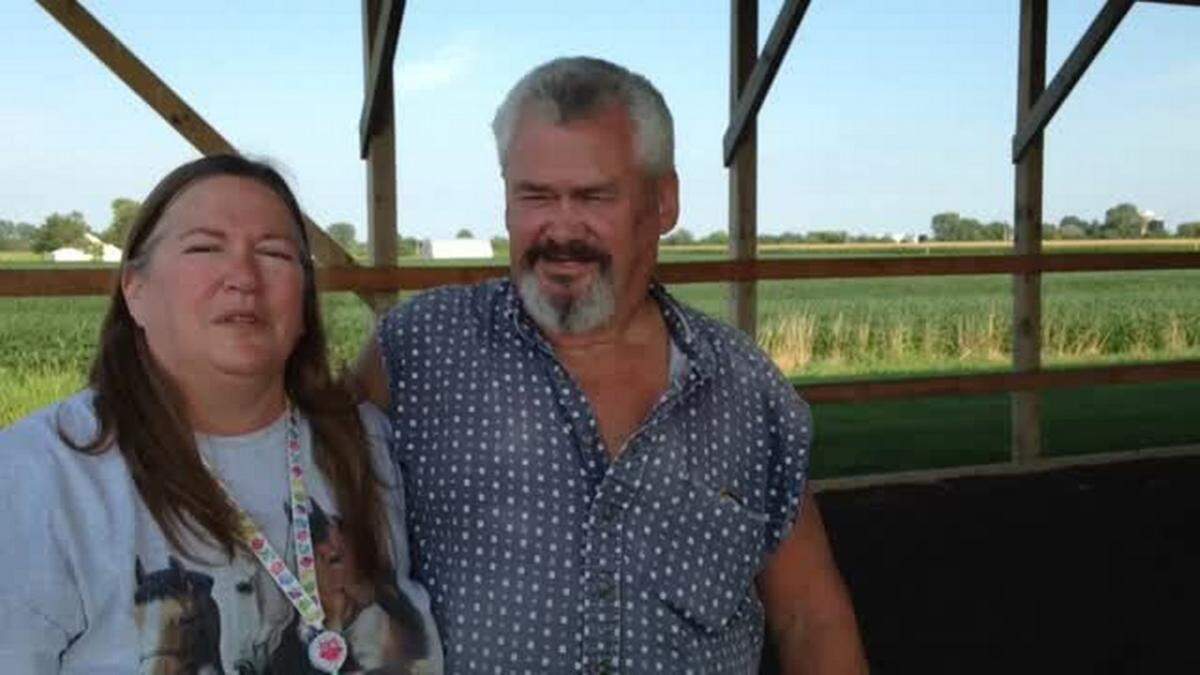
They just got an air conditioner last year, but Dave still wears shirts with the arms cut off.
“I did it long before ‘Larry the Cable Guy,’” he said. “If I ever see him, I’m going to tell him I want royalties.”
As equine and barn director, Dave spends most of his time outside, caring for 10 horses, ranging from miniatures to a 17.2-hand Belgian that’s used for heavier riders.
The center has 20 clients, who pay a discounted rate of $25 per session. “Riderships” (scholarships) are available for low-income families.
“We don’t want to turn any child away,” Kay said.
The Lagenhorsts said horseback riding builds confidence and social skills and gives people with disabilities a sense of freedom. Some clients help feed and groom horses and even clean out stalls.
“Breakthoughs” at Chakota have included non-verbal children speaking their first words on horseback and those in wheelchairs gaining enough core strength to walk with crutches.
“(Kids) don’t like doing therapy in gyms or doctor’s offices,” Dave said. “That’s boring.
“Here, they’re riding horses. It’s more interesting. They don’t even know its therapy. They’re just having fun.”
Freak accident
Each client at Chakota has a story, but Molly’s is perhaps the most unusual.
At 15, she was an Edwardsville High School student who played field hockey and first-chair viola and kept busy with Drama Club and other extracurricular activities.
“She was a straight-A student,” said her mother, a former lawyer who manages the family’s rental property.
Molly’s accident occurred after a basketball game in 2006. Her friend swerved to avoid an oncoming car on a narrow lane, plowed through two yards and a fence and hit a utility pole. (No drugs or alcohol were involved.)
The pole broke apart and dropped a power line, electrifying the car. Molly was OK until she put one foot on the ground while touching metal.
“Forty-thousand-plus volts of electricity went through her body,” Sandy said.
Molly may have survived only because an emergency room doctor ran out of his house and performed CPR for 12 minutes until an ambulance arrived.
Once on the scene, paramedics defibrillated Molly’s heart twice before she was transported to Anderson Hospital and helicoptered to St. Louis Children’s Hospital.
“I don’t remember the accident or several months before the accident or several months after the accident,” she said. “It’s like a black hole.”
Lack of oxygen caused Molly to suffer a massive brain injury, affecting memory, speech and movement. It took nearly a year for her to walk again.
But disabilities haven’t kept the cheerful young woman from living life. She rides an adult trike, enjoys nature, sells greeting cards decorated with her watercolors and spends time with her boyfriend of five years.
Molly is a junior at Southern Illinois University Edwardsville, majoring in psychology and art therapy. She hopes to become an art therapist.
“Her conceptual ability is still top-notch,” her mother said. “Her personality is still there. She’s the same person, and give her a social situation and she’s got it.”
Saddling up
In the past nine years, Molly has worked hard to improve physically, trying everything from yoga and gym workouts to occupational, aquatic, horticultural and art therapy.
A Chakota volunteer suggested horsemanship. The first session caused Molly to both laugh and cry.
“I was overwhelmed,” she said. “The fact that I was on a horse in my condition, that I was capable of something that I didn’t think I could do.”
Last week’s session began with “the dance,” a term Michele uses to describe how she and Molly stand on an elevated platform, hold hands and swing around so Molly can mount Patches.
Molly initially couldn’t reach the stirrups because of leg stiffness, but that changed after two laps. When the session was over, her gait also had improved.
“She’s taking bigger steps because of the muscles being relaxed and stronger,” Michele said. “When she walked up (to the platform), she had two people and a cane. When she dismounted, all she needed was to hold my hand.”
Today, the Chakota property is owned by the Jim’s Formal Wear charitable foundation, which helps with building and infrastructure. Program costs are covered by fees and donations.
Recently, the center’s focus has expanded to include adult clients, particularly veterans with post-traumatic stress disorder.
“Working with the horses really helps them get through their issues,” Dave said. “The horses are very intuitive. We’ll turn three horses loose in the arena, and they’ll sort of gravitate to the people with the problems. That always amazes me.”
Michele is a PATH-certified therapist who is big on safety. She requires all clients to wear helmets.
Staff and volunteers at Chakota can’t help themselves from developing personal relationships and rooting for the children. It’s just part of the program.
“The physical aspect of it has helped, but also the people out there are so lovely,” Molly said. “It just makes me feel good. They really want to help kids, and it’s very powerful to see that. I feel connected to the people. They’re like family.”
How to help
Donations to Chakota Therapeutic Riding Center are used for maintenance, supplies, programming and “riderships” for low-income families. The latter generally are awarded in six-week session increments for $150.
To donate or get more information, visit the website at www.chakota-trc.org, call Kay Langenhorst at 618-334-0885 or send a check or money order to 6248 Wesclin Road, Germantown, IL 62245.
This story was originally published August 8, 2015 at 4:00 AM.