Bald eagles soar into the metro-east. Here’s how you can watch and protect them
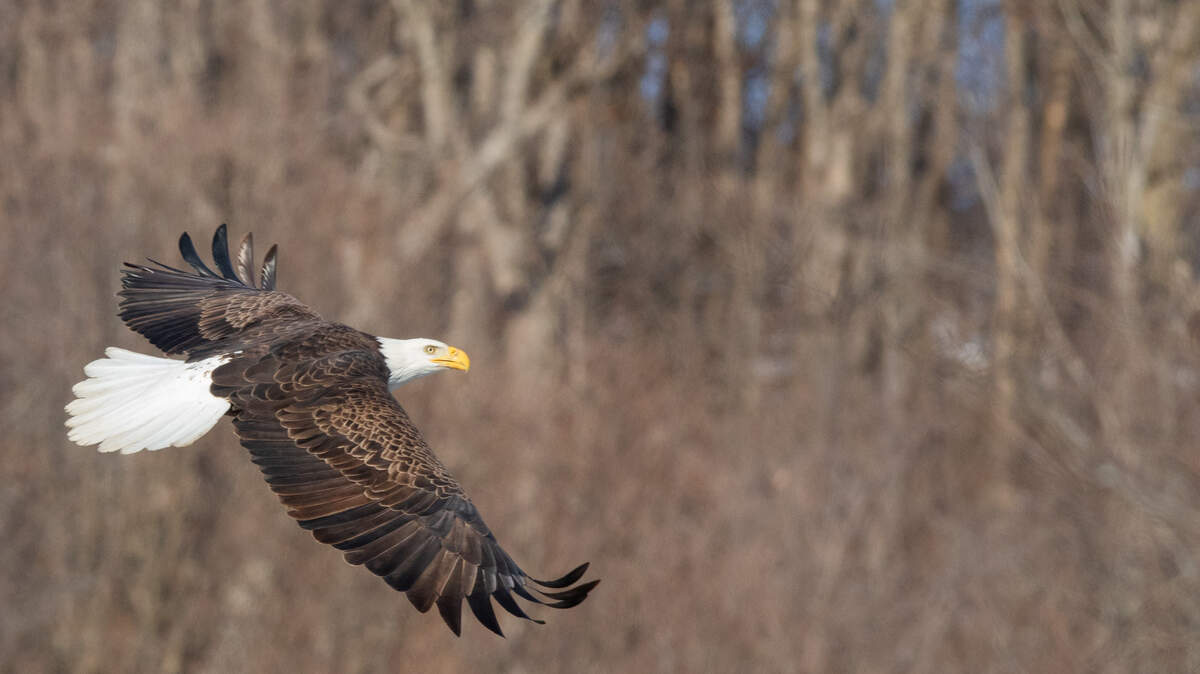
Now that the metro-east is fully into winter, expect to see bald eagles around major bodies of water, along cliffs and ridges, and maybe even on the road, picking up roadkill — as was seen in Collinsville recently.
But what should you do if you find one in your neighborhood or backyard?
“Being bald eagle friendly is actually pretty easy,” says Matthew Hayes, the assistant director for the Illinois Audubon Society.
“Observe them from a distance, especially with binoculars and spotting scopes. They don’t need to be fed, they are fully capable of finding food on their own. Just sit back and enjoy the spectacle of Bald Eagles soaring on thermals or locking talons to do their mating dance.”
Bald eagles are aquatic hunters and choose to nest along water sources, which is why so many have been spotted in Collinsville, where Horseshoe Lake has attracted eagles for thousands of years, and at Lake Lorraine neighbrohood in Belleville. Their nests can weigh hundreds of pounds and sometimes become so large they damage the trees they are built in.
"They use large trees and add to and build on to their nest each year. The largest bald eagle nest ever recorded was found in St. Petersburg, Florida, in 1963, measuring an incredible 9.5 feet wide, 20 feet deep, and weighing over 2 tons (4,400 pounds). Some nests get so large they actually topple the tree they are built upon. When this happens, the eagle pair starts to collect material again and find a new tree to build their nest. On average, a nest can be 5 to 6 feet wide and 2 to 4 feet deep."
Leaving food out for eagles is not recommended. Unlike many other raptors, bald eagles prefer open nests for roosting instead of hollows or closed spaces. If you live near a body of water, Hayes says the best thing to do is provide a tree for them to build a nest in.
"Bald eagles typically nest along water sources," Hayes said. "So maintaining large trees on their property is important, especially if they live along rivers, streams and lakes."
Wildlife experts urge birdwatchers to remain a respectful distance from eagles in order to prevent them from fleeing their nests and exposing their young to predators or other hazards.
There are plenty of places in the metro-east where they can be safely observed. Here’s a few:
Horseshoe Lake State Park, Collinsville
Horseshoe Lake State Park is one of the last remaining natural lakes in the state of Illinois, with the first human activity recorded around 8,000 B.C., according to Illinois Department of Natural Resources. An average depth of only three feet proves its age and status as a low floodplain lake, and provides eagles with ample opportunity to catch fish in the shallow waters. Look for eagles soaring above the lake, sitting on the ice or resting in the many trees surrounding the lake.
Carlyle Lake, Clinton County
Carlyle Lake is a great place to watch wildlife in general, but in winter, the eagle spotting is excellent. You can see eagles nesting in the trees surrounding the lake. Near the Carlyle Lake Dam you can find eagles taking easy prey as fish wind their way through the Kaskaskia River and into the lake.
Illinois 155, Randolph County
As you travel south down Illinois 155, also known as Bluff Road, limestone cliffs to the left juxtapose a sprawling floodplain to the right. On the tops of trees lining the long road and all along the cliff faces, bald eagles will make their nests or take long rests between hunts. One nesting pair, roughly a mile north of Levee Road in Valmeyer, is said by locals to have nested in the same tree for almost 20 years.
At Salt Lick Point Land And Water Reserve, old mine shafts and rock quarries provide an excellent spot to see eagles as they perch from atop the limestone cliffs. While the population here is relatively small, the cliffs still host an occasional eagle or two, staring down into the valley below.
Melvin Price Lock and Dam, Alton
If you ask any local veteran birdwatcher, they will likely say Melvin Price Lock and Dam is one of the best and surest places to watch bald eagles. There are plenty of viewing platforms leading to the dam and in the nearby Great Rivers Museum to watch the brave birds as they catch fish exiting the turbulent waters of the dam. The Army Corps of Engineers regularly schedules trips to the dam, which are available here.
Great River Road, Alton to Grafton
Dams aren’t the only places to spot eagles in Alton, and the St. Louis Audubon Society and Great Rivers and Routes of Southwestern Illinois recommend looking to the cliffs for eagles. Along the Great River Road, which spans from Alton to Grafton and up to Pere Marquette State Park, eagles make their winter homes and year-round nests in the cliffs that form the idyllic landscape across from St. Louis. You can also spot eagles along the road, especially in and near Grafton, flying across the road in daredevil-fashion or riding the chipped ice of the Mississippi like surf boards as they wait for prey.
Audubon Center at Riverlands, West Alton, Mo.
The Audubon Center at Riverlands is a good place to view bald eagles not just in winter, but year-round. With the convergence of the Missouri and Mississippi forming islands, prairies and wetlands alike, there is plenty of food for the brave birds to choose from and plenty of viewing opportunities for birdwatchers.