
Last call for Stag on tap? Amid rumors, Belleville still pours its ‘local legend’

Dakin Vencil and Kari Molloy celebrated their wedding with Stag beer.
“Instead of flower girls, we had beer boys,” Vencil said. “It’s like, dead quiet, and then you just hear ‘CRACK!’ while our officiant is talking. So Stag is pretty important.”
But recently, the couple found themselves drinking Stag at a funeral.
Vencil and Molloy were two of dozens of mourners who packed sardine-dense into the Crow’s Nest bar in Maplewood on a Friday night in February. The occasion: a funeral for kegs of Stag, the classic American lager with deep roots in St. Louis and the Metro East.
Crow’s Nest owner Eliza Coriell decided to throw the Stag funeral after the bar’s beverage distributor said the company would no longer be producing the kegs.
“He actually came and met with us in person to let us know that they had, in fact, already stopped kegging Stag,” said Coriell, who added that the beer has been the bar’s No. 1 seller for 15 years. “My first thought was utter denial. ‘This can’t really be true. We’ll just keep selling it. It’ll be fine.’”
After the news sank in, Coriell and her staff decided to send Stag kegs off with a bang — a true “Stag party,” with giveaways, custom T-shirts and pints and pints of the light golden beverage.

The night of the funeral, the Crow’s Nest ran through five kegs of Stag — roughly 600 pints — she said. The bar has about seven kegs left. After that, Crow’s Nest customers will only be able to get the beer in cans and bottles.
“We’ve really always tried to have local and or regional beers on tap, and so this kind of opens the door for us not being able to do that anymore, which is a little sad,” Coriell said. “We’ll probably have to put something larger, maybe Busch.”
Mourners at the funeral spoke of Stag’s price point — cheaper than craft draft — and its local, cultural cachet. Several younger patrons mentioned Shakespeare’s Pizza near Mizzou, where students could buy a Stag and a pickle for pocket change shaken from a backpack.
Not one person interviewed mentioned the taste, but some online aficionados describe it as crispy, zesty and drier than its peers.
“If you’re young, it’s cheap. You drink Stag … it’s just purely a nostalgia thing for me,” said Jake Allscheid, who exclusively drinks Stag on tap “because it’s colder.”
“The recipe was designed here. It’s our local sh—-y beer. So we have to represent.”
.jpg "stag aerial (1).jpg")
Belleville roots
For decades, Stag was brewed in Belleville.
The Western Brewing Co. created Stag in 1906 as a seasonal Christmas beer, said Bob Brunkow, a historian with the Belleville Historical Society. The name “Stag” came from a 10-year-old boy who entered a contest and won $25 in gold.
Although the brewery changed hands and names throughout the 20th century, Stag remained a consistent cultural touchpoint for Belleville.
“The brewery’s steam whistle to mark the shifts could be heard throughout the area, as far down as Freeburg, and maybe Shiloh, if the wind was right,” Brunkow said. “It kind of set the tone for the business cycle in the town. About 800 people or so [worked there] at its height.”
Brewery workers were offered two “beer breaks” a day, Brunkow said.
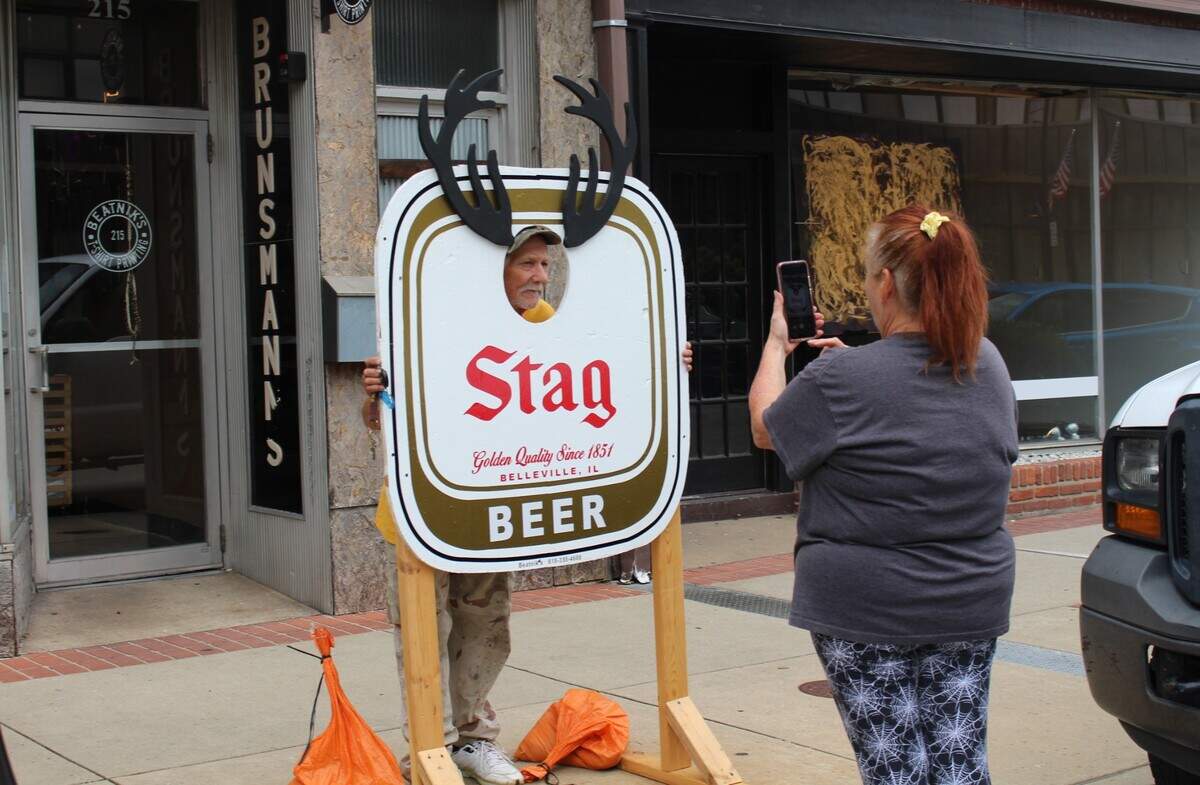
Today, about 70% of the Belleville Historical Society’s museum, housed in a 130-year-old saloon once owned by Western Brewing’s president, is dedicated to Stag history and paraphernalia.

The brewery in Belleville shut down in 1988 because it needed costly sewage system upgrades, but the lager remained popular throughout the region, said Belleville Historical Society President Larry Betz. “They were going to have to invest large amounts of money to build new sewage systems. And so I think the betrayal here was more toward the city,” he said. “They blamed the city for Stag moving out, more so than Stag doing it on its own.”
“You go to any local saloon around town here, and that’s what you’re going to see these guys, and that’s all they drink,” Brunkow added.
A parade of cans dating back nearly to the beer’s inception shows the consistency of the beer’s branding: a gold can with a handsome deer on the label. The one exception came in 2019, when the company briefly experimented with more abstract, stylized branding. Fans revolted, and the classic Stag label with a 12-point buck soon returned.
At Fletchers Kitchen & Tap in Belleville, Stag is “definitely one of our top sellers,” said Maria Randall, the restaurant’s manager, even if it carries a reputation as “kind of an old-man beer.”
She said that instead of pickles, some people put olives in their pints or shake salt into the glass.
“The younger generation’s drinking Stag, I think, because their fathers and their grandfathers have always been Stag drinkers,” Randall said. “They’re just kind of keeping it alive. You know, the tradition lives.”
Future snags for your Stag
Stag is now owned by Pabst Brewing Co., based in San Antonio. Pabst contracts its beer production to partners around the country, including Anheuser-Busch.
Pabst’s portfolio now includes several legacy beers — regional brands that could be considered the Stags of their own cities: National Bohemian in Baltimore, Lone Star in San Antonio and Rainier in Seattle.
“We would call them local legends, because they were iconic legacy brands that had small footprints,” said Chris Chartrand, who until recently worked as Pabst’s St. Louis market manager. “Which mostly means I was selling Stag,” he added.
Pabst has had a rough few years, reportedly laying off dozens of workers. Chartrand says the company laid him off in December during a round of job cuts.
Consumer tastes among young people have shifted, and the market has grown to include prepackaged cocktails, CBD drinks and seltzers. That puts domestic legacy brands such as Stag in a precarious position, Chartrand said.
While Stag has a huge fan base in St. Louis, it barely penetrates other parts of the country, he said.
“They’re having to make some tough decisions,” Chartrand said. “They’re taking away whole packages. And so these low-priority brands that we’re talking about are first on the chopping block.”
For every Stag that’s endured, he said, there are countless regional beers that have been forgotten.
“For a brand to survive this long and go relatively untouched is something really special,” Chartrand said. “It kind of goes hand in hand with just local culture, local pride, you know, pride in St. Louis or Belleville, pride in the Midwest and our people. Really, it resonates with people. It’s sentimental to people. It’s its own kind of microculture.”

Pints in peril?
It’s unclear if any Stag kegs will still be available in the coming months or if the kegs will be available in certain parts of the region in the future. Representatives from Pabst, its parent company Blue Ribbon Partners, Anheuser-Busch and the distributor that serves the Crow’s Nest did not respond to multiple requests for clarification or comment.
Beer enthusiasts and professionals have shared conflicting rumors in online forums. But Pabst is a privately held company, which means business information is not usually disclosed to the public.
Anne Fritz of Robert “Chick” Fritz distributors in Belleville said that “Stag barrels will continue to be made.”
“Periodically, some brewers and producers review brands and packages of what should be produced,” she said. “And sometimes those conversations can spark a rumor.”
Fritz said she couldn’t be sure what’s happening in other regions or with other distributors.
“Distributors can make their own decisions,” she said. “But we will continue to carry Stag draft.”
Betz, of the Belleville Historical Society, used to own a tavern. He said that while kegged beer can offer a higher return on investment for owners, it can be a toss-up. If not enough people order the beer, it quickly goes sour and whatever is left over is wasted.
If not enough people are ordering Stag, cans and bottles could be a financially safer alternative.

At the Crow’s Nest’s Stag wake, Beau Diamond, dressed in a black suit and tie (“What I would wear to any funeral”), was also grasping at straws. He is a musician who also works in the service industry and said Stag is a mainstay at dive bars and music venues.
“I’ve tried looking it up online, why they’re getting rid of it, and there doesn’t seem to be a clear answer,” he said. “It caught all of us off guard. I actually was giving up drinking for Lent, and this is my one cheat day.”
He took a swig out of his pint glass.
“I have to have a Stag before it goes.”
