
Illinois requires face coverings in public to fight coronavirus. Here’s how to make one
Gov. J.B. Pritzker’s extended stay-at-home comes with a few modifications, including mandatory face coverings.
Effective May 1, Illinoisians will be required to cover their mouth and nose in all public places where people cannot maintain a six-foot social distance and in all indoor public spaces, such as grocery stores and other businesses.
So what qualifies as a face covering, and how does it differ from a face mask?
The term “face covering” is being used to differentiate from the surgical and N-95 respirator masks used by health care workers and other medical first responders. Because face masks are already in short supply, the Centers for Disease Control and Prevention recommends using cloth face coverings.
According to the CDC, like a face mask, a cloth face covering should fit snugly against the sides of the face. It should include multiple layers of fabric without obstructing breathing. Coverings should be secured with ties or ear loops. The covering should also be able to go through multiple washings without damaging it or changing its shape.
While many cloth face covering options can be purchased through online sources like Amazon and Etsy, they also can be made at home.
The Illinois Department of Public Health recommends using materials already available at home or purchasing materials online to avoid exposure in public. Face coverings can be made from bandanas, T-shirts or other breathable fabrics. Tightly woven cotton fabrics are often recommended.
The CDC has provided illustrated instructions for both sewn and no-sew cloth face coverings:
Sewn cloth face covering
Materials:
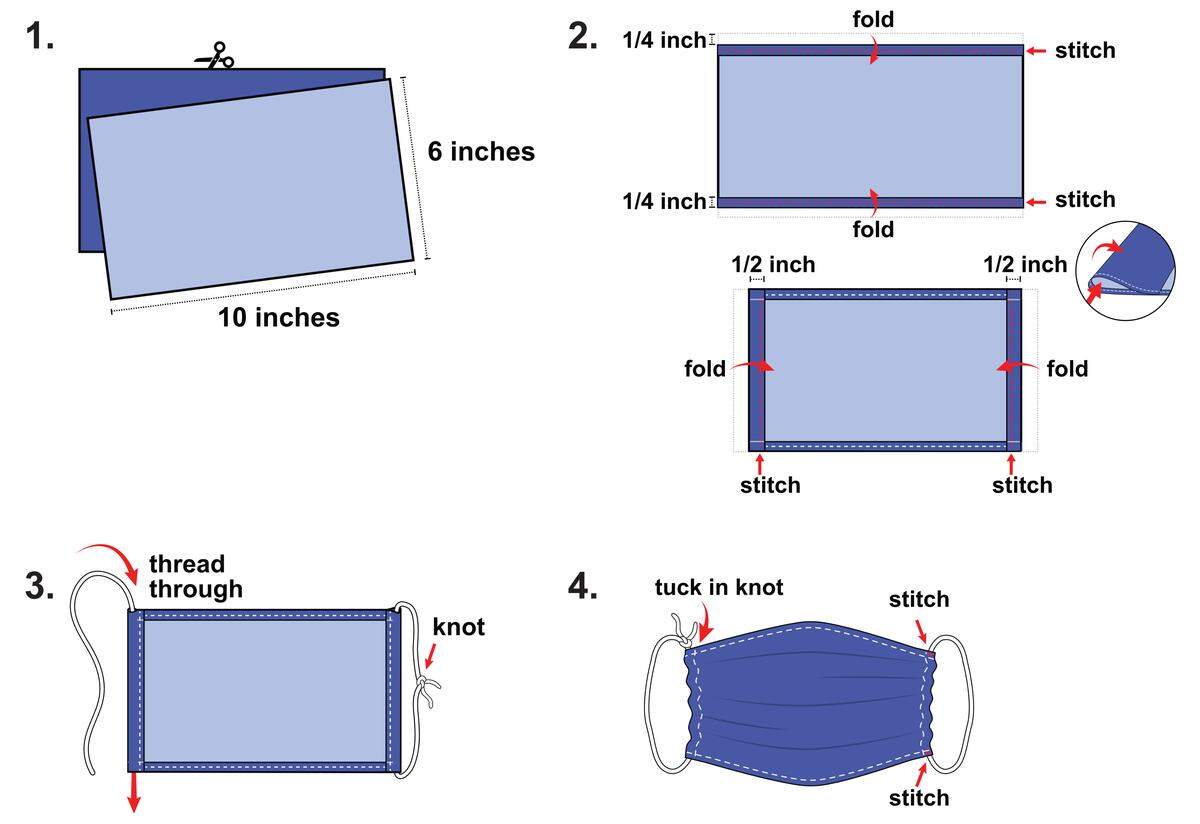
• Two 10-inch by 6-inch rectangles of cotton fabric
• Two 6-inch pieces of elastic (or rubber bands, string, cloth strips, or hair ties)
• Needle and thread (or bobby pin)
• Scissors
• Sewing machine
Instructions:
1. Cut out two 10-by-6-inch rectangles of cotton fabric. Use tightly woven cotton, such as quilting fabric or cotton sheets. T-shirt fabric will work in a pinch. Stack the two rectangles; you will sew the mask as if it was a single piece of fabric.
2. Fold over the long sides ¼ inch and hem. Then fold the double layer of fabric over ½ inch along the short sides and stitch down.
3. Run a 6-inch length of 1/8-inch wide elastic through the wider hem on each side of the mask. These will be the ear loops. Use a large needle or a bobby pin to thread it through. Tie the ends tight.
Don’t have elastic? Use hair ties or elastic headbands. If you only have string, you can make the ties longer and tie the mask behind your head.
4. Gently pull on the elastic so that the knots are tucked inside the hem. Gather the sides of the mask on the elastic and adjust so the mask fits your face. Then securely stitch the elastic in place to keep it from slipping.
Quick cut t-shirt face covering (no sew method)
Materials:
• T-shirt
• Scissors
Instructions:
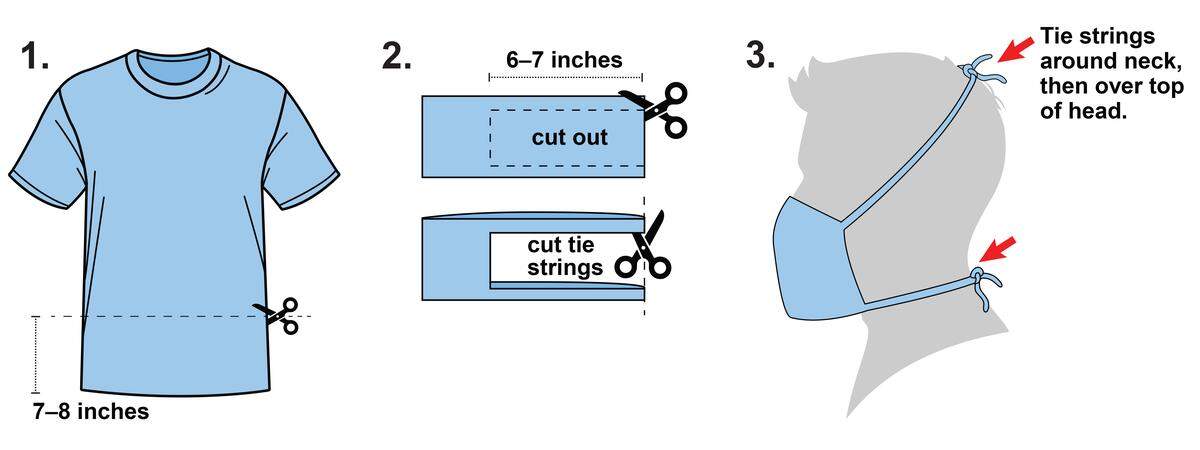
1. Cut 7-8 inches from bottom of T-shirt
2. Cut out 6-7 inches from one side to make tie strings
3. Tie strings around neck, then over top of head
Bandana Face Covering (no sew method)
Materials:
• Bandana (or square cotton cloth approximately 20 by 20 inches)
• Rubber bands (or hair ties)
• Scissors (if cutting your own cloth)
Instructions:
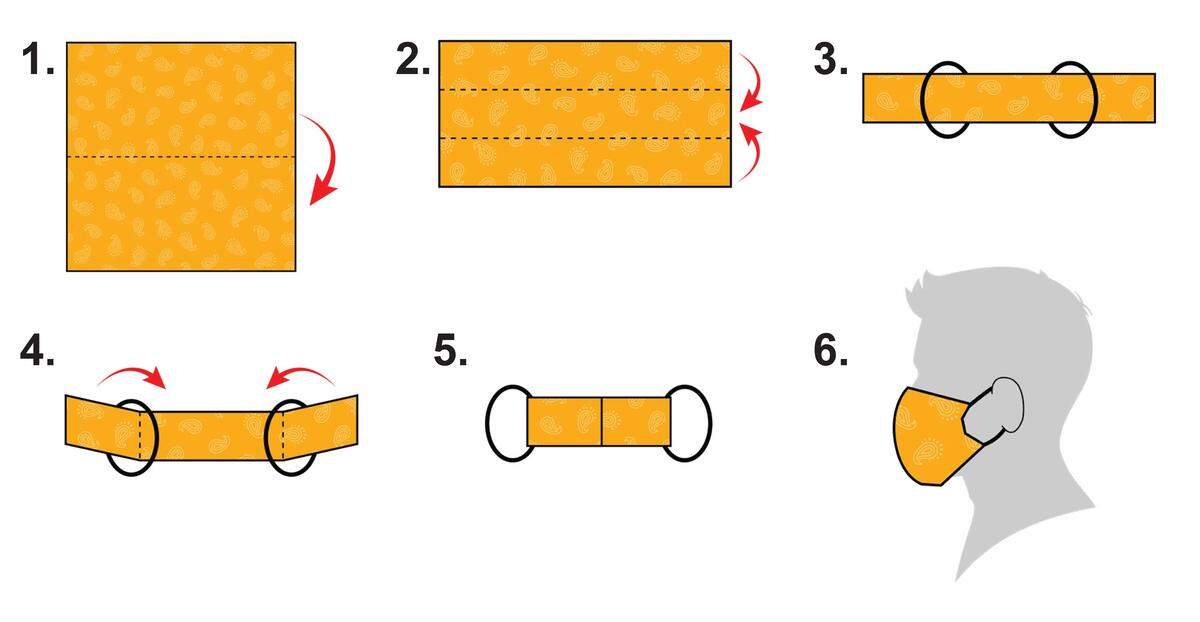
1. Fold bandana in half
2. Fold top down. Fold bottom up.
3. Place rubber bands or hair ties about 6 inches apart
4. Fold side to the middle and tuck.
Face covering care
Having more than one face covering per person is recommended by the IDPH. Cloth face coverings should be routinely washed, depending on the frequency of use. Machine washing should be sufficient.
Make sure your hands are clean prior to putting on the face covering. Avoid touching your face covering while using it. Do not touch eyes, nose or mouth when removing the face covering. Wash your hands immediately after removal.
Used masks should be kept in a bag or bin away from pets and children until they can be washed.