Here’s how the state tracks ICU bed availability at southwestern Illinois hospitals
Gov. J.B. Pritzker raised concerns in southwestern Illinois on Monday when he announced only 25 intensive care unit beds were available in the region.
Public health officials will use the availability of ICU beds as one metric for deciding when to reopen businesses.
Though 25 “is not a big number,” as the governor said, it’s correct as far as the state knows, according to Dr. Ngozi Ezike, director of the Illinois Department of Public Health.
Hospitals themselves report numbers daily to the state through an electronic system that tracks bed availability. The state’s numbers would only be inaccurate if data from hospitals is incorrect, Ezike said Wednesday during a daily news briefing in Chicago.
The St. Louis Metropolitan Pandemic Task Force tracks numbers for Memorial hospitals in the metro-east, but does not separate those numbers from hospitals in St. Louis City or County, according to task force spokesman Tony Wyche. The task force was unable to say whether the state’s numbers are accurate, Wyche said.
HSHS hospitals, which includes St. Elizabeth’s Hospital and St. Joseph’s hospitals in Breese and Highland, report available bed numbers to the state health department twice a day, according to hospital spokesperson Kelly Barbeau.
“It is important to note the (Illinois Department of Public Health) website only shows beds in the region at the time they posted that number,” Barbeau said. “Patients at all hospitals are discharged or transferred all day long so numbers could be different at any point in the day.”
Though metro-east residents could go to hospitals in St. Louis to seek treatment for a severe case of COVID-19, Illinois does not count out-of-state hospitals in its data about available ICU beds and ventilators.
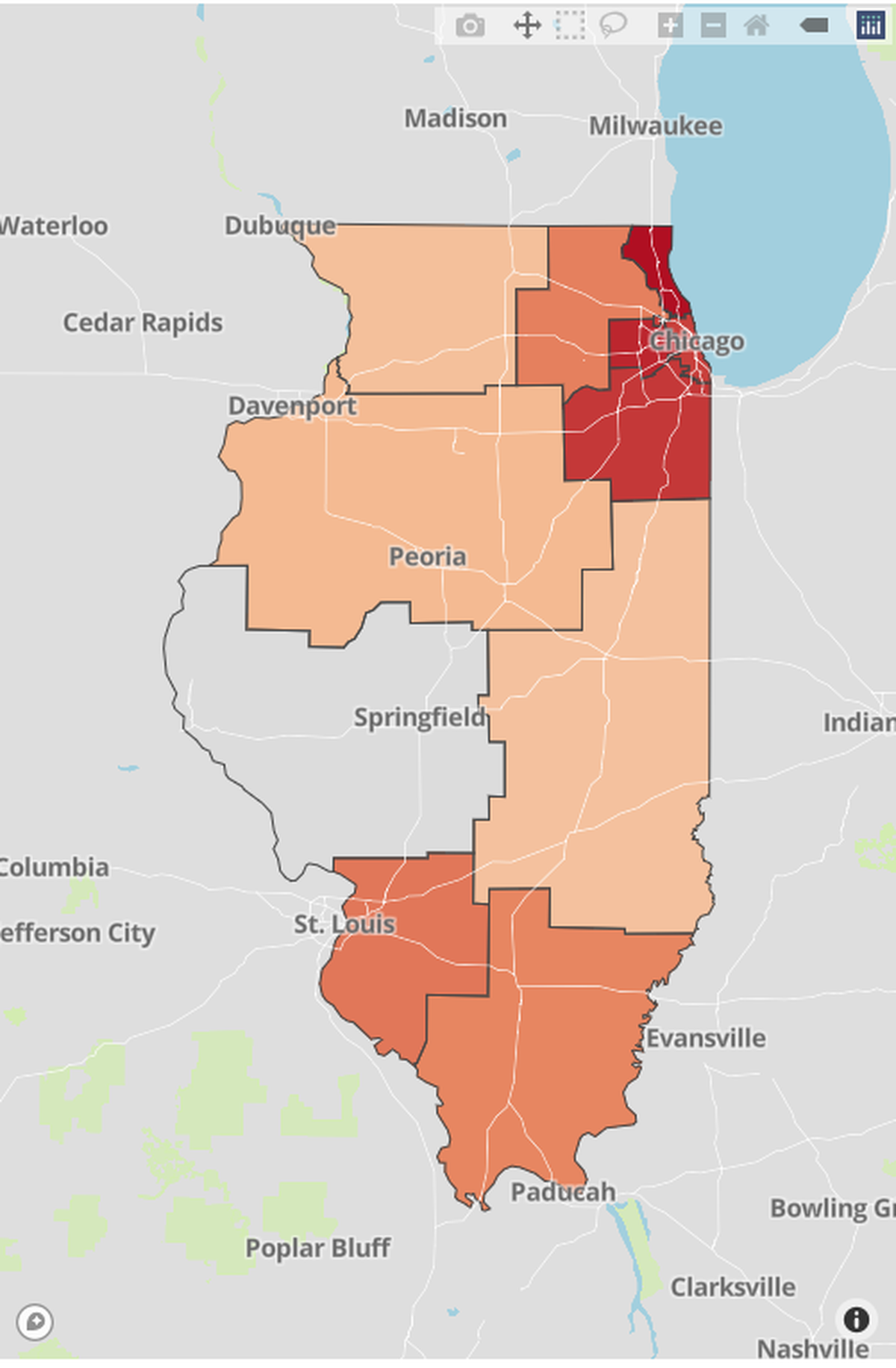
Coronavirus data problems
Ezike said the state tries to provide data to the public “in real time” as they receive it, and that comes with problems.
“By doing this, it means the data essentially can change as new information is updated,” Ezike said, which means local and state data will vary as it changes at each level. Normally, public health officials take time to clean the data and verify its accuracy.
“During this pandemic as we’re trying to share the information so quickly, we’re not able to do all of that work,” Ezike said.
Sharing those numbers is “vital” to understanding the pandemic, Ezike said, but the public should be aware of “those caveats.”
“We’re putting out numbers faster than I’m really comfortable with,” she added.
The governor’s plan to reopen business in Illinois comes in five phases, and the state is currently in phase two. Phase three is marked by the reopening of retail stores, offices, salons, barbershops and other businesses with capacity limits and other precautions.
To move from phase two to three in the governor’s reopening plan, a region would need to meet the following thresholds: no more than 20% of all COVID-19 tests come back positive, increasing no more than 10 percentage points over two weeks; no overall increase in hospital admissions for COVID-19-like illness for 28 days; and at least 14% of intensive care unit beds, medical and surgical beds, and ventilators available.
As of Thursday, there were 25 of 95 ICU beds available in the Edwardsville region. The region would only need 13 available ICU beds to meet the state’s 14% threshold.
The number of ICU beds and ventilators available at local hospitals is updated daily at: https://www.dph.illinois.gov/covid19/hospitalization-utilization.