Pritzker urges caution in southwest IL as COVID increases, warns of tougher penalties
If metro-east residents don’t manage to control rising COVID-19 rates in their region, bars and restaurants could face a second round of bans on indoor service — and the state might not be as lenient with noncomplying businesses, Gov. J.B. Pritzker said.
The southwestern Illinois region near St. Louis must keep the percentage COVID-19 tests coming back positive below 8% to avoid extra rules to control the virus’ spread. State and local public health officials have used contact tracing to identify businesses, as well as private gatherings, as the main source of community spread.
After eight straight days of increased positivity rates, Metro-East Region 4 topped the 8% threshold once again at 8.1% on Friday and 8.2% Saturday. Should the positivity rate be higher than 8% again on Sunday, the tighter restrictions on indoor dining and social gatherings likely will be restored no later than Monday.
“Let me be clear, we’re not there yet,” Pritzker said at a news briefing in Belleville Thursday. “ ... I’m pleading with everybody. Wear a mask. Wear a mask, keep social distance. You keep hearing us say it. I’ll try to do an interpretive dance for you sometime. But the truth is that it really does work, and you all have done it here and you can do it again.”
The metro-east was under additional restrictions from Aug. 18 through Oct. 9, when it returned to the less stringent Phase 4 under the state’s reopening plan. In the two weeks since the regulations were lifted, the region’s rolling seven-day average positivity rate has increased from 5.8% to 7.8%.
If the rate goes over 8% for three consecutive days, the extra restrictions will come back, a potentially devastating blow to businesses as the weather makes outdoor dining less likely.
Some businesses defied the state’s orders the first time around, offering indoor service in spite of the ban, and a few received fines issued by Illinois State Police. If the region sees another set of restrictions, noncomplying businesses could face a loss of their liquor or gaming licenses, the governor said.
The state has been hesitant to take such a drastic measure that would have a long-term impact on a business, opting instead for education and citations, the governor said. But with the flu season arriving and hospitalizations increasing statewide, officials will have to protect front-line workers, the immunocompromised, the elderly, children and health care staff, he added.
Dr. Omer Badahman, an infectious disease physician at Memorial Hospital, said the hospital system can’t handle both flu and COVID-19 patients.
“This year it’s very important because the health care system is taxed to the max by the patients we have,” Badahman said. “We need those beds for other problems. So really, if we have influenza coming in with COVID-19 and the colder weather, the health care system will be overwhelmed.”
Avoiding even small gatherings with people outside one’s household, washing hands, social distancing and wearing a mask can prevent the spread, said Myla Oliver-Blandford, deputy director of the St. Clair County Health Department. Public health officials are also urging the importance of getting a flu shot.
The Illinois Department of Public Health reported 4,942 new cases of coronavirus disease statewide Thursday, including 44 additional deaths, for a total of 360,159 cases and 9,387 deaths since the pandemic began.
Research from contact tracing in Illinois
The state released a list of studies on Tuesday supporting their claims that bars and restaurants are a main source of COVID-19 spread in Illinois, but also across the United States and in other countries.
With 69 of 97 county health departments reporting within a two month period from August through September, state officials found that the highest number of cases were associated with restaurants and bars, followed by workplaces. Vacations, family gatherings, weddings and college parties were also key events that caused community spread.
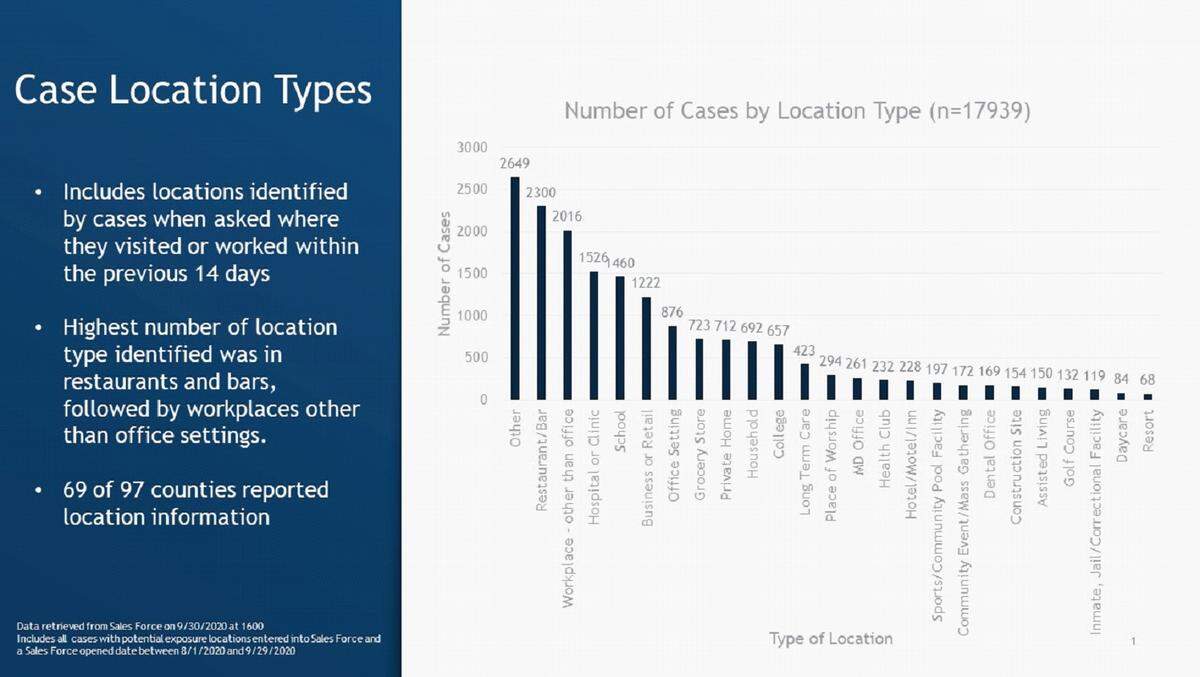
The state also cited a study by the U.S. Centers for Disease Control found that adults with COVID-19 were roughly twice as likely to have dined at a restaurant than those who tested negative.
Another study published in the Emerging Infectious Disease journal showed clusters of coronavirus in Japan were associated with karaoke parties, clubs, bars and gyms.
As for masks, the literature overwhelmingly supports their effectiveness in reducing COVID-19 transmission, Badahman said.
“There is no argument about whether masks work, not anymore,” Badahman said. “The community can get numbers down by masking.”
This story was originally published October 22, 2020 at 4:42 PM.