Memorial East moves forward on construction of new Siteman Cancer Center building
Construction has begun on a $38 million medical office building that will house the metro-east branch of Siteman Cancer Center on the Memorial Hospital East campus in Shiloh.
Officials expect the three-story building to be completed in early 2020. At that time, Siteman physicians and other staff will move from their temporary location in Swansea.
“We are really excited to be in Illinois,” said Dr. Tim Eberlein, director of Siteman, which is based in St. Louis. “Over the years, we have taken care of lots of patients in Illinois. So to have a cancer treatment facility in Illinois is exciting, and I think we will be able to take even better care of patients in that community.”
Officials have released an artist rendering of the new 70,000-square-foot building, which will be brick and other masonry, matching an existing medical office building at Memorial East.
Siteman will cover about 39,000 square feet, providing radiation oncology, medical oncology (including chemotherapy) and imaging services. There also will be a diagnostic laboratory and pharmacy.
“What it means for Memorial is that we’re continuing to fulfill our mission of providing exceptional health care and compassionate service,” said Mark Turner, president of Memorial Regional Health Services, also known as Memorial Network, which includes Memorial Hospital in Belleville and Memorial East.
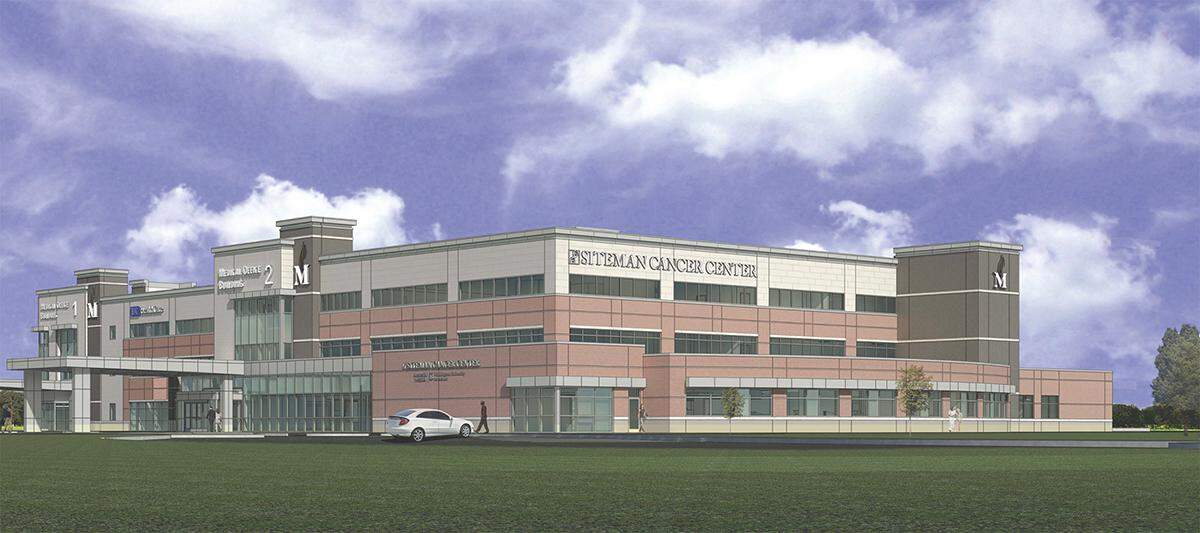
The other 31,000 square feet of the new building will accommodate an expansion by Memorial and BJC Medical Group in OB/GYN and primary care practices. Memorial and Memorial East are part of BJC Healthcare. Siteman is affiliated with Washington University School of Medicine and BJC.
Siteman staff in Swansea who will be moving to Shiloh include radiation oncologists Dr. Susan Luduzinsky and Dr. Jason Lee; medical oncologists Dr. William J. Popovic, Dr. Alfred O. Greco and Dr. Guillermo Rodriguez Jr.; Dr. John L. Viconti, doctor of osteopathic medicine; and nurse practitioners Rhonda McCabe and Alicia Carmack.
“Initially, the cancer compound (in Shiloh) will be smaller than it will be in a couple of years,” Eberlein said. “There’s room for growth.”
Also this week, St. Elizabeth’s Hospital in O’Fallon announced that it will open a radiation oncology clinic in early 2020. It will share a new 30,000-square-foot building with Cancer Care Specialists of Illinois, a medical oncology group.
Siteman is headquartered on the Washington University medical campus in St. Louis. It has branches in south St. Louis County and at Christian Hospital in north St. Louis County, Barnes-Jewish West County Hospital in west St. Louis County and Barnes-Jewish St. Peters Hospital in St. Charles County.
“It is the only National Cancer Institute-designated Comprehensive Cancer Center in the region,” Turner said, adding that its reputation “speaks for itself.”
Memorial East opened in April of 2016. At that time, Memorial and St. Elizabeth’s in Belleville jointly operated a radiation oncology clinic called Cancer Treatment Center in Swansea.
In November of 2017, St. Elizabeth’s closed its Belleville hospital and opened a new one in O’Fallon. Shortly after, St. Elizabeth’s sold its share of the Cancer Treatment Center to Memorial. In January, BJC took ownership of Memorial Regional Health Services.
By August, Memorial had converted the Cancer Treatment Center into a Siteman branch, adding medical oncologists, formerly with a practice called Illinois Oncology, who joined the Washington University School of Medicine physicians group.
“(The new Shiloh location is) going to be a great addition to our community and our region, especially for patients with cancer,” said Shiloh Mayor Jim Vernier. “It’s huge that they won’t have to drive to St. Louis.”
St. Elizabeth’s and Memorial still own the 33,000-square-foot building in Swansea where Siteman now is operating. They’re likely to sell it after the new medical office building opens at Memorial East, Turner said.
Siteman patients, including those in Illinois, have access to the center’s clinical trials.
“(These) are designed to evaluate the effectiveness of innovative cancer therapies,” according to a press release. “By participating in a clinical trail, patients can gain access to investigational therapies that are not widely available to the public.”
This story was originally published December 14, 2018 at 5:00 AM.