
In 178 years, three Belleville firefighters have died on duty. Here are their stories
Throughout his career, Belleville Fire Chief Tom Pour noticed the fire department flag that flies during events has three black banners on it, but it was only two years ago that he really acknowledged the names written on each banner.
Ransom Lewis, Frank Dinges, Fredrick Phillips: the only firefighters in the department’s 178-year history who have died on duty.
Though the three men have been honored on the flag and with a plaque in the department, Pour said no current firefighters until recently had looked into the history behind the men’s deaths in the early 20th century.
“It’s a terrible thing to forget or to not know,” he said.
Two years ago, Pour and firefighters Curt Lougeay and Brian Reaka started a history committee to delve into the events that have shaped the department.
Lougeay, who has a background in history, chairs the committee. When his neighbor, Freeburg High School student Drew McKillip, spoke with him about ideas for an Eagle Scout project in the spring of 2017, Lougeay suggested McKillip and the department work together to find a way to memorialize Lewis, Dinges and Phillips.
“I thought, ‘This is perfect for the project,’” McKillip said.
He worked with his dad, his scoutmaster and Lougeay to get an estimate and a design from Tisch Monuments in Belleville, which told him it would be about $3,000 total to create a memorial stone.
McKillip got to work on fundraising. He spent about a year and a half writing letters to local businesses and politicians, asking for financial support to create a lasting monument for the fallen firefighters.
“Not many Eagle Scout projects are this complicated. Most involve building a picnic bench, or landscaping, or something, but this is something a lot of people will see and I’ll be able to see 30 years from now,” McKillip said.
The memorial stone took about three months to make, McKillip said. It will be unveiled at a ceremony at the department’s Station 4 at 1125 South Illinois St. on Sunday at 2 p.m.
The date — Dec. 1 — holds significant meaning because it’s the day Dinges died in 1926. McKillip will read biographies of all three men at the event.
“I’m very proud of the project,” McKillip said, saying he is looking forward to seeing the looks on the faces of the firefighters’ descendants. “I hope they’ll be proud too.”
BEHIND THE STORY
MOREHow we did this story
In preparation for the Belleville Fire Department’s Line of Duty Death Memorial Dedication on Dec. 1, the Belleville News-Democrat interviewed current department members, descendants of Ransom Lewis and Frank Dinges, members of the Belleville Historical Society and the Eagle Scout who inspired the project from the start. Photos of Fred Phillips and Ransom Lewis could not be found, but articles from Belleville News-Democrat and Belleville Fire Department archives helped tell the stories of local heroes.
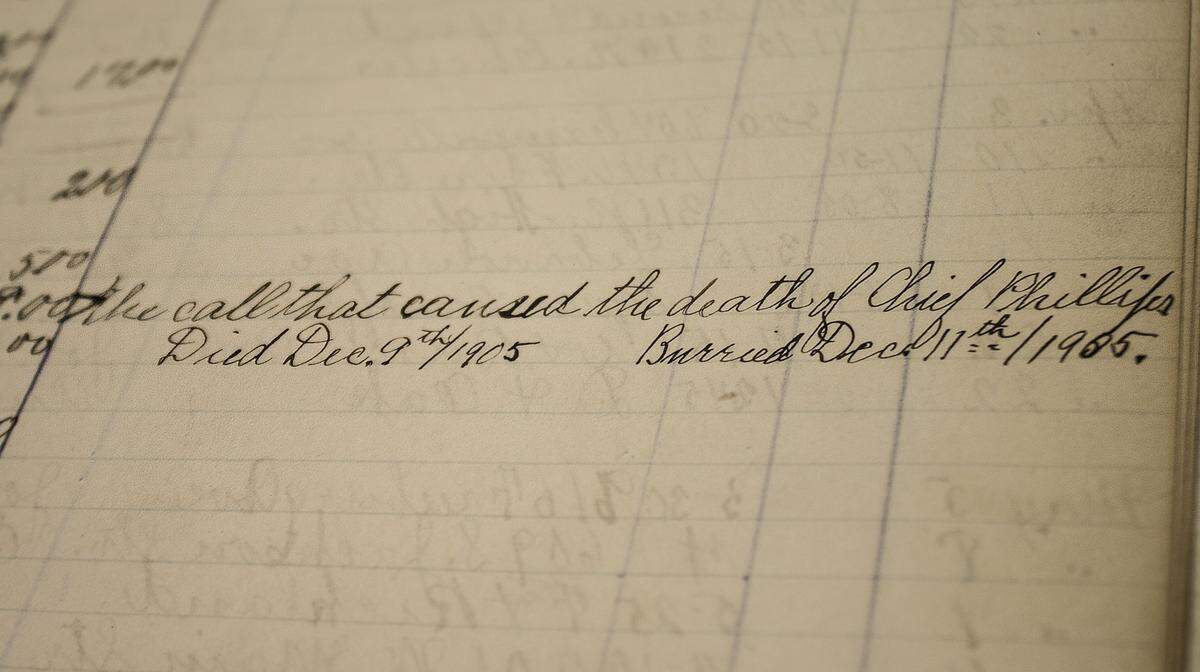
Fire Chief Fredrick B. Phillips
According to Belleville News-Democrat and Belleville Fire Department archives, at 10:30 a.m. on Thursday, Dec. 7, 1905, the Belleville Fire Department was called to a report of a fire at the Anheuser-Busch Beer Depot at the corner of A Street (now North Second Street) and Richland Street (now West A Street).
Two companies responded, including Hook and Ladder Company No. 1, which was staffed by driver Martin Keck, ladderman Thomas Bosworth, Assistant Fire Chief Frank Dinges and 50-year-old Chief Fred Phillips.
The horse-drawn fire engine was northbound on Jackson Street, passing through Main Street, when it crossed paths with a St. Louis & Belleville Electric Railway streetcar. The streetcar struck the rear of the fire truck, driving it into a telegraph pole in front of a jewelry store.
All four men in the truck were thrown to the ground, as the horses, scared by the accident, bolted north on Jackson Street. Keck, the driver, managed to climb back into his seat from the hitch and bring the frightened animals to a stop three blocks from the scene.
Dinges and Bosworth suffered minor lacerations and bruises from the impact of the accident, but Phillips fared worse. He was knocked unconscious when he struck his head on the curb. Belleville Police Officer Gustave Klamm, who had been on the street car, rushed to Phillips’ aid as he lay on the sidewalk.
Klamm and several citizens carried Phillips into the jewelry store and immediately sent for Dr. Charles H. Starkel, who examined Phillips’ injuries and ordered that he be taken to St. Elizabeth’s Hospital.
At the hospital, doctors operated on Phillips, attempting to relieve pressure on his brain, but Phillips never regained consciousness. He died on Saturday, Dec. 9, 1905, two days after the accident.
Phillips left behind a mother and a brother, and was laid to rest in Walnut Hill Cemetery. According to the archives, he was a well-known and popular citizen, having served as the Belleville chief of police before becoming chief of the fire department.
Belleville’s current fire chief, Tom Pour, says attempts to locate family members of Phillips have been difficult, as he was not married and did not have children.
After Phillips’ death, Assistant Fire Chief Frank Dinges took on the role of chief.
Hoseman Ransom Lewis
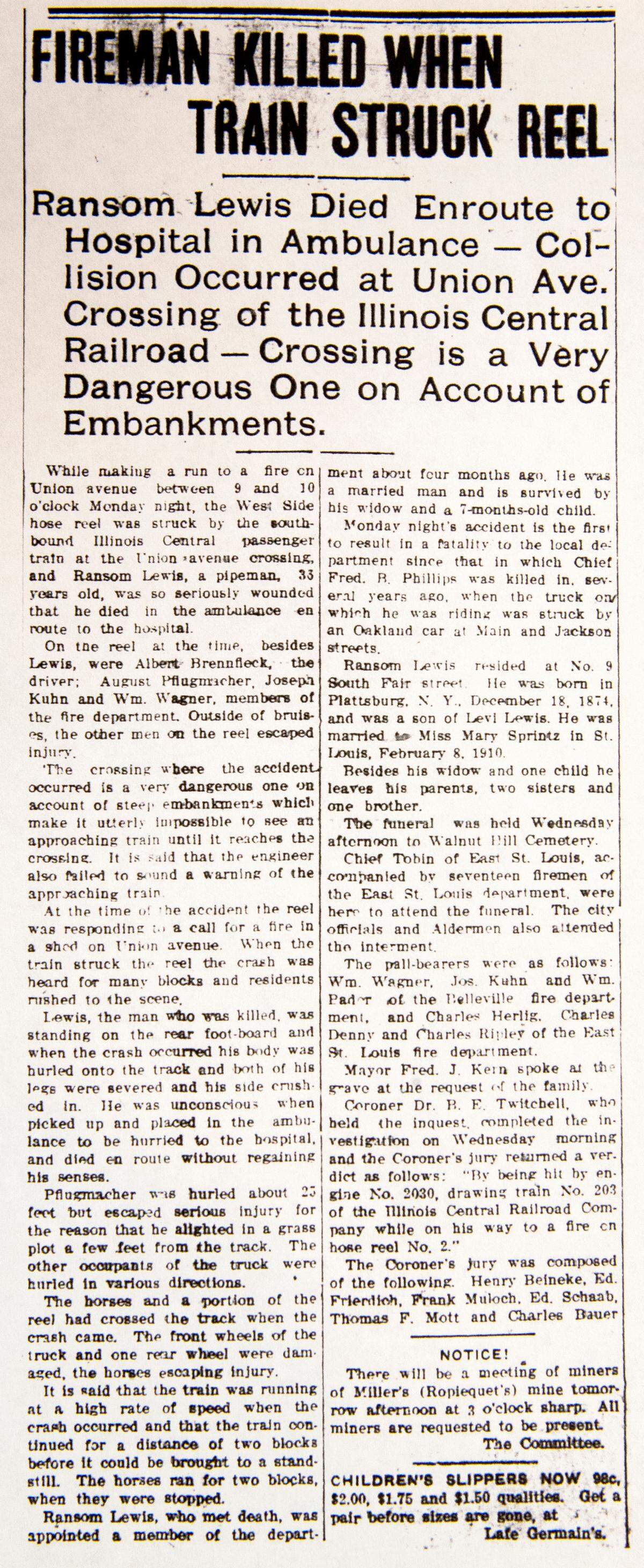
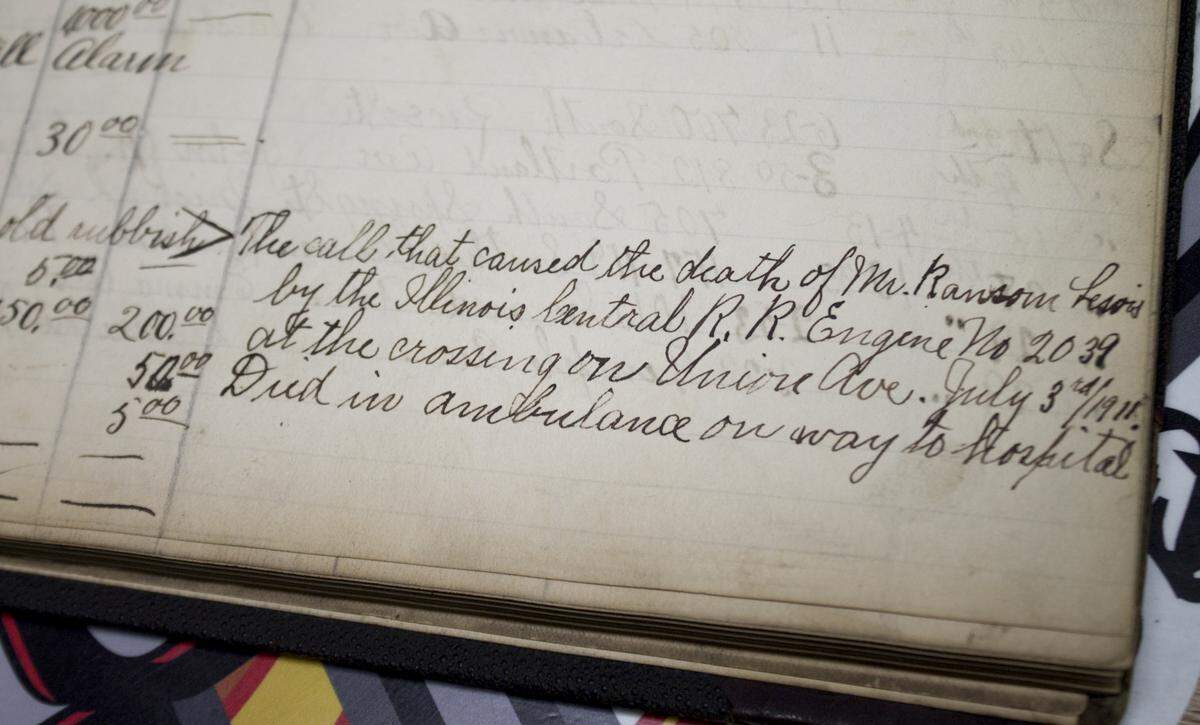
The Belleville Fire Department’s West Side Hose Reel was dispatched to a report of a fire in a stable at 615 Union Ave. at 9:40 p.m. on Monday, July 3, 1911.
According to Belleville News-Democrat and Belleville Fire Department archives, the crew of Hose Company No. 2 at the time included Capt. Joseph Kuhn, driver Albert Brennfleck and hosemen August Pflugmacher, William Wagner and Ransom Lewis.
En route to the fire, Lewis was standing on the rear foot board of the fire truck when an Illinois Central Railroad train struck the horse-drawn car at a crossing on Union Avenue near Henry Raab School. Lewis was pinned between the train and the truck’s hose reel, which was about halfway through the crossing at the time of impact.
Lewis’ body was hurled onto the railroad tracks. Both of his legs were severed and, according to the original news article from 1911, the side of his body was crushed. He was knocked unconscious and, after being put in an ambulance, died on his way to the hospital.
The other company men who were thrown from the truck suffered minor injuries, including Brennfleck, who was dragged by the spooked horses for one block before the reins snapped and released him. The truck itself was damaged beyond repair in the crash.
“The crossing where the accident occurred is a very dangerous one on account of steep embankments which make it utterly impossible to see an approaching train until it reaches the crossing,” the 1911 news article about Lewis’ death stated. “It is said that the engineer also failed to sound a warning of the approaching train.”
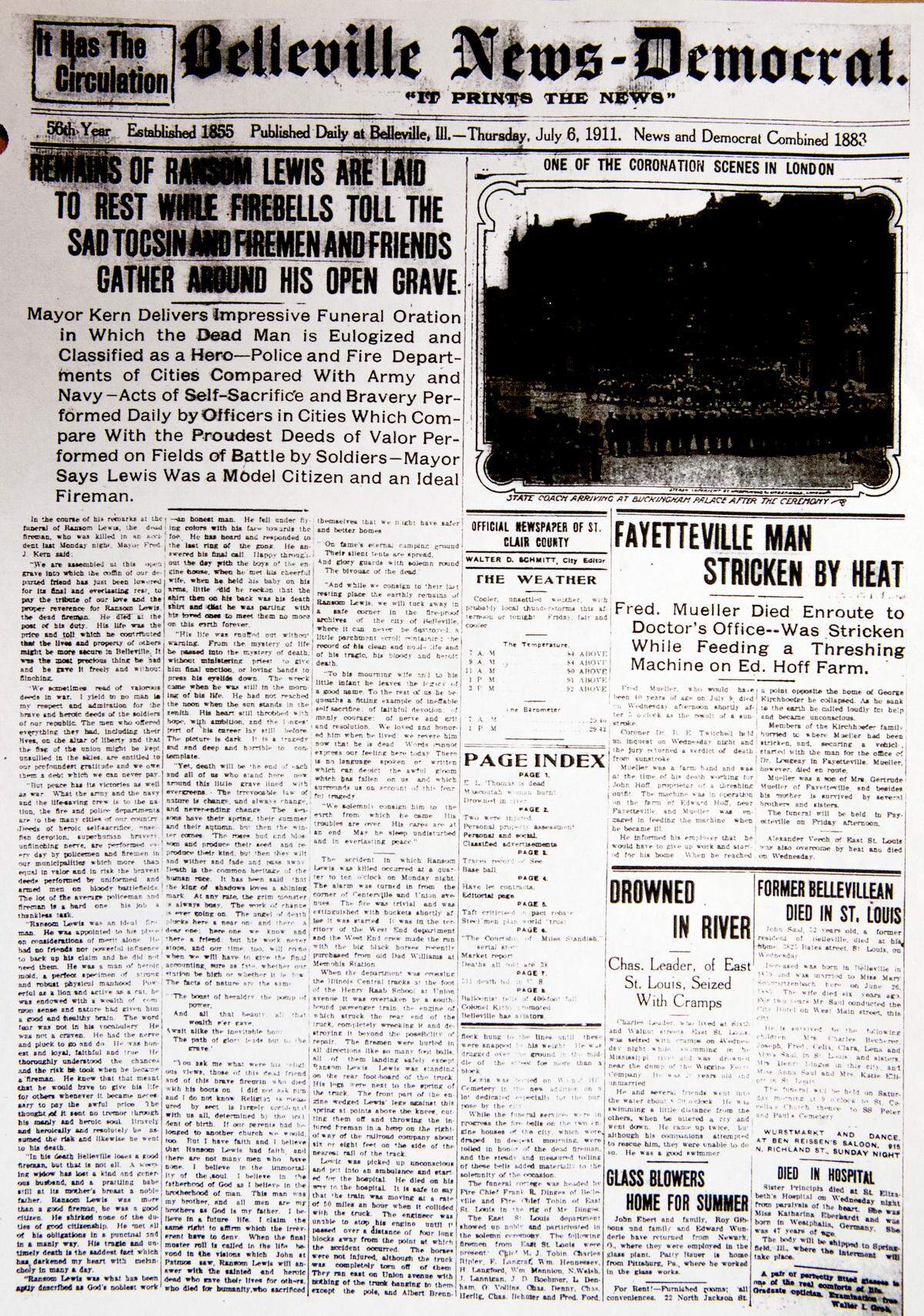
Lewis had only been a member of the department for four months. A resident of 9 South Fair St. (now 10th Street), he was married to Mary Sprintz Lewis, who was pregnant with their son, Edward Lewis. The couple also had a daughter, Caroline Mary Lewis, who was less than a year old when her father died.
Lewis had been handpicked by Mayor Fred J. Kern, who spoke at Lewis’ funeral at the request of his family. He said Lewis was a “model citizen.”
“The lot of the average policeman and fireman is a hard one, his job a thankless task,” Kern’s speech stated. “Ransom Lewis was an ideal fireman. He was appointed to his place on considerations of merit alone ... He was a man of heroic mood, a perfect specimen of strong and robust physical manhood. Powerful as a lion and active as a cat, he was endowed with a wealth of common sense and nature had given him a good and healthy brain.”
At his funeral, Fire Chief Frank Dinges read the eulogy.
Lewis’ great-grandson, Chris Feldt, said Monday that Dinges stepped up to the plate to help Lewis’ widow and children following his tragic death.
“It’s kind of like how we have Backstoppers today,” Feldt said, referencing the charity that provides financial assistance to the spouses and children of St. Louis-area first responders who lose their lives in the line of duty. “It’s amazing that even at that time, the city was willing to step up and help out the woman whose husband paid the ultimate sacrifice.”
For accepting that support, many in society viewed Mary Sprintz Lewis as greedy, prompting her to issue an editorial in the Belleville News-Democrat in December 1911, publicly thanking the men who stood by her side: Kern, Dinges and lawyer Charles A. Karch.
“Nothing but praise belongs to the men who helped me when I could not help myself and when a friend in need was a friend indeed,” she wrote. “I believe the abuse against these men (is) to have been heaped upon them for a political purpose and with an improper and impure and onwardly motive to hurt them.”
Now, over 100 years later, Feldt works with Dinges’ great-grandson Rick Meister on the Northwest Fire District volunteer department. The two have been friends for 25 years.
“We both knew we had great-grandfathers that had died while on duty, and after talking about it several times, we put together that they were both on the same department,” Meister said in a phone interview. “How coincidental is that?”
Through the research Feldt’s wife Amy and her mother did regarding Feldt’s family tree, Meister was able to learn more about Dinges, the great-grandfather he shared a love of firefighting with.
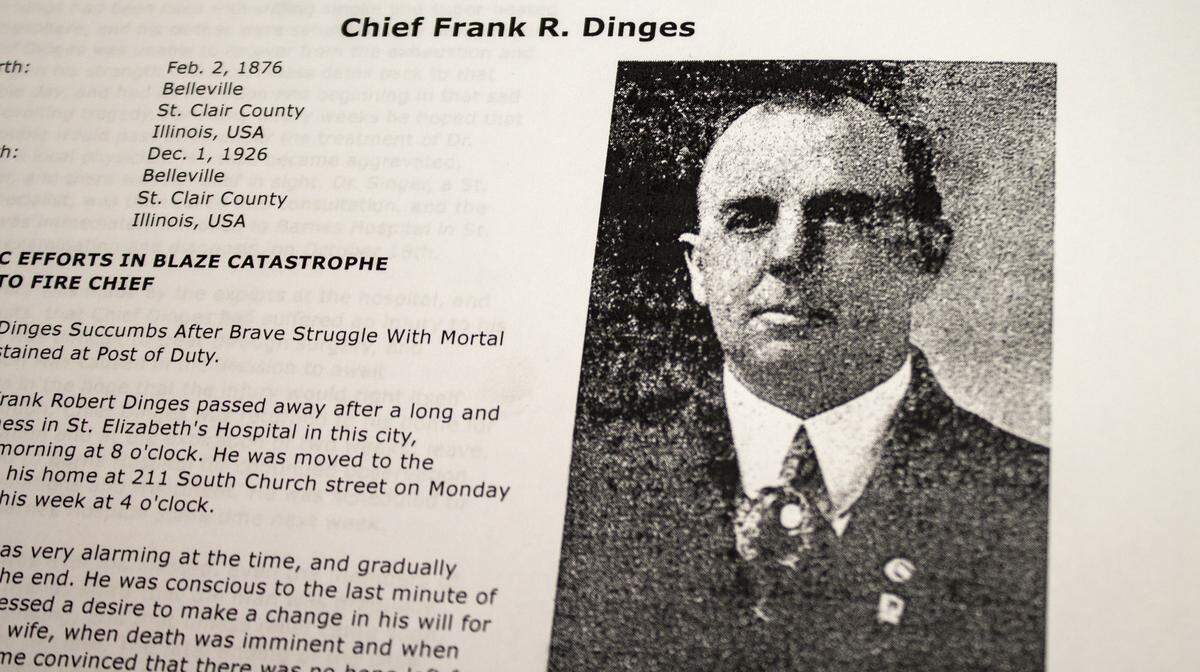
Chief Frank R. Dinges
On the morning of Tuesday, May 4, 1926, the Belleville Fire Department, which had unionized in 1918 and expanded to two engine houses by the early 1920s, were dispatched to a report of a fire in a one-story house at 20 Indiana Ave. at 4:46 a.m.
When they arrived, firefighters were met with a rapidly extending fire with seven members of a family named Haas trapped inside the house, according to Belleville News-Democrat and Belleville Fire Department archives.
Fire Chief Frank Dinges arrived with the first engine company and immediately entered the house in an attempt to rescue the family. Conditions inside the building were “punishing,” with heavy smoke and an “intensely hot atmosphere.”
All members of the family were found in their beds except for 17-year-old Irene Haas, who had attempted to escape by hiding under a bed, and 45-year-old John, who was found under a first floor window.
Dinges located and removed all seven victims with the assistance of other firefighters, but they died from smoke inhalation and burns. As soon as the bodies of the Haas family were removed from “the gutted and charred shack,” Dinges and his company were rushed away to another fire on Virginia Avenue.
During the rescue of the Haas family, however, Dinges was exposed to “toxic super-heated gases.” Shortly after the fire, which was started by a kitchen stove, he “began to develop a chronic lung ailment.”
Dinges’ condition worsened through the summer of 1926, and he was hospitalized on several occasions. Despite this, he continued to lead the fire department. By October, his condition had deteriorated to the point that he was hospitalized longterm at St. Elizabeth’s Hosptial. He lingered until Dec. 1, 1926, when he passed away in his home at 211 South Church Street.
Dinges was buried in Greenmount Cemetery.
Mayor Kern had appointed Dinges to the fire department in 1902, where he stayed until his death. A devout Catholic, he was a member of St. Peter’s Cathedral congregation since childhood.
According to the 1926 Belleville News-Democrat article on his death, he was a well-regarded man in the community.
“The death of Chief Dinges has cast a veil of gloom over all of the city buildings, particularly the Jackson Street Fire department, the West End Fire Department and the City Hall,” the 1926 article read. “He was deservedly popular and universally respected in official circles, as well as with the general public.”
Dinges, who married Amelia Gruenewalt, left behind two children: Irvin R. Dinges and Evira Agnes Meister, Rick Meister’s grandmother.
Meister said that although he’d always known he was related to a fire chief that had died on duty, it wasn’t until he saw that the Belleville Fire Department was honoring him that his interest in learning more about his family’s history was rekindled.
“I’m kind of excited about (the ceremony),” Meister said. “It’s really neat that they’re doing that and I’m happy to be a part of it.”
Continuing to honor the fallen firefighters
Beyond Sunday’s ceremony, the Belleville Fire Department plans to remember Phillips, Lewis and Dinges throughout the year, Pour said. Firefighters on the department will wear black mourning bands on their badges every year on the day of each man’s death, and every year, a dispatcher will read a tribute to each man on the same day.
“We want everyone to know their stories,” Pour said. “We want to make sure that those who paid the ultimate sacrifice are not forgotten.”
This story was originally published November 29, 2019 at 5:00 AM.
.jpg)