Tracy Hayden remembered as metro-east law enforcement works to curb domestic violence
St. Clair County prosecutors who specialize in handling domestic violence cases are based in the Tracy Fogarty Center.
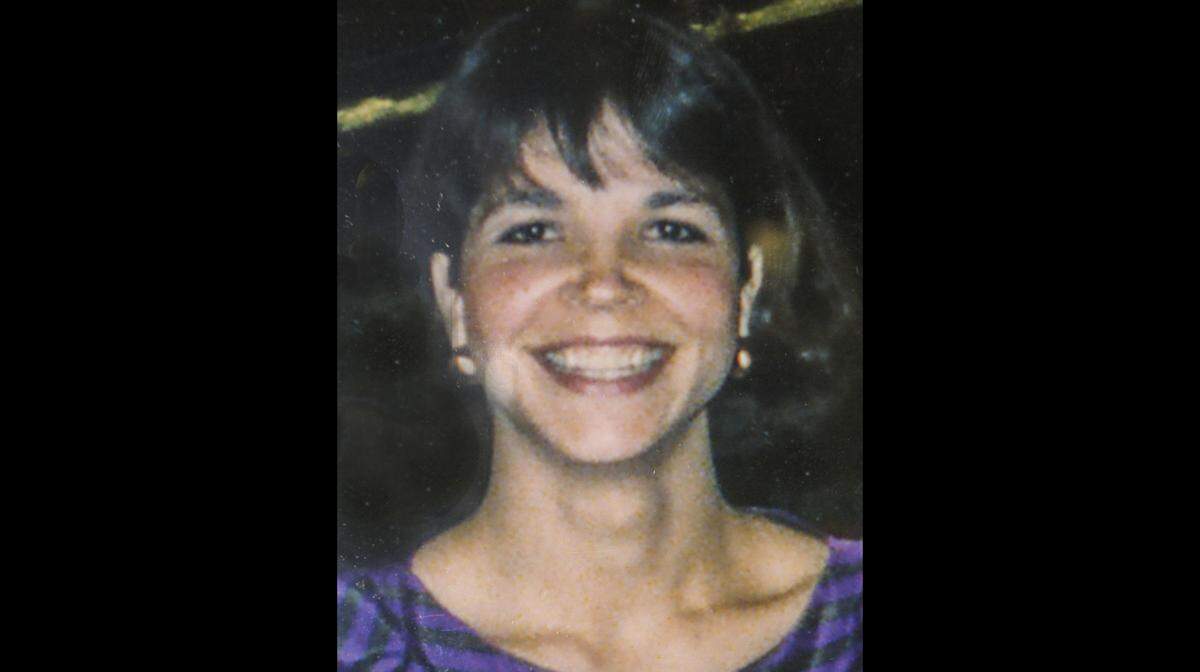
The center was dedicated in honor of Tracy Hayden — formerly Fogarty — who was fatally stabbed by her husband, Timothy Hayden, in a west Belleville bar and restaurant in 1990.
This unit is one of the ways metro-east police officers, prosecutors and victim advocates work to reduce domestic violence. Others include a special court for domestic violence case in Madison County and a program about to be launched in Monroe County.
The Tracy Fogarty Center operated by the St. Clair County State’s Attorney’s Office assisted 754 victims in 2018 and 672 in the first half of 2019. In 2018, St. Clair County prosecutors charged 544 cases of domestic violence.
In Madison County, officials have established the Madison County Domestic Violence Accountability Court to hear all intimate partner domestic violence related cases, as well as orders of protection associated with pending domestic violence criminal cases, according to the court.
In Monroe County, law-enforcement officials are launching a new effort to reduce domestic violence. One part of the program calls for law-enforcement officers to follow-up with offenders in the days following a domestic violence incident to “put them on notice.”
Belleville Police response
Belleville Police Chief Bill Clay said laws regarding domestic violence began changing in the 1970s and 1980s.
“They started recognizing that just because you have a marriage relationship, this doesn’t mean that you should be able to be battered, it doesn’t mean that you should be able to be sexually assaulted,” he said.
Belleville Police Lt. Todd Keilbach said officers are trained to recognize the volatility that a domestic violence case can bring. Belleville officers typically take a video when they respond to domestic violence incidents.
“You can see the house. You can see the disarray,” Clay said of the videos used as evidence. “Words in a report, they’re just flat and when you read them, they just don’t convey what you see with the video and the audio. It has been very helpful.”
Sometimes a domestic violence victim may not want to prosecute their partner but Keilbach said officers can proceed in such a case if a third party like a neighbor or a customer at a store witnessed the abuse.
“With domestic violence, it’s one of the rare cases where even if the victim doesn’t cooperate, we can still make an arrest as long as we have an independent witness,” Keilbach said.
Lethality forms
Keilbach said Belleville police officers work closely with the Violence Prevention Center of Southwestern Illinois during domestic violence investigations.
One of the tools officers use was recently suggested by the Violence Prevention Center: It’s a lethality assessment form that helps officers collect information about the vulnerability of the victim.
Part of the form prompts the investigating officer to find out whether the suspect has ever tried to strangle the victim.
Darlene Jones, executive director of the Violence Prevention Center, said her group asks officers to call the center’s 24-hour hotline when they are the scene of a domestic violence incident and encourage the victim to talk to with the group’s representative.
Jones said her group wants to help a victim develop a safety plan, which can include moving to another family member’s home or going to the 35-bed shelter operated by the Violence Prevention Center.
“It’s the first 48 hours that the victim is at the most risk of being murdered,” Jones said. “The whole idea is to reduce murders.”
Effectiveness of orders of protection
Victims of domestic violence who want to request a judge to issue an order of protection can get assistance from the Violence Prevention Center of Southwestern Illinois.
But Jones notes that even if a victim gets an order of protection, it’s still “just a piece of paper.”
“It doesn’t mean that they’re not going to still come around but at least you started that process where it’s illegal for them to do that and it’s easier to get them arrested,” Jones said. “You still have to be safe, even if you do have an order of protection.”
Ruth Glenn, president of the National Coalition Against Domestic Violence based in Denver, echoed Jones’ comments.
“I always caution, ‘Protection orders will not keep you safe,’” Glenn said. “We never want victims to feel as though they have done all they can for their safety when they’ve gotten a protection order.
“It is good to have one for documentation purposes.”
Domestic violence offender registry
The idea of developing a domestic violence offender registry similar to the widely used sex offender registries has been discussed by advocates of domestic violence victims but no law-enforcement agency has started one.
Supporters of such a registry say it could help people maintain their safety by showing a current photo and criminal history of a person convicted of not only domestic violence charges but of all violent offenses. Opponents argue that registries have not reduced crime, they are expensive to maintain and there may be cases of “victim blaming” where a victim could be asked why he or she didn’t check the registry.
Representatives of the FBI and the federal Bureau of Justice Statistics also said they did not know of any agency that tracks how often someone is killed after filing for an order of protection in a domestic case.
“We certainly know anecdotally that many, particularly women, lose their lives after they filed a protection order,” Glenn said.
“That’s why you have to be so careful in encouraging someone to get a protection order because it’s almost converse, which is, you’re getting a protection order and you’ve probably heightened your risk.”
Glenn said this statistic is something her organization would certainly be interested in seeing.
If this statistic was compiled, Tracy Hayden’s name would fall into that category. She had received an order of protection from her husband, who was arrested twice on charges of violating the order of protection.
‘Monica’s Law’
While a violent offender registry has not been created for people to research, Texas lawmakers have approved an online, statewide registry for people to search for orders of protection issued by a judge as a result of domestic violence.
The registry is known as “Monica’s Law” in memory of Monica Deming, who was shot to death in Odessa, Texas, by an ex-boyfriend. Prior to his relationship with Deming, the ex-boyfriend had two orders of protection for domestic violence issued against him.
The Texas law was sponsored by state Rep. Brooks Landgraf, whose spokesman said the registry is scheduled to be available this summer. The victim in the domestic violence incident has the right to request that information about his or her case be withheld from the database that the public can read.
Landgraf proposed the bill after he met Jon Nielsen, who is the Deming’s father and a former Odessa police officer.
If there had been a database for Deming and Nielsen to check, they would have been able to see that the man accused of abusing Deming had a history of domestic violence complaints against him, Landgraf said in a news release.
“Monica’s Law cannot go back and save Monica’s life, or take away her family’s grief, but it can help prevent others from entering into tragically abusive relationships that can lead to physical violence, and worse, death, and it gives law enforcement officers an additional tool to understand threats posed by those with a history of domestic violence,” Landgraf said in a statement.
How to get help
Domestic violence victims can call crisis hotlines for assistance:
▪ Call 618-235-0892 for the Violence Prevention Center of Southwestern Illinois hotline. For more information about the center, go to vpcswi.org.
▪ Call 800-799-7233 for the National Domestic Violence Hotline. For more information, go to thehotline.org.
BEHIND THE STORY
MOREHow we reported this story
Tracy (Fogarty) Hayden was murdered by her estranged husband, Timothy Hayden, in a Belleville restaurant in July 1990. In 2011, the St. Clair County State’s Attorney’s Office named its domestic violence unit the Tracy Fogarty Center in her honor. To provide context and solutions-based information regarding the issue of domestic violence and the effectiveness of orders of protection, we reached out to organizations that work to help domestic violence victims as well as with law-enforcement authorities. Please see the accompanying article for more information about the Hayden case.
This story was originally published January 17, 2020 at 5:00 AM.