When Thomas Trice teaches courses at the Southwestern Illinois Law Enforcement Commission, or SILEC, he asks law enforcement officers to watch viral videos of police brutality, then he gauges their reactions.
“For many, the instinct is to get very defensive with these topics, to try and say the action was justifiable,” he said. “I let them speak their minds, and then we walk through it.”
Part of “walking through it,” Trice said, is posing this question: “If that was your child, would you still be in agreement with the officers’ actions?”
“That question is typically the tipping point for officers to start rethinking how that situation happened or the decisions that were made,” he said.
For law enforcement officials in the metro-east, the international reaction to George Floyd’s death — including calls to defund police departments or abolish them all together — has forced them to reassess their use of force tactics and approaches to community policing, with one police chief even saying it would be “negligent” not to undertake reviews.
How police in Illinois are trained
Trice, a retired law enforcement officer with a doctoral degree in leadership management, teaches courses at SILEC that cover communication across cultural and ethnic boundaries.
SILEC offers law enforcement training to agencies in Bond, Clinton, Madison, Monroe, Randolph, St. Clair and Washington counties. The courses cover specific topics beyond the basic training officers receive at the police academy.
David Hayes, the director at SILEC, said that almost all metro-east law enforcement agencies, including the local division of the Illinois State Police, send officers to receive this extra training.
Hayes said SILEC began adding several courses to its curriculum when the Illinois Police and Community Relations Act was put into place in 2015, on the heels of protests in Ferguson, Missouri, when Black teenager Michael Brown was shot and killed by a police officer.
“Among many of those things mandated for law enforcement were topics such as constitutional and proper use of force, law enforcement authority, procedural justice, civil rights, human rights and cultural competency,” Hayes said. “As a result of that, we kind of modified our training and focused it on these mandated areas.”
Much of the language in the Illinois act was lifted from then-President Barack Obama’s executive order creating the Task Force on 21st Century Policing, Hayes said.
Steve Johnson, Swansea Police Department’s chief, was an active member of that task force. He has also taught law enforcement practices to departments, agencies and companies in all 50 states, including officials in the FBI and the U.S. Department of Homeland Security.
“There are over 800,000 police officers nationwide and over 18,000 police agencies,” Johnson said. “The biggest problem I see is that means 18,000 different policies, training, hiring, discipline, professionalism, etc. Nationwide standards on all of them need to be developed and attained. All cops want this.”
Thomas Trice, of Triken Transformational Training in Belleville Tim Vizer
Police reforms introduced at national level
In response to the protests over Floyd’s death, U.S. Congressional Democrats introduced the Justice in Policing Act 2020 on June 8, a sweeping police reform bill that would ban chokeholds, establish a national database to track police misconduct and require bias training. The Washington Post reported that the bill also contains several provisions that would make it easier to hold officers accountable for misconduct in civil and criminal court.
On Tuesday, President Donald Trump signed an executive order that would implement several of those requirements, including the excessive use of force database and adding a financial incentive for departments to adopt best practices and encourage programs that work with co-responders like social workers.
Illinois was ahead of the curve on many of these protocols, Hayes said, noting that chokeholds are banned in the state, that a statewide police misconduct database already exists and that racial bias training is already mandated.
“All of these things have been done to try to prevent things like George Floyd’s death from happening,” Hayes said. “Illinois is very fortunate that we have at least the Police and Community Relations Act that started a tidal wave for all of these things in training.”
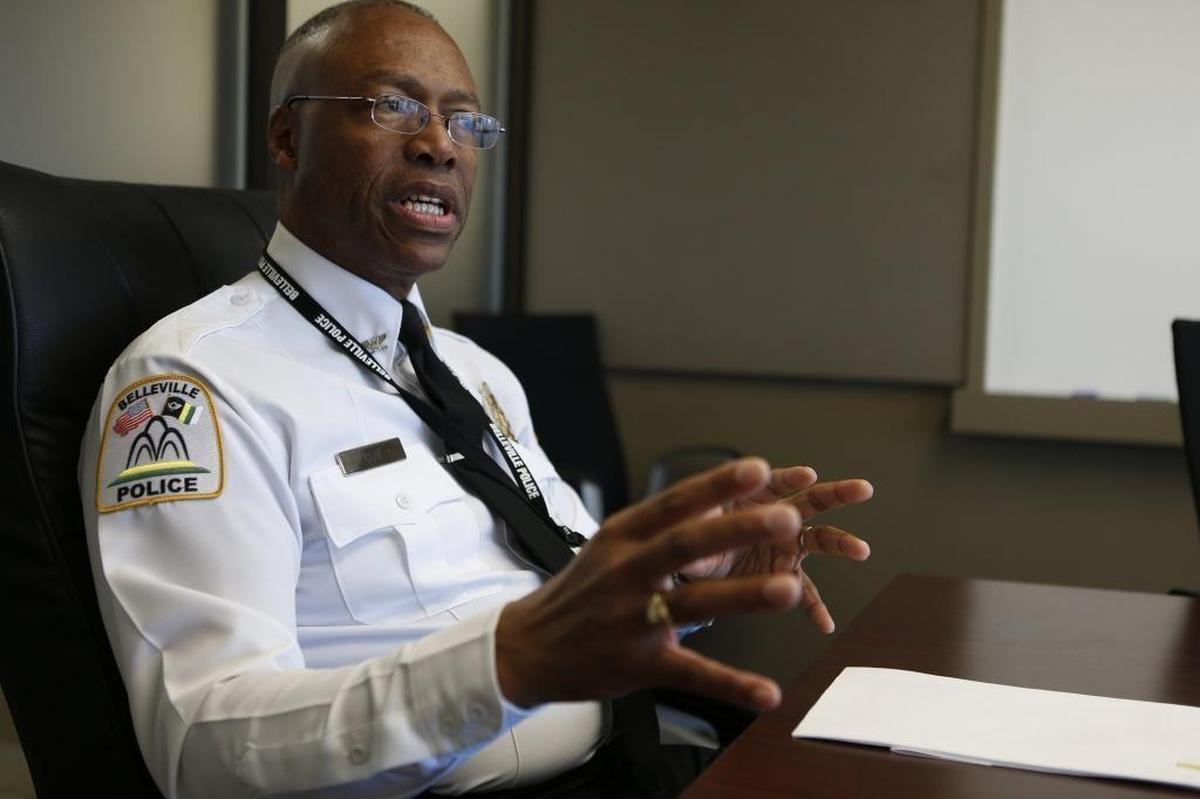
Belleville Police Chief Bill Clay said that the video of Floyd’s death would cause any law enforcement agency to reassess their practices.
“The leadership of this department, and any other department, would be negligent in their duties and responsibilities to their officers and the public they served if they were not examining their policies and use of force training tactics,” he said.
He added: “An officer’s training does not stop after the police academy. Officers have continuing education and retraining throughout their whole career.”
Johnson agreed, saying that his department has outlawed the philosophy of “we have always done it that way so we will keep doing it that way,” claiming that it’s an outdated law enforcement line of thinking that does not work in the modern world.
“We also learn from the mistakes of others,” he said, adding that he too sends videos of police brutality to his police force and breaks them down with officers.
Of the video of Floyd’s death, Johnson said, “It was wrong, shocking and disturbing to watch. It hurt me to watch.” He believes the other officers should have intervened.
“An officer who observes another employee use force that exceeds the degree of force permitted by law should promptly report these observations to a supervisor,” he said. “Using a knee to someone’s neck for almost 9 minutes is not how we train.”
Belleville Police Department Chief William Clay III Zia Nizami znizami@bnd.com
Dealing with unfunded mandates
The biggest problem Hayes said he is wrestling with at SILEC is that funding is drying up for training programs like the one he leads.
“I believe Illinois does a good job laying out training outlines and curriculum outlines, but it’s hard to accommodate because the funding for these have dried up lately while these mandates continue to build and multiply,” he said.
SILEC is an extension of the Illinois Law Enforcement Training and Standards Board and is funded by the Traffic and Criminal Conviction Surcharge Fund, the latter of which was created by the Illinois General Assembly in the late 1960s and uses court fees and payments from traffic tickets to pay for continued law enforcement training.
Hayes said that his problem with the fund is that over time, other entities apart from the Training and Standards Board were given permission to begin drawing money from the fund, leaving him with a smaller budget to work with every year.
“I don’t know where it will take us,” he said, mentioning that he’s only planned 275 classes for the upcoming training year, as opposed to last year’s more than 300.
Hayes also mentioned that the culture of law enforcement has changed over recent years that “no one wants to be a police officer anymore.”
Part of that, he said, is that officers have been forced to take on so many duties that they aren’t usually trained for.
Clay agreed, saying that police have become “the default government agency” for many social services.
“I began my career as a law enforcement officer in 1978, and I have been a member of the Belleville Police Department since 1995,” he said. “During my time here, I have seen a steady and sometimes significant expansion of police jurisdiction and responsibility by the legislative process in this state and many others.”
Clay said this is evident with programs like the Crisis Intervention Team, which was designed as a police mental health collaborative where officers were trained to help guide interactions between law enforcement and those living with a mental illness.
Though the goal was to resolve exigent mental health incidents by training police officers to direct individuals to treatment programs and away from arrest, Clay said there were “mixed results,” with officers sometimes spending up to four or more hours waiting with the patient for assessment or a decision on admittance.
The COVID-19 pandemic is another example, Clay said. With Gov. J.B. Pritzker’s stay-at-home executive order in place, police were forced to consider enforcement options in their communities.
“The police found themselves at the forefront of this crisis in many communities with very little guidance or a comprehensive plan of action, ensuring there would be preventable conflict and confrontation with the public they serve and thus damaging the trust needed to protect and serve the public effectively,” he said.
Johnson said he also supports adding more social programs, noting that they are “sorely needed.”
“It is unfair and not realistic to ask that of one profession,” he said.
Swansea Police Chief Steve Johnson Zia Nizami znizami@bnd.com
Possible solutions for police to improve relations
In his 2017 article “Law Enforcement Leadership Through the Eyes of a Citizen,” Trice laid out a theoretical framework of three pillars for police agencies could follow to improve law enforcement and community relations: “real” leadership, cultural competency and empathy.
When incidents of police brutality occur and are spread through social media platforms, the public naturally creates a negative narrative around law enforcement, Trice said.
“The public will not support and/or trust in leadership that appears to be fraudulent or counterfeit,” he said.
Trice said that “real” leaders often get swallowed up in the politics and nepotism of police forces, and that finding them goes beyond training — it starts with the hiring process.
“If you buy a bad apple, it’s not like longer you keep it, the better it gets,” he said. “If the beginning is flawed, you’re never going to be able to teach someone compassion.”
Clay, of Belleville, said that he supports a proposition to license individual officers, which he said would help to prevent “Circuit Riders” officers, or officers with “checkered histories” and numerous complaints.
“They remain in law enforcement because they are able to find employment in agencies that are unable or unwilling to conduct background checks since these individuals have already completed the police academy,” he said.
Those background checks, Trice said, are extremely important in law enforcement hiring because departments can catch “red flags” and assess the risk of hiring that potential police officer. Trice is the president of Triken Transformational Training, which does background checks for police departments.
One way to weed out these “bad apples,” Trice suggests, is require more education for police officers.
“When officers come in with a broader knowledge of law, they are much more empathetic to citizens and there is less use of force used,” he said. “It’s time for the government to support that and time for a national policy to look at how we hire officers.”
What local activists say
“I think there is a stigma in the Black community that police are bad, and that children grow up scared of officers,” said Jeremy Watson, a community organizer in Belleville.
Watson said he and his wife Carmelita have conversations with their children, particularly with their 16-year-old son, about what not to do when they’re out in public so as to avoid becoming victims of police brutality.
“White people are not having those same conversations with their kids,” he said. “Some people are scared of getting a phone call that their kid is at the police station. I get scared of a phone call telling me my son is in the morgue.”
One of the biggest ways police could be better, he said, is to get more involved in communities and be with citizens in good times, not just the bad. He said that growing up, his fondest memories of police officers were those he knew by name.
“I think when you know someone by name, it’s harder to shoot them in the back,” he said.
Nikki Hughes, a 20-year-old activist in Belleville, agreed. She recalled that the only time she didn’t feel scared of police officers is when there was an officer in her school who led the DARE program, because she became familiar with the officer and knew she had kids’ genuine interests at heart.
Hughes and another organizer, Tommia Douglas, 21, said that they supported defunding police departments and diverting that money to other programs. Those include better playgrounds and education for children in Black neighborhoods, and having social workers and domestic violence interventionists on staff to respond to some 911 calls.
“By continuing to give so much money to police departments, you are saying that police departments have more value than everything else,” Hughes said. “Whereas we’ve been defunding things like education for years.”
The young activists said that though they had cooperated with the Belleville Police Department in organizing the downtown Black Lives Matter protests, they were disappointed that officers were not joining them on the streets.
“They have not been nearly loud enough,” Douglas said. “You can say what you want, but actions speak louder than words.”
Watson said that now would be a great time for city officials and police officers to come together with protesters.
“While the world is listening, we need these communities of officers to speak up and say ‘we’re there for you, we’re here to protect you, not harm you,’” he said. “It’s their job to make sure people they serve to feel comfortable, not the other way around.”
Empathy is an important factor in choosing to be a public servant, Watson said, and he supports requiring more cultural training for officers, especially in places with diverse populations.
“We can’t wait for another Black man to die before we see change,” he said. “Our communities are begging them to change.”
Focus on trust and transparency
Trice also suggests that law enforcement create more trust and transparency in their communities by developing relationships with the citizens they serve.
“Although law enforcement officers have a stressful job and often respond to unknown situations, not understanding the individuals they are there to assist or confront, coupled with implicit biases, increases the potential of make things worse,” Trice said.
Officers should educate themselves on microaggressions, and become more open-minded and understanding of the factors that could drive someone to commit crime, Trice said.
Another suggestion is for police departments to prioritize putting minorities, including racial minorities and women, in positions of power, he said.
“You have to have representation throughout every level of any organization ... you’ve got to have those that represent the population you’re serving so you can actually have someone for people to go to when they do have a complaint,” he said. “When you have a Black community and 95% white police force, where do they go to have that trust?”
Empathy, Trice says, is imperative to an officer doing his or her job responsibly. That’s why reviewing those viral videos and breaking them down, like what Johnson does with his officers or how Trice does in his SILEC training courses, can be beneficial to policing overall.
Trice said that law enforcement officers must realize a culture shift is happening, and that officers refusing to adhere to that change “will only continue to make the same miscalculation related to the treatment of American citizens.”
“Leaders must reinforce within their organizations that it is an honor to wear the badge and that underneath that badge, officers are no more than a citizen with powers to take individuals’ liberties.”
This story was originally published June 18, 2020 at 9:40 AM.
Hana Muslic has been a public safety reporter for the Belleville News-Democrat since August 2018, covering everything from crime and courts to accidents, fires and natural disasters. She is a graduate of the University of Nebraska-Lincoln’s College of Journalism and her previous work can be found in The Lincoln Journal-Star and The Kansas City Star.

.jpg)