East St. Louis protest raises awareness for economic empowerment
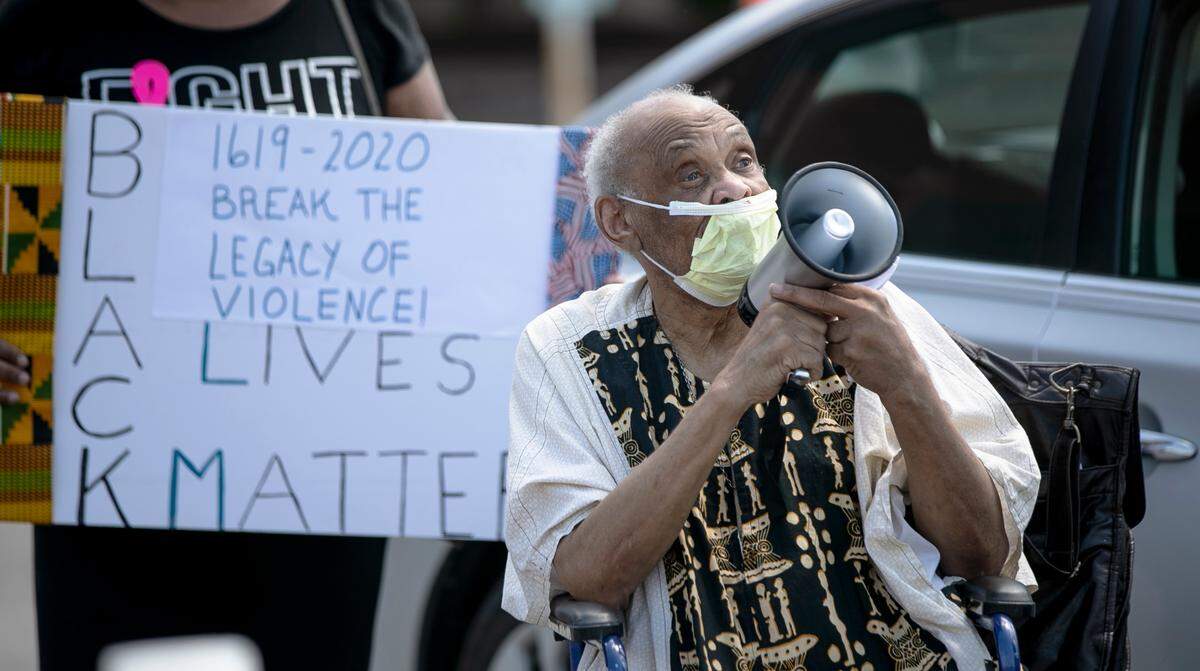
While a small group of protesters rallied outside of City Hall in East St. Louis with signs and megaphones on Thursday morning, Reginald Petty, a city historian and civil rights leader, reminded participants about the legacy of protest movements.
“The question that you’re going to have to ask yourself is who’s going to be the next Jesse Jackson or Martin Luther King Jr. of your generation?” Petty, 84, told the crowd of about 20 people from his wheelchair. “I’d like to apologize on behalf of my generation for putting this stuff on you because there’s more work to do, and especially in East St. Louis because we need more businesses.”
Although there was a small group, the protest was among the first anti-racism rallies in East St. Louis that showcased solidarity with the Black Lives Matter movement. Last month, the city hosted “6 Feet in the Street -Neighbors Caring For Neighbors” rally that highlighted the impact of COVID-19 and police brutality in Black communities.
Fareed Alston, the organizer of the protest, said he plans to host more rallies in the city that highlight racial injustice and economic empowerment in East St. Louis.
“I organized the protest to bring awareness to the city of East St. Louis,” Alston, 31, said. “What I would like to see in the city of East St. Louis is an influx of resources to this community, meaning its people and businesses.”
Alston is the founder of City-Publishing, an audio company that provides media for business needs. He said he organized the protest in 10 days.
“I have a career in protests as a visual journalist, so my experience with protests led me to want to participate in the new wave of cultural revolution that’s going on now outside of documenting and recording,” Alston said. “I wanted to take a more administrative role and organize the protest.”
At the beginning of the rally, Alston handed a sheet to participants that listed the definition of “economic awareness.” He asked people to read the definitions out loud.
“I want people to be aware that East St. Louis is a predominantly African-American town, and it’s one of the last townships like that,” Alston said. “I really want to bring awareness to the economy of East St. Louis, so we want people to participate and come from other cities and make them feel comfortable to come here and spend money.”
Lauren Mudge, a teacher from Edwardsville, said she wanted to attend the protest to show support in demanding justice for Black lives. Since the police killing of George Floyd, Mudge said she tries to attend two protests a week.
“I think it’s important to stand in solidarity with the movement, and I think it’s especially important for white people to do that,” Mudge, 30, said. “Unfortunately, it took a pandemic for people to realize their own humanity. I also think it’s important that we look at education and how to change things in our curriculum in our public schools to be more inclusive and diverse.”
East St. Louis economy
Shontay Ford, an East St. Louis resident, said she attended the protest to urge for more economic improvements in her hometown.
“It’s just really bringing attention to the challenges that we’re enduring as a people, and not just Black people, but people in general,” Ford, 33, said. “I feel like if we as Black people, aren’t successful, then this country won’t be successful, so addressing all of the disadvantages of the disenfranchised is extremely important.
“For my community specifically, I’ve never seen East St. Louis thriving,” she said. “I’ve always heard about how it was successful at one point, but I’ve never witnessed it myself. I know that it has great potential because of its location, so if we can really see what the challenges are and why the investments aren’t coming to this community, then maybe that’s an opportunity to improve it.”
Alston said he was grateful for the protest’s reception, considering it was his first time organizing a protest.
“I intend to do this every year on 618 day,” Alston said “This is also significant in bringing awareness to 618 day, which is really the perfect day for East St. Louis since it’s our area code. I also think the day has symbolism with the the Black business districts that have historically been set up, so I’m looking to commercializing this day.”
Protesters marched through East St. Louis business district on Collinsville Avenue and the event ended at a park on the intersection of Ninth Street and St. Clair Avenue.
“One person really is a protest, so just to have so many people here that I don’t know is a success,” Alston said.