New COVID restrictions don’t affect all Belleville restaurants and bars the same
New state restrictions that take effect Tuesday in an attempt to stem the spread of the coronavirus will affect restaurants and bars in very different ways, even those in the same neighborhood.
Big Daddy’s in downtown Belleville can easily deal with smaller party sizes (six people instead of 10 at a table) and bans on people sitting at bars, congregating in open spaces or dancing to live music, said owner Scott Schmelzel.
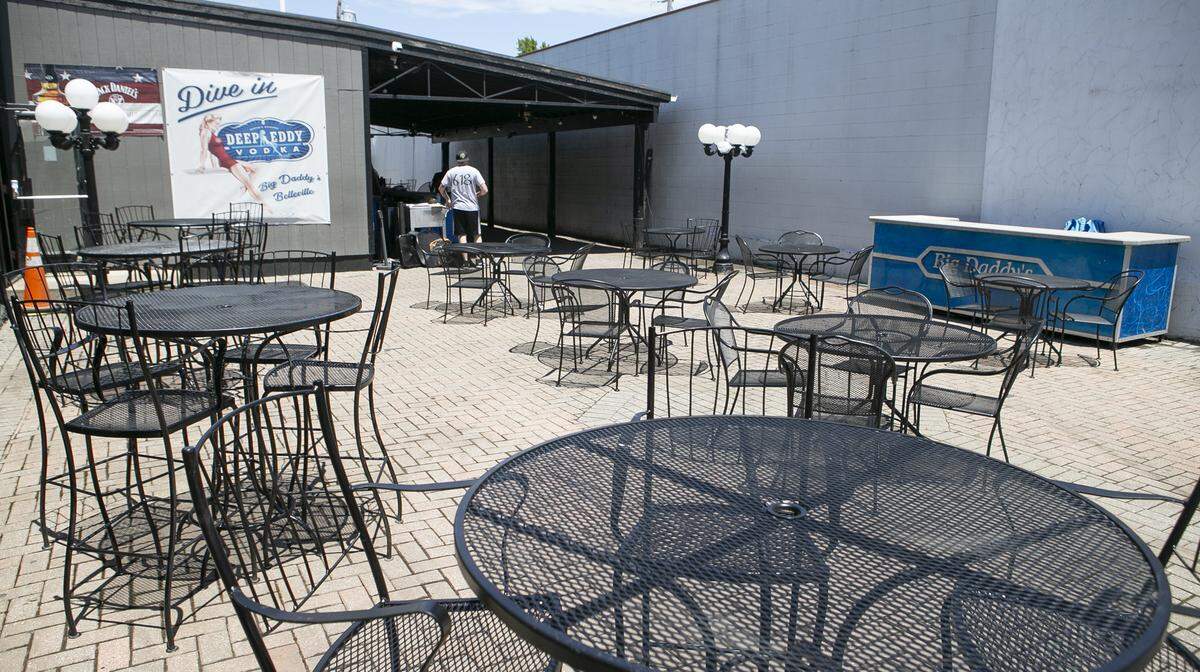
“Our patio is huge,” he said Monday. “It’s nearly 3,000 square feet. So we have plenty of seating and plenty of room to social distance.”
The restaurant and bar was closed more than two months during the COVID-19 shutdown before opening only its patio for drinks in late May. The outdoor bar has no stools, servers wait on tables 6 feet apart and large groups have gotten used to being divided up.
The new restriction that will be toughest on Big Daddy’s is the 11 p.m. closing time, said Schmelzel, who has a liquor license that normally allows him to stay open until 2 a.m.
“We’ll be greatly, greatly affected by the curfew,” he said. “... It will hurt places that offer gaming and places that sell drinks.”
Schmelzel does both. He hasn’t been operating his kitchen during the pandemic because, he said, it’s not financially sustainable. Instead, he encourages people to bring in carry-outs or get food delivered from other locally-owned restaurants.
Counter service at issue for Bennie’s
Across the street, the owner of Bennie’s Pizza Pub isn’t that concerned about the 11 p.m. closing time. Bennie Parr, who also has a 2 a.m. liquor license, has been closing at midnight on Fridays and Saturdays and 8 p.m. on other nights this summer.
But Parr was wondering Monday if the new restriction that prohibits customers from ordering at bars applies to him.
“We’re a walk-up service,” he said. “You order your food at the counter. You order your drinks at the counter. We don’t have a wait staff.”
Also at issue is the rule against people standing in open spaces. Parr said customers often get up from their tables, see friends and stop to chat for a few minutes, and he doesn’t have enough employees to go around policing them.
Parr said he understands that it’s been hard for state officials to come up with guidelines for entire industries during the COVID-19 pandemic. He feels fortunate that his business has been good, and he’s been able to adjust to changes.
“I’m going to have to really take some hard looks at how (the new restrictions are) going to affect us and how we’re going to do it,” he said. “I’ve considered closing inside again and going to only outside and curbside. We’re still trying to decide. ... We want to do the right thing for the health of the public and our employees.”
No big changes at Tavern on Main
Like Bennie’s, Tavern on Main won’t be significantly affected by the 11 p.m. closing time because it hasn’t been staying open that much later on Fridays and Saturdays, said owner Mark Onstott.
The restaurant and bar has a large outdoor area, including its regular patio and a section of Church Street, one of three streets that the city of Belleville temporarily closed to allow expanded seating this summer. Tables are spaced 6 feet apart.
Like Schmelzel, Onstott said customers in large groups have gotten used to dividing up. Now they will just have to sit six to a table instead of 10.
“I think we’re going to live with the new rules and call it a day,” Onstott said. “We’re going to have to modify a few things, but most of it, we were already doing.”
Another new restriction is that customers must make reservations to eat or drink at bars or restaurants. This can be done by calling ahead or checking in at the door, said Melaney Arnold, spokeswoman for the Illinois Department of Public Health. She noted that it could help with contact tracing at a later time.
Illinois Gov. J.B. Pritzker announced new restrictions for the metro-east in a press release Sunday after the region’s COVID-19 positivity rate reached a state threshold for three consecutive days.
The Illinois Department of Public Health’s website on Sunday reported an 8.5% seven-day rolling average of positive results from coronavirus tests for the metro-east, also known as Region 4, the highest in the state. The region includes St. Clair, Madison, Randolph, Clinton, Monroe, Washington and Bond counties.
“The new measures were developed in close coordination with local public health administrators and county officials and account for the unique characteristics of the region,” the release stated.
Rules could get tougher after two weeks
The state restrictions, which also affect other types of businesses, will remain in effect for 14 days. After that, additional action could be taken, including a ban on indoor dining, if a high rate of positive tests continues.
“Throughout the COVID-19 pandemic, I have made it clear that neither arbitrary dates on a calendar nor political pressure will dictate Illinois’ efforts to protect our people,” Pritzker stated in the press release. “If the data shows we need to go backwards in our reopening, I won’t hesitate to tighten restrictions to protect our collective health.”
Pritzker closed restaurants and bars to indoor and outdoor dining on March 17 to slow spread of the coronavirus. They could continue to offer carry-out, curbside pickup, delivery and drive-thru service, if desired.
The state’s Restore Illinois plan for restarting the economy allowed restaurants and bars to reopen for outdoor dining on May 29 and indoor dining on June 26. They had to place tables 6 feet apart, require servers to wear face coverings, limit standing in open spaces to 25% of normal capacity and follow other rules.
Here are the new restrictions for bars:
- All bars must close at 11 p.m. (matching new closing time at St. Louis bars)
- No ordering, seating or congregating at the bar (bar stools should be removed)
- All bar patrons should be seated at tables inside and outside
- All indoor tables should be reduced to 6 persons or less
- Tables should be 6 feet apart
- No standing or congregating indoors or outdoors while waiting for a table or exiting
- No dancing or standing indoors
- Reservations required for each party
Here are the new restrictions for restaurants:
- All restaurants must close at 11 p.m. (matching new closing time at St. Louis bars)
- All indoor tables should be reduced to 6 people or less
- Tables should be 6 feet apart
- No standing or congregating indoors or outdoors while waiting for a table or exiting
- Reservations required for each party
- If the restaurant also has a bar, the rules for bars apply
This story was originally published August 18, 2020 at 7:00 AM.