Here’s why Romanik’s ‘Whites in Politics’ signs were taken down by St. Clair County
Bob Romanik lost his fight earlier this year to operate a radio station that featured his daily radio program laced with racist language and now he’s lost the “Whites in Politics” signs he was able to get posted along Frank Scott Parkway as a participant in St. Clair County’s Adopt a Highway program.
While critics of Romanik called his “Whites in Politics” signs racist, that was not the reason they were taken down, a county official said.
The “Whites in Politics” signs were recently removed because neither Romanik nor other volunteers worked to clean litter along the roadway, as is mandated by the Adopt a Highway program, according to St. Clair County Engineer Norm Etling.
The “Whites in Politics” signs were posted on a one-mile stretch on Frank Scott Parkway next to another mile-long stretch that had been adopted by local members of the Washington D.C.-based Blacks in Government.
Romanik applied for sponsorship of the road in July 2019, according to paperwork obtained by the Belleville News-Democrat via a Freedom of Information Act request with the county.
He originally asked for the signs to say “Whites in Government” but the Adopt a Highway signs that were posted said “Whites in Politics.” Etling said he did not know why the change was made.
Romanik declined to comment on the county’s decision to take down the “Whites in Politics” sign and hung up the phone when asked about his request to have his signs installed on a section of road next to the “Blacks in Government” signs.
About seven weeks after Romanik applied for “Whites in Government” sponsorship, the St. Clair County Transportation Committee voted in September 2019 to terminate the Adopt a Highway program. Etling said the program was phased out because of a lack of participation and reduced staff available to monitor it.
All signs were taken down, including the “Blacks in Government” sign, were taken down once their two-year sponsorship contracts expired, Etling said.
Romanik’s contract had been scheduled to end on July 21, 2021. He was listed as the “president” and “coordinator” of the group he called “Whites in Government.”
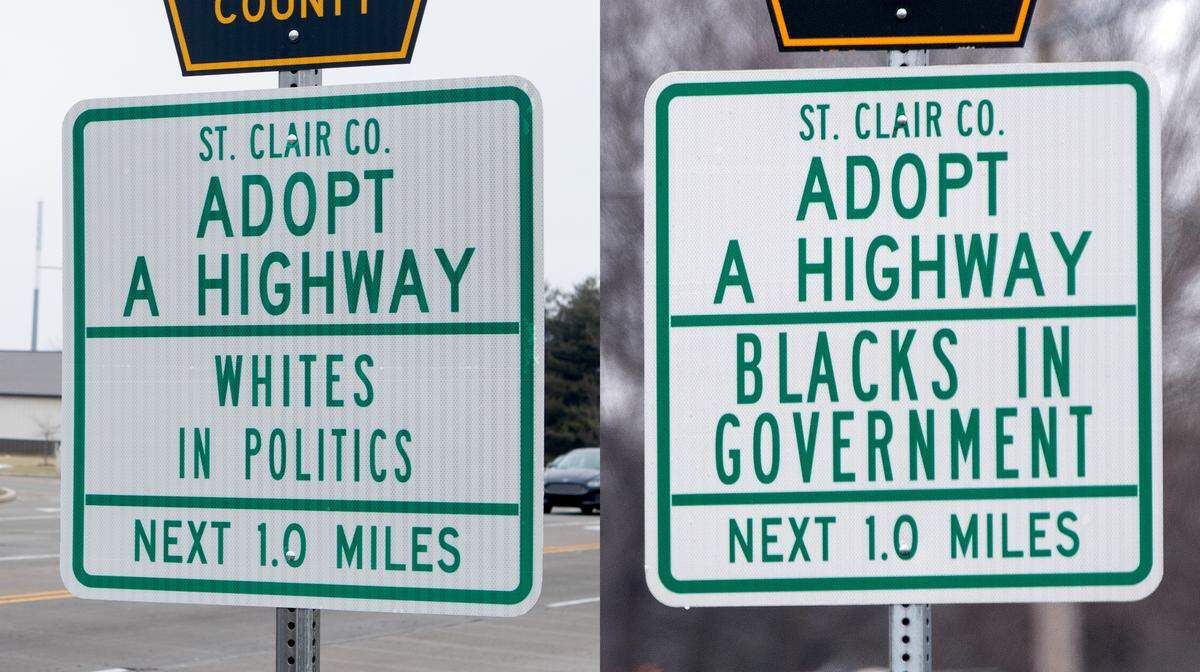
Feud between Kern and Romanik
St. Clair County Board Chairman Mark Kern has not responded to multiple requests for an interview about the county’s decision to end the Adopt a Highway program shortly after Romanik’s “Whites in Government” sign was installed.
Kern and other elected officials often were criticized by Romanik on his radio program.
In February, the Federal Communications Commission rejected an application to renew the license for KQQZ 1190 AM, which was the station that broadcasted Romanik’s controversial talk show.
Kern had sought to have the FCC remove the license for the radio station because he questioned whether Romanik actually controlled KQQZ and three other radio stations and hadn’t disclosed that to the commission.
An FCC administrative law judge permanently dismissed the application to renew KQQZ’s license and three other stations licensed to Entertainment Media Trust because the group’s trustee didn’t show up for an FCC proceeding or file documents the FCC sought.
Romanik, who called himself “The Grim Reaper of Radio,” also has put up billboards in Belleville mocking Kern. In 2011, Romanik was charged with trespassing at Kern’s home on High Street near downtown Belleville but was acquitted of the charge in 2015.
Signs called racist
When J.D. Dixon learned about Romanik’s Adopt a Highway application and the sign’s proximity to the “Blacks in Government” sign, he described Romanik’s motives as racist.
Dixon is a machine operator at Belleville-based Empire Comfort Systems and co-organizer of demonstrations to protest the company’s treatment of Black employees and the company’s workplace safety calendar that featured a drawing he called “racist satire.”
Dixon, who was recently elected president of the union at Empire, said Romanik’s radio show was filled with “racist language.”
“It shows that he did it as an agitator to the Blacks in Government,” Dixon said. “To put it, you know, adjacent to their street, that’s … like a direct hate action towards them.”
In light of the nation’s reckoning with racial injustices since the death of George Floyd on Memorial Day, Dixon said it was troubling to see the “Whites in Politics” signs still on display along the highway this summer.
“Seeing that systemic racism is a problem in our country and that for decades” signs like that have been downplayed as “a ‘joke’ or it’s just ‘inappropriate’ or it’s just ‘unfortunate that it came off like that,’” Dixon said. “No, it’s racism. That’s all it is is hands down racism. There’s nothing else to it. There’s no undertone to it to me at all. It’s just racism, period.”
A representative of Blacks in Government organization could not be reached for comment. The group’s website says it was founded in 1975 and works to “to promote equity, excellence and opportunity through training and education for African Americans in local, state and federal governments and provide opportunities for members/employees to have the ability to maximize their career opportunities and provide a mechanism for inclusion, growth and advocacy.”
Blacks in Government had sponsored a section of Frank Scott Parkway since at least 2010, according to documents released by the county to the BND. The group had the section of Frank Scott Parkway from Old Collinsville Road to Hartman Lane. This section of the parkway is also known as Thouvenot Lane.
Romanik had the section of Frank Scott Parkway from Hartman Lane to North Green Mount Road.
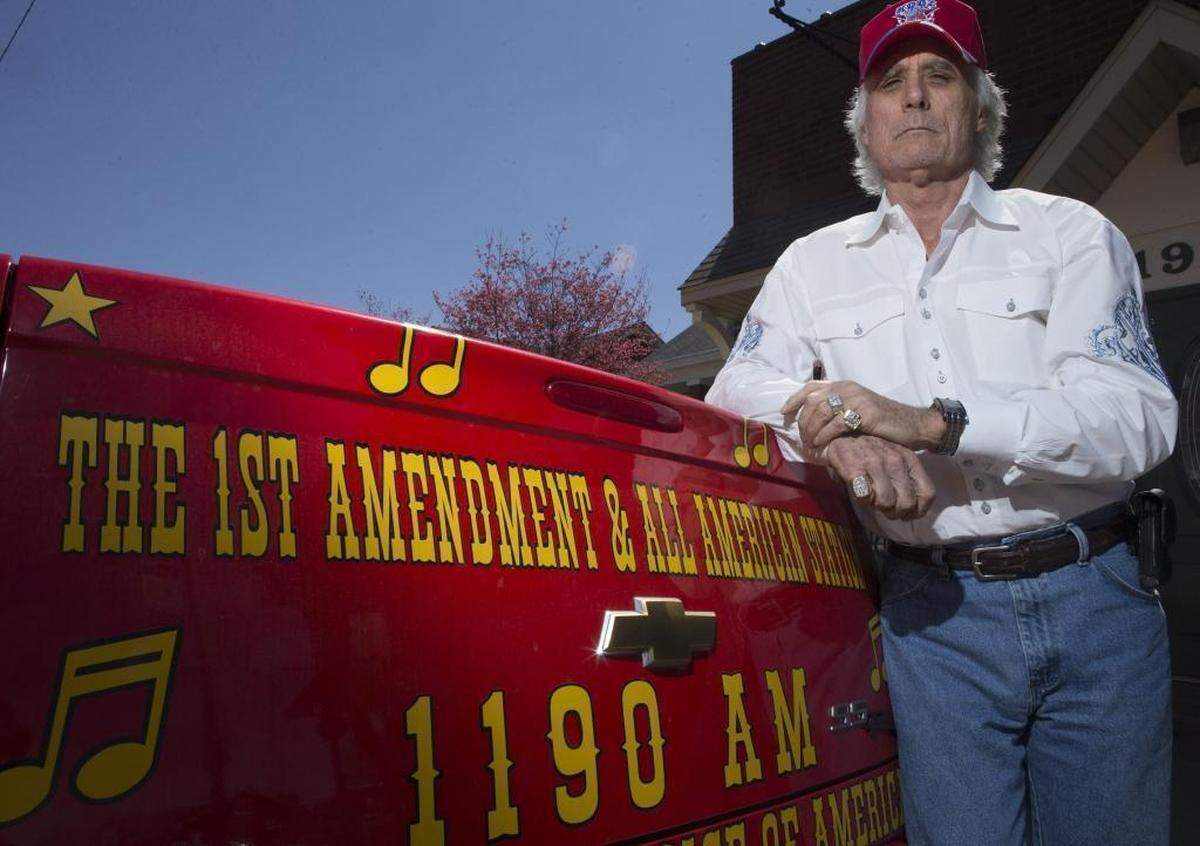
First Amendment issue
One of Romanik’s slogans aired on KQQZ said it was “The First Amendment” radio station. He also has said his use of racial slurs on his radio show was not directed to a race but to a criminal or corrupt element of society.
If St. Clair County had rejected Romanik’s application to be an Adopt a Highway sponsor, the county possibly could have faced a First Amendment fight with Romanik, according to Ed Yohnka, spokesman for the American Civil Liberties Union of Illinois.
“The requirement for government is to operate these types of programs in a way that’s content neutral,” Yohnka said.
“They do have the right to, and the ability to block anything on the roads that is offensive or profane because it is government speech. It’s a form of government speech, they’re the ones paying for and putting up the signs. You cannot deny someone the opportunity to participate in the government program simply because of what they believe, or what they think or what their ideological viewpoint is.”
This story was originally published October 29, 2020 at 5:00 AM.