Lawsuit pits homeowners association against Belleville couple over solar panels
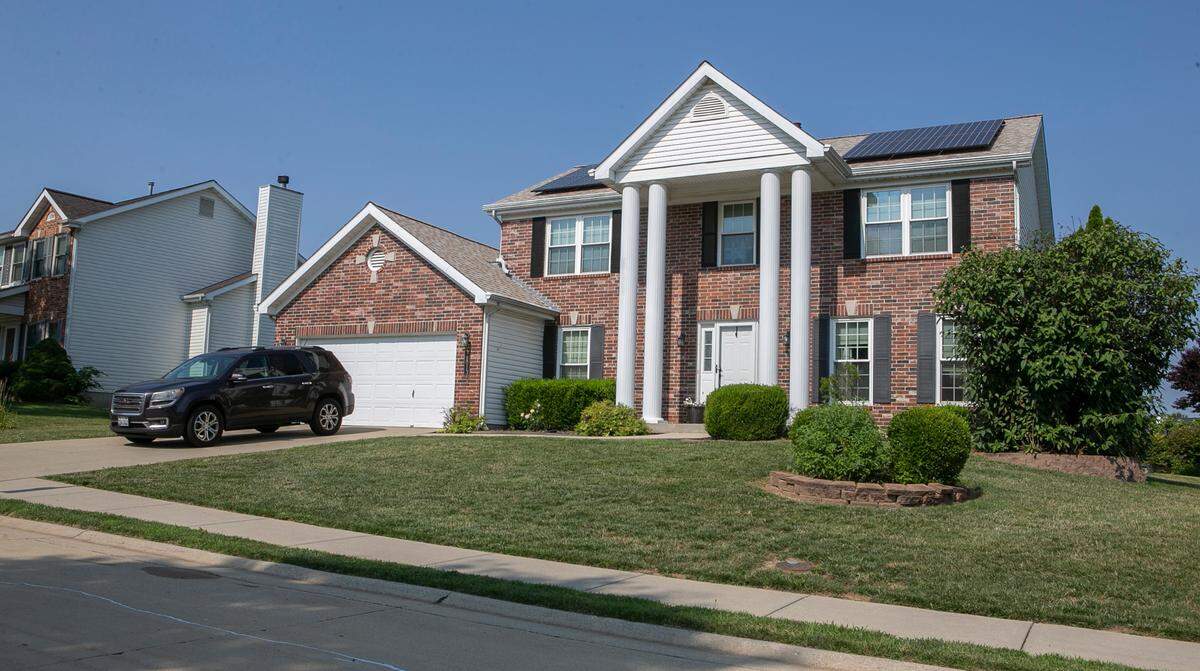
A couple who live in The Orchards subdivision in Belleville are being sued by its homeowners association for installing rooftop solar panels on both the front and back of their home.
The association had rejected half of their plan last fall, pointing to subdivision rules that allow solar panels only on rear-facing roofs for aesthetic reasons.
Jennifer and Mark Bassler went ahead with their full plan in early December. They maintain that Illinois law protects their right to put solar panels where they’re needed to be fully efficient, allowing them to save money on electricity costs and help the environment.
“We love our neighborhood, and we hate to make our homeowners association look bad,” said Jennifer Bassler, 37, a second-grade teacher with two small children. “But at the same time, we have to take care of our family, and in our hearts, we know that this isn’t right.”
The Orchards Homeowners Association filed a civil lawsuit on Dec. 9, 2020. Its amended complaint is asking the St. Clair County Circuit Court to require the Basslers to remove their front-facing panels in accordance with its Solar Energy Policy and other subdivision restrictions and to pay all legal fees.
The couple’s attorney, John Albers, of Shaw Law in Peoria, filed a motion to dismiss the case on March 22, arguing that the association is violating an Illinois law known as the Homeowners’ Energy Policy Statement Act.
The law was enacted in 2011 to keep homeowners associations from adopting measures that would prevent subdivision or condominium residents from installing solar-energy systems, according to its description of legislative intent.
“To me, it is blatantly obvious that if your policy says you can only have solar panels on the back of your house, and it makes no provisions for exceptions (if that placement isn’t feasible), it violates state law,” Albers said. “The law says very clearly that a policy cannot prohibit or have the effect of prohibiting a solar system.”
Associate Judge Julie Katz denied the Basslers’ motion to dismiss the case on May 19 and scheduled a status conference hearing for July 26.

State encourages solar
The Orchards Homeowners Association is a non-profit corporation with a three-member volunteer board. Its day-to-day business is managed by Natalie Stinson, of Pinnacle HOA Management.
On Thursday, Stinson declined to comment on the lawsuit. She referred questions to attorney Mike Wagner of Clayborne & Wagner in Belleville, who didn’t return phone calls.
It’s common for subdivisions to have rules and regulations that people agree to follow when they purchase property. It’s uncommon for homeowners associations to sue over solar panels, according to Albers, a former administrative law judge with the Illinois Commerce Commission.
“To my knowledge, this is the first time anyone has gone to court over (the Homeowners’ Energy Policy Statement Act),” he said.
Since the law was enacted 10 years ago, the state has taken other steps to encourage the transition to renewal energy, offering financial incentives to supplement federal grants and rebates.
Legislation that would amend the law is now awaiting Gov. J.B. Pritzker’s signature. It further strengthens the rights of homeowners to go solar, Albers said.
The Orchards subdivision is built around The Orchards Golf Club, a public 18-hole golf course off Green Mount Road, northeast of Eckert’s. It also has a restaurant and swimming pool.
The Basslers bought their two-story home with white siding and a brick facade on Fairway Drive in March 2020. Mark, a Belleville firefighter, needed to live in the city, and the couple wanted their kids to to attend school in the Mascoutah district, where Jennifer teaches.
“Before we even submitted our request for approval (of the solar-panel installation), we talked to all of our surrounding neighbors, including the two on either side and the three across the street, and all of them were fine with it,” Jennifer Bassler said.
Projects require approval
The Orchards subdivision rules require that improvement projects affecting home exteriors and yards, including solar systems, be approved by the homeowners association, according to the lawsuit.
It argues that the association isn’t trying to keep the Basslers from using rooftop solar panels, only those on the front of their home, facing east.
“(The Homeowners’ Energy Policy Statement Act) permits a HOA to determine the specific location where a solar energy system may be installed on the roof within an orientation to the south or within 45 degrees east or west of due south provided that the determination does not impair the effective operation of the solar energy system,” the lawsuit states.
Paul McKnight, owner of EFS Energy in St. Louis, which installed the Basslers’ system in early December, submitted an affidavit in support of their motion to dismiss the case.
It’s best to place solar panels on south-facing roofs in the Northern Hemisphere because the sun is always along the southern part of the sky, but they can work on the east and west sides, according to the affidavit.
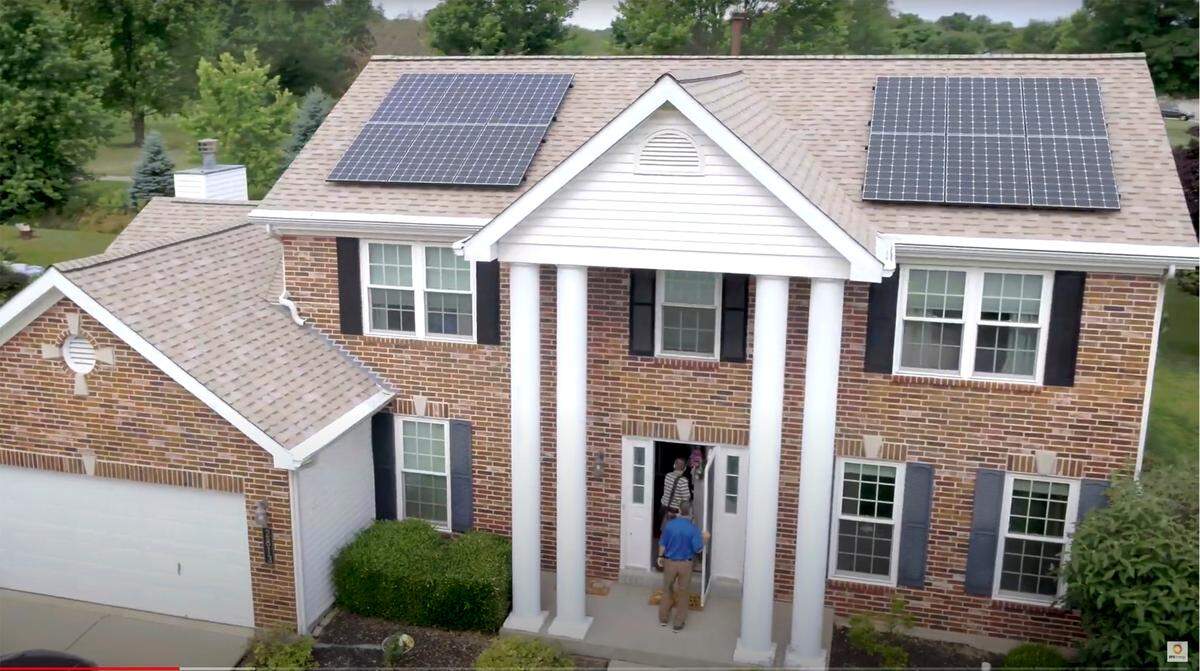
The Basslers’ system, which includes 23 rooftop solar panels in back (west) and 12 in front (east), is designed to produce enough electricity to meet 100% of their energy needs.
“If the Basslers are only able to install panels on the rear roof of their home, the effectiveness of their solar energy system will drop by approximately 35 percent,” McKnight wrote. “Not only because there are fewer panels but also because the remaining panels on the west facing rear roof will only be in direct sunlight for half of the day.”
McKnight also wrote that The Orchards Homeowners Association Solar Energy Policy could keep “numerous” homes in the subdivision from powering with solar due to roof space, tree blockage or angles toward the sun.
In the Basslers’ motion to dismiss, they maintained that the association improperly adopted its subdivision restrictions and that it has selectively enforced its Solar Energy Policy, allowing some residents to put solar panels and equipment on the sides of homes, visible from the street.
The Basslers spent about $40,000 on their solar-energy system, according to Jennifer Bassler. They expect to recoup all but $12,000 through grants, rebates and other government incentives.
Jennifer Bassler described the solar panels as being barely noticeable from the street or other homes in the neighborhood.
“Since we’ve had the panels installed and the system began functioning just after Christmas, we have not had any electric usage, even in the winter,” she said. “Our panels ended up doing better than we thought they would.”