A Belleville landfill has gone unused for decades, but it finally has a new purpose
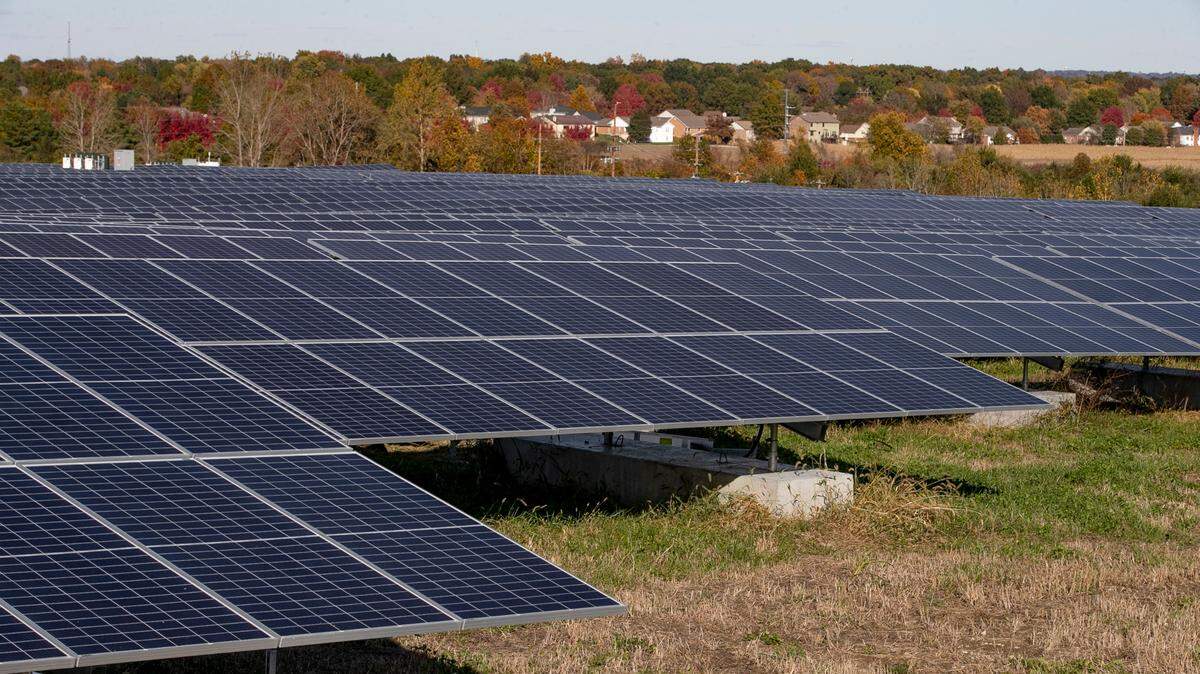
Nearly a hundred rows of huge, shiny black panels face the sun on top of an old landfill overlooking a subdivision in southwestern Belleville.
It’s a solar field that can generate enough energy to power more than 2,000 homes. Wires stretch from the field’s equipment to an electric pole, sending power directly to the grid.
A team of companies developed the site over the past year or so. The landfill operated from 1974 to 1993 and collected more than 2.3 millions tons of waste, according to the U.S. Environmental Protection Agency.
Phoenix-based waste management company Republic Services owns the landfill itself just east of Illinois 159 and Mine Haul Road. Virginia-based electric corporation AES owns and operates the solar equipment, and local crews employed by San Diego-based solar contractor Borrego built the infrastructure.
Energy from the 13-megawatt solar field goes to Ameren’s electric grid and supplies Renewable Energy Credits to it and two other Illinois utilities: ComEd and MidAmerican. The credits allow utilities to measure and account for their clean energy goals.
It converts sunshine into enough solar energy to offset 13,382 metric tons of carbon dioxide, the equivalent of 2,910 gas-powered cars per year, according to AES.
Even on rainy days, the solar arrays work with surprising capacity, said Caleb White, site superintendent for Borrego.
“It’s gotta be pretty overcast and rainy for these not to function at 100%, but they’ll still be putting out over 50,” White said. “You can still get a sunburn when it’s cloudy.”
Once landfills close, there aren’t many uses for them. State and federal regulations require capping them with a liner and thick layers of soil and clay. Rules also bar digging or building.
Solar fields, or arrays, can be an ideal use. They’re relatively lightweight, don’t require a lot of foot traffic and generate renewable energy to displace carbon-emitting fuels that contribute to climate change. Putting solar panels on a landfill means they aren’t taking up valuable farm land. They also generate local property taxes typically paid by the landowners and solar companies leasing the land.
“To be able to make it a source of renewable power to the local community and help the state and utility meet their clean energy objectives, it’s a win-win for everyone,” said AES project manager Joshua Mayer.
The Belleville project is expected to generate millions in local taxes over the next two decades, Mayer said. That revenue comes from $372,000 in Illinois sales tax for purchasing the solar equipment, $61,000 in property taxes for the first year and an estimated $880,000 in property taxes over the next 20 years. Roughly 120 workers were employed to build the array.
The project was financially feasible because of a state program incentivizing companies to build solar arrays, said Brian Martz, Republic’s director of renewable energy development. Illinois awarded the project through a 2019 brownfield solar farm program mandated by the 2016 Future Energy Jobs Act, Mayer said.
Without incentives from the government, it might not make economic sense to develop a solar field on a landfill.
“We have land and we have a willingness to use that land in a way that we think aligns well with it,” Martz said. “We have to continue to provide the environmental security (for the landfill), and because of that, it costs a little more. ... We want to make them work and we think it’s a good solution for the community.”
Republic has seven solar sites nationwide, five of which are on closed landfills.
This story was originally published November 4, 2021 at 7:00 AM.