St. Clair County property tax rates are higher due to an exemption. It’s getting worse
Editor’s note: This story was updated at 12:57 p.m. Thursday with information on the city of O’Fallon.
Some St. Clair County homeowners pay hundreds of dollars more than their neighbors in property taxes because of an exemption they’re not qualified for.
The exemption for disabled veterans went into effect in 2015 and the problem it causes for taxpayers and taxing bodies has been discussed since. Those issues are magnified, however, as the loss of revenue increases year after year.
The provision has two effects, according to St. Clair County Chief Deputy Clerk Dina Thurlow. It increases rates for other taxpayers and reduces the amount of money extended to taxing districts, such as a school district.
The exemption forgives up to 100% of property taxes for disabled veterans depending on the level of their disability as certified by the U.S. Department of Veterans Affairs.
No one is questioning the legitimacy of the exemption. It’s the least the state can do for a veteran who was injured during service, said state Rep. Jay Hoffman, D-Swansea, at a March hearing in Springfield. He called the law that created the exemption “historic” in its support for veterans.
Those who qualify for it might not be able to work because of a disability or otherwise afford a family home, said Keith Wetherell, executive director of veterans advocacy group Illinois AMVETS.
“They got a disability because of their service and they should be taken care of the rest of their lives, and that includes property tax exemptions,” Wetherell said.
But in communities with large veteran populations, residents who are not eligible and local entities that depend on property tax revenue, such as schools, end up “getting hit unreasonably hard,” Hoffman said.
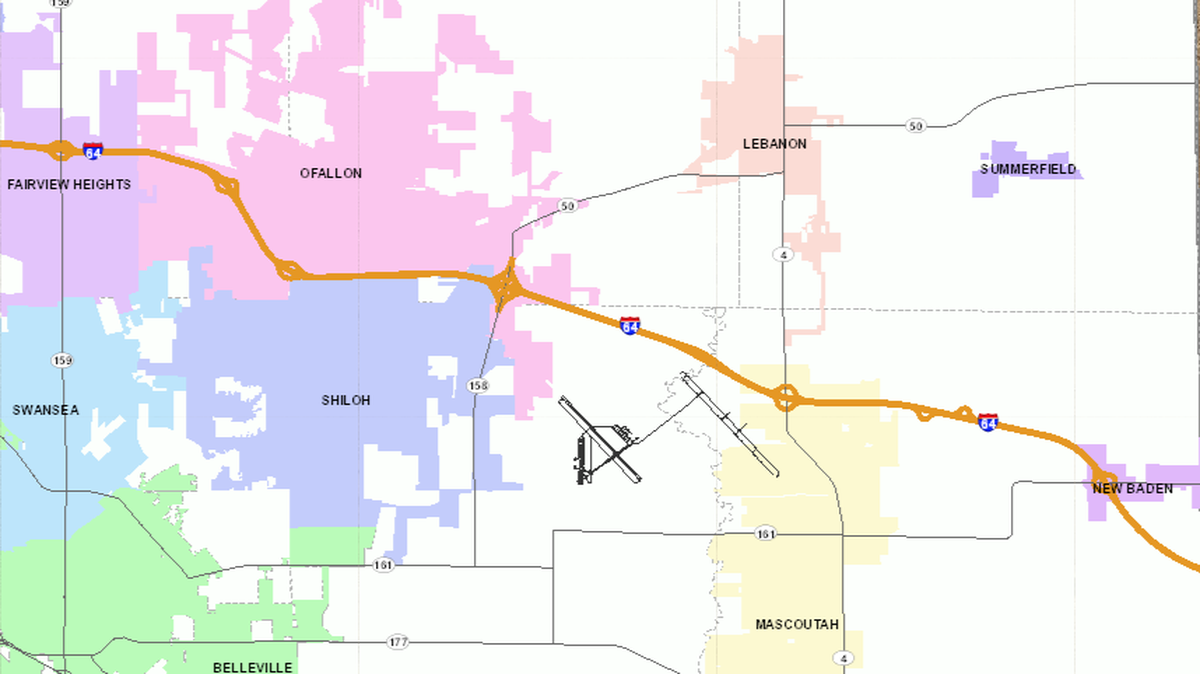
It’s not a huge problem in most Illinois counties, where the veteran population is relatively low. But St. Clair, home to Scott Air Force Base has an eligible population second only to Cook County, which is 20 times bigger.
In 2020, there were nearly 3,000 parcels in St. Clair County that didn’t have any property tax due, or 2.5% of all housing units, compared to roughly 6,100 in Cook County, or about 0.3%. Lake County in northern Illinois, where there’s a U.S. Navy boot camp, comes in third with 2,300 parcels.
“We love that we have our military base and we love that our veterans want to live here, but it is causing a property tax shift to taxpayers that are not entitled to that exemption or else property taxing districts are simply not getting funds,” St. Clair County Assessor Jennifer Gomric Minton said at the hearing.
Veterans exemption costs schools
School districts can only tax so much under a maximum rate. When there’s less property value to tax at the maximum rate, there’s less money coming in.
In 2020, the exemption cost O’Fallon Township High School $1.4 million, according to Superintendent Darcy Benway. That’s a 248% increase in losses from 2015.
“It grows significantly every year,” Benway said in an email.
Since 2018, Belleville District 118 has missed out on $1.6 million in revenue because of the exemption, according to Superintendent Ryan Boike. In 2021, the district lost $509,271, an amount that could cover wages of seven middle-income teachers. The median total wages for District 118 teachers was just over $70,700 the fiscal year that ended June 30, 2021, according to the BND’s Public Pay Database.
O’Fallon School District 90 has lost a total of $8.8 million since 2015, according to the district’s business manager. In 2021, the district lost $1.8 million. The average teacher earned just over $53,870 that same year, the district’s Illinois Report Card shows.
St. Clair County Regional Superintendent Mark Eichenlaub said any relief the legislature could provide would help.
“The legislation is good legislation from the standpoint that we should do everything we can for those that serve for us. There’s nobody who disagrees with that whatsoever,” Eichenlaub said. “The issue is when legislators decide that they want to make good legislation but at the cost of other things.”
Exemption costs taxpayers
Schools aren’t the only ones to be affected. The exemption also impacts counties, townships, municipalities, fire districts and libraries.
St. Clair County last year lost $234 million of equalized assessed value in 2020 to the exemptions. Because of those losses, Thurlow estimates a person who doesn’t qualify for the exemption could be paying as much as $400 more on a $250,000 house in O’Fallon.
Equalized assessed value is the value of a property used to set calculate taxes. It’s called “equalized” because the assessor multiplies a property’s assessed value by a factor usually close to one as needed. This ensures uniformity in assessments across the state.
The basic logic goes that when one group of property owners doesn’t have to pay taxes, everyone else has to make up for it, Gomric Minton said. The lower the equalized assessed value, the higher the tax rate.
“If a school district wants $100 and there’s 10 taxpayers, everyone pays $10,” Gomric Minton said. “If you have five people who don’t pay anything, the other five people have to pay $20.”
In O’Fallon, disabled veterans exemptions account for 13% of the residential property value, according to Gomric Minton. That amounts to $3.5 million annually in lost equalized assessed value for the school districts there.
If the exemption didn’t exist, the city of Belleville and its library district would have had a tax rate of 2.5861% for 2020 instead of 2.7276%, according to finance director Jamie Maitret. The city collected the same amount of money as it would have without the exemption, so it didn’t lose money to the exemption like school districts do, Maitret said. But since there were fewer people to pay, the tax rate had to be increased to meet the district’s levy.
In O’Fallon, the city reduces the amount it requests from taxpayers each year so their rates won’t go up, said City Administrator Walter Denton. The city forfeited nearly $1.4 million in 2020, up from just over $394,000 in 2015.
The number of eligible veterans in St. Clair County is growing. The county expects to account for 5,200 eligible veterans and a lost equalized assessed value of more than $300 million in 2021, the assessor said. When the exemption started in 2015, there were only 2,700 eligible veterans with $95 million in equalized assessed value, Gomric Minton said.
State legislators must find a solution, said St. Clair County Clerk Thomas Holbrook.
“You need to provide some state revenue to offset that,” Holbrook said, “because your average taxpayer that’s not on that (exemption) is picking up the balance.”
Hoffman said the cost “really should be borne by the entire state.”
“The idea would be the rest of the taxpayers have some type of a state fund that could be applied for to get reimbursed the amount of money that they possibly are paying. We passed the bill. The counties didn’t, and the counties and the school districts are suffering as a result of it.”
Hoffman said he’s looking at legislative solutions to the problem. The House was expected to be in session until April 8.
Wetherell of Illinois AMVETS said his organization would support any solution to resolving the shortfall so long as it doesn’t impact the exemption.
“This helps them to survive on a day-to-day basis,” Wetherell said.
This story was originally published April 5, 2022 at 5:00 AM.