Edwardsville warehouse columns came loose like ‘a peg coming out of a hole,’ engineer says
It was an uncommonly warm December afternoon with severe storms looming when Fire Marshal Dan Bruno got a call from the West County EMS and Fire battalion chief.
Battalion Chief Bob Kartje asked if Bruno would be available to respond if the weather caused any damaging tornadoes later that day as expected. He said he would be.
Six hours later, Bruno would be heading to Edwardsville, where six people had been killed when a tornado tore through an Amazon warehouse.
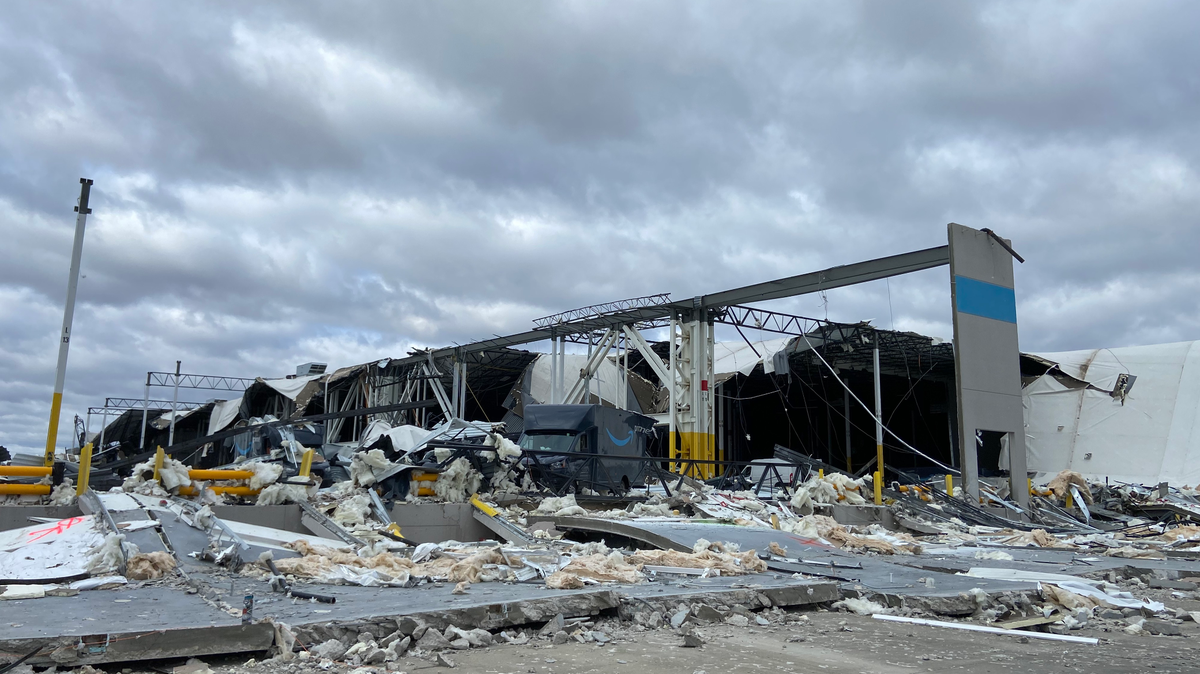
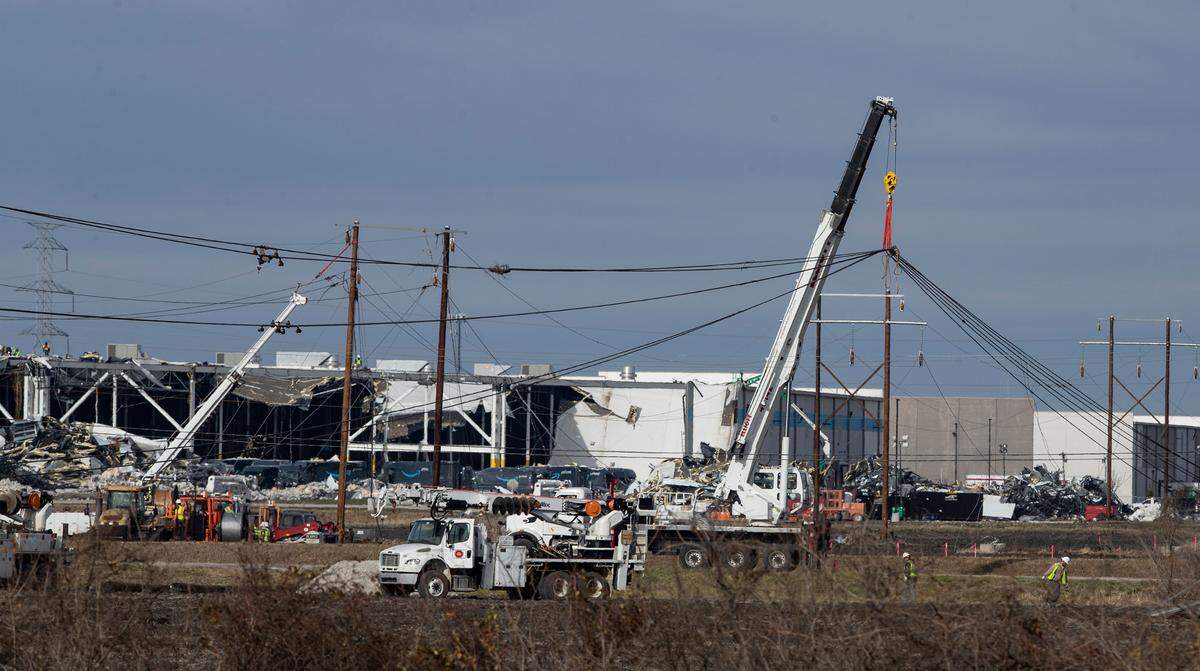
The EF-3 tornado hit the 1.1-million-square-foot Amazon warehouse on Gateway Commerce Drive, along Interstate 255, at around 8:30 p.m. Winds of up to 150 miles per hour caused the concrete walls and roof to collapse. The facility had no storm shelters built to withstand a tornado.
Bruno’s account of the tornadic night and its deadly impact were recently released through an open records request. His review of the destruction showed columns used to support the roof were lifted like “a peg coming out of a hole” without any resistance, raising concerns that the columns were not secured.
“Having seen a lot of tilt-up construction, the method of installation of those columns was nothing I had seen before and appeared to be void of restraint against vertical movement,” Bruno said in an emailed statement.
Several days after the tornado, Bruno found out about product that had been in use since 2018 or 2019, he said. Its design uses sleeves in the floor to slide columns into, expediting construction. But the design requires the columns to be secured to the sleeves.
“I found none,” Bruno said.
The findings are evidence that the building wasn’t built appropriately, and that Amazon neglected to ensure its integrity, said Jack Casciato, a Chicago attorney suing Amazon and the companies that constructed the warehouse on behalf of a family whose son died.
“How can you have workers working in a building where you know these support columns, or should know, these support columns are not properly anchored?” Casciato said in a news conference Tuesday.
Amazon says it’s too soon to draw conclusions. The company continues its own internal “forensic investigation” of the building and debris, said spokeswoman Kelly Nantel in an emailed statement. Edwardsville officials inspected and approved the building in 2020 when Amazon began leasing it. The structure was also approved in 2018 when construction was completed.
“So it’s premature and misleading to suggest there were any structural issues,” Nantel said.
Structures, steel and concrete
While Bruno works for West County, he responded to the collapse as a civil engineer and as a structures specialist trained by the Federal Emergency Management Agency. FEMA pays to maintain groups in urban areas called “Strike Teams. They’re made up of first responders who are trained and constantly ready to quickly address big emergencies.
A structures specialist is trained to assesses damage, advise on how to rescue trapped people and keep first responders safe. While pursuing his civil engineering degree, Bruno studied structures, steel, concrete and engineering mechanics, he said. In his nine years at West County, he has kept up-to-date on codes.
His purpose at the warehouse that night was to assess the risks for first responders as they worked to rescue people from the dangerous wreckage, Bruno said in an emailed statement.
“Knowing how things are connect or remain connected provides key information on which directions of movement are or remain possible,” Bruno said. “While I make no assessment as to the overall competence of the original design, I must assess what moved, what could still move, what forces will act upon the structure and how to mitigate those imminent forces and movement so that search and rescue can take place.”
Bruno worried there was further risk of collapse because the columns didn’t appear to be secured. It would have been one thing if a tornado had ripped them out, but that’s not what appeared to have happened. They could continue to fall even without tornado-strength winds, putting first responders at risk, he said.
“I could find no weld or bolted connection at the base of any column, but only a bead of what appeared to be some sort of caulk around the column at the finished floor line,” Bruno wrote in his report.
Cadaver dogs and crushed Amazon vans
Bruno’s priority on the night of the storms was to make sure his family and home were safe, according to his report. Having ensured their safety, he headed to his West County station office to monitor the storm’s effects.
Around 9:15 p.m., he heard a dispatch calling for help in Edwardsville for a commercial building collapse. Crews gathered at the station and learned as much information as they could before heading to the scene.
On his way to the warehouse, Bruno watched a live video from Fox2 News, a St. Louis television station, he said in his report. He noticed at least two sides of the building had collapsed. An additional dispatch told crews at least 350 feet of the wall had fallen and up to 20 people were unaccounted for.
When he arrived, Bruno noticed the north half of the building remained standing while the south half had mostly collapsed. During his inspection of the ruins, he noticed dozens of Amazon delivery vans had been flattened “to only 1 or 2 feet tall at most.” He saw “several dozen columns” still stood in the middle of the building and that some roof supports were still hanging.
“But what appeared to be a majority of the columns and roof trusses and girders had failed or were missing from view,” Bruno wrote in his report.
As a tow truck lifted a wall panel on the west side where people might be trapped, Bruno entered the wreckage with a fellow engineer and structures specialist, Allen Smith, according to the report.
Bruno’s attention was drawn by the columns that had fallen. He noticed “a considerable number” of the columns “appeared to have been lifted out of the floor.” Other columns “were partially raised out of the floor and laid over,” but not torn or ripped out of their bases. This suggested the columns weren’t secured.
The International Building Code requires columns such as those to be secured to prevent wind from lifting them up. The code, widely used in the United States, suggests minimum building requirements for safety. While the newest versions recommend enforced storm shelters, Edwardsville uses the 2006 version, St. Louis Public Radio reported in February.
The 2006 version still requires columns to be secured, Bruno said in his report.
At around 1:30 a.m., “cadaver” dogs found an area where bodies might be near the south wall. Bruno advised the safest way to access the area would be to use heavy machinery to lift up concrete walls section by section until they could reach the bodies. A man who was there to operate the machinery agreed. He said he helped construct the building.
Around 3:15 a.m., Metro West Fire Protection District Battlion Chief Mike Digman told Bruno the operation was no longer attempting to rescue anyone. They would focus on recovery, and Bruno could leave.
Bruno’s work wasn’t done, though. On the following Monday, he visited several similarly constructed facilities in the area and studied their building plans “to determine how their interior columns were secured against uplift.” Bruno didn’t find any designs that showed a column fitting into “a sleeve.”
The next day, Bruno told fire Chief Jeff Sadtler he had found “what I believed to be one or more significant structural issues with the Amazon building that may have contributed to the failure of the structure.” The chief said a local representative with the Occupational Safety and Health Administration would like to talk with Bruno.
Bruno shared his findings and photos with OSHA as well as with the Edwardsville fire chief. He said his findings were “advisory only,” and should be analyzed further to reach conclusions on if the building was constructed properly.
Additional lawsuits possible
Casciato said additional lawsuits may be filed against Amazon and the construction companies in coming weeks, and Illinois lawmakers were reviewing the possibility of changing warehouse code requirements. A bill to create a warehouse safety task force was stalled under consideration as of mid-April.
Meantime, the parents of 26-year-old Austin McEwen of Edwardsville are “wonderful people” who felt a sense of confidence in the engineer’s report, Casciato said.
“It’s upsetting to them but at the same time it instills a level of confidence in what they’re pursuing,” Casciato said.
The lawsuit names Amazon as well as the companies that constructed the warehouse as defendants: Contegra Construction Co. in Edwardsville and TriStar Properties in St. Louis. A lawyer for Contegra said the company wouldn’t comment on “specifics of the lawsuit,” but said it is “without merit.”
“We stand behind our company’s record of quality construction. We are not aware of any code violations at the Amazon fulfillment center,” said St. Louis attorney Michael Wilson. ”We are heartbroken by the devastation of the tornado to our community and those who lost their lives or property, and we believe the allegations in this lawsuit against Contegra are without merit. Contegra will vigorously defend our company’s work and our reputation.”
Representatives from the TriStar did not respond to requests for comment.
This story was originally published April 12, 2022 at 12:41 PM.