Family begged for help with son’s mental illness. Now he’s charged with Belleville murder
An East Alton man charged in a Belleville stabbing death on July 20 had told his family, friends, police officers and mental-health professionals that he was going to kill someone.
Specifically, Bailey Hamor, 26, spoke of killing a Granite City child molester, a rapist and Russian and German soldiers he believed were trying to “assassinate” him, according to family members.
“He’s diagnosed with paranoid schizophrenia,” said his father, Robert Hamor, 56, who Bailey Hamor lived with and worked for at Hamor Landscaping and Retaining Walls.
Robert Hamor said his son has spent time in hospital psychiatric units and drug-treatment centers and benefits from medication, but he loses his grip on reality at times. His delusions became more disturbing in recent weeks, prompting family and even Bailey Hamor himself to call 911 about his homicidal thoughts.
Family members said they repeatedly begged authorities to put Bailey Hamor into a long-term treatment facility but were told that beds weren’t available, he didn’t meet the criteria or he couldn’t be involuntarily committed if he wasn’t an immediate danger.
St. Clair County sheriff’s deputies answered one of the family’s 911 calls about 10 p.m. July 19. Three hours later, they returned to the home of Bailey Hamor’s mother and stepfather in unincorporated Belleville and arrested him for allegedly stabbing a man to death in the garage.
“The system failed us,” Robert Hamor said, adding that he feels terrible for the family of the victim, James L. Goodwin.
“My mom is so mad. She saw Bailey struggling. She saw him begging for help. What is wrong with the law in Illinois? Somebody is mentally ill, and they’re saying they’re going to kill someone, and (a hospital) can only keep them for three days? It’s ridiculous.”
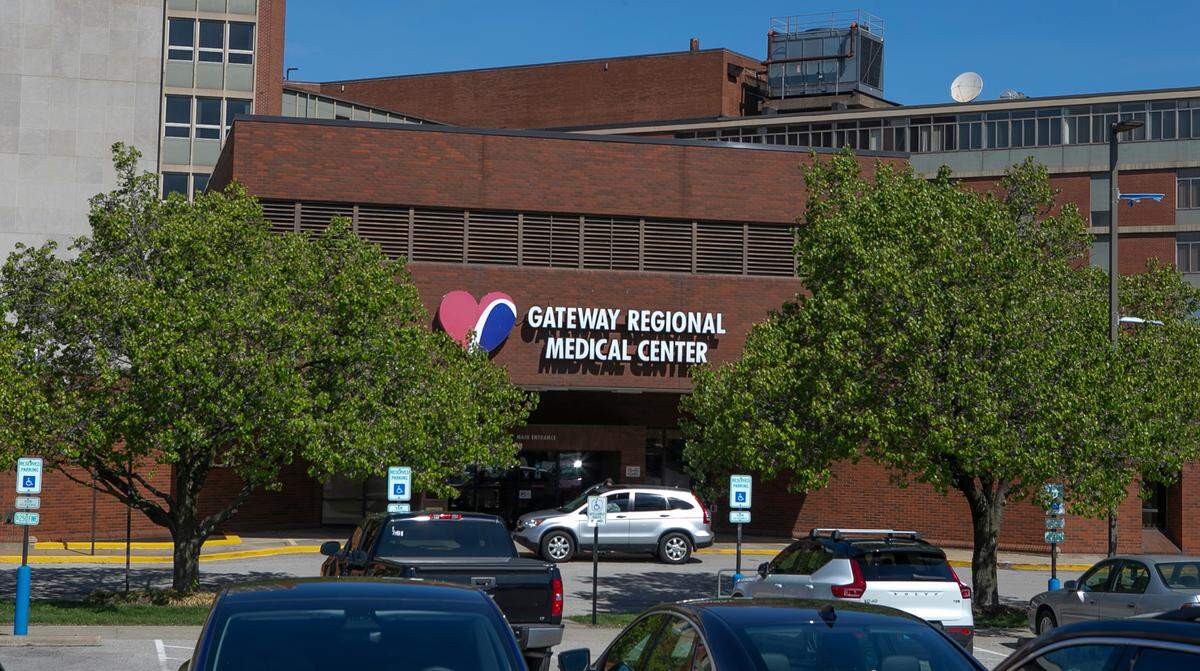
Robert Hamor was referring to the fact that psychiatric units often release Bailey Hamor after three days. He said that’s what happened at Gateway Regional Medical Center in Granite City in mid-July, despite signs that his son was unstable.
Under Illinois law, when police take people to hospitals for psychiatric treatment, staffs can forcibly keep them by preparing petitions showing that they meet involuntary commitment criteria, but those petitions must be filed in court within 72 hours for stays to continue.
Suspect in ‘quiet room’ at jail
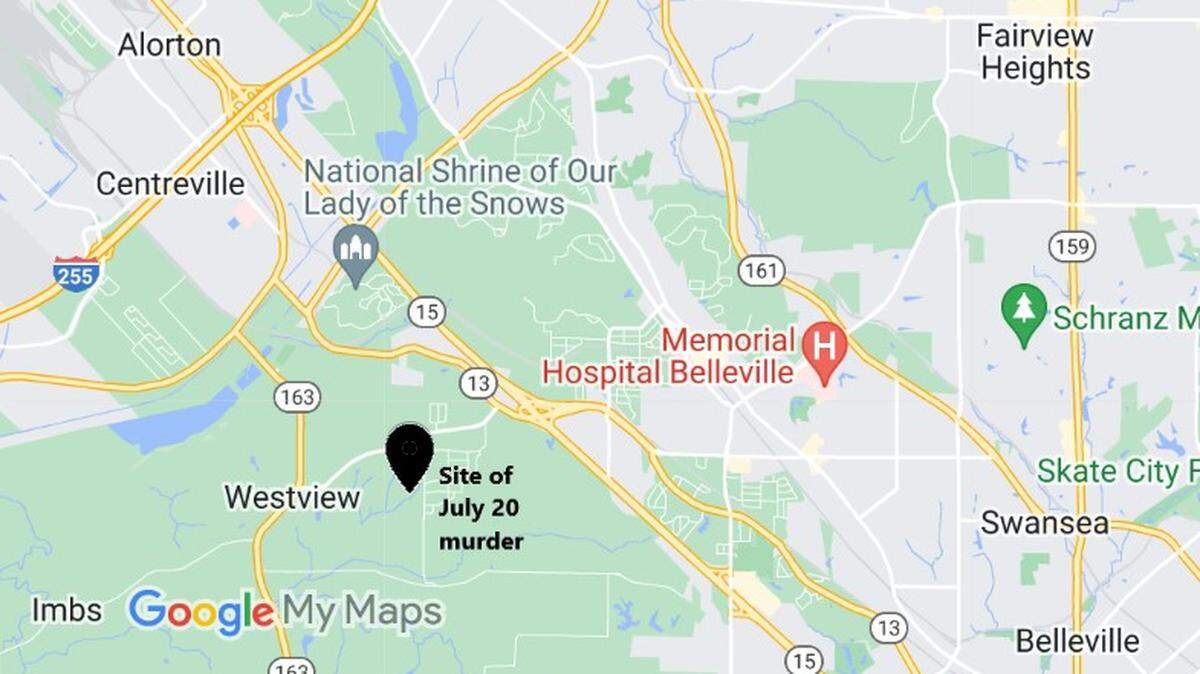
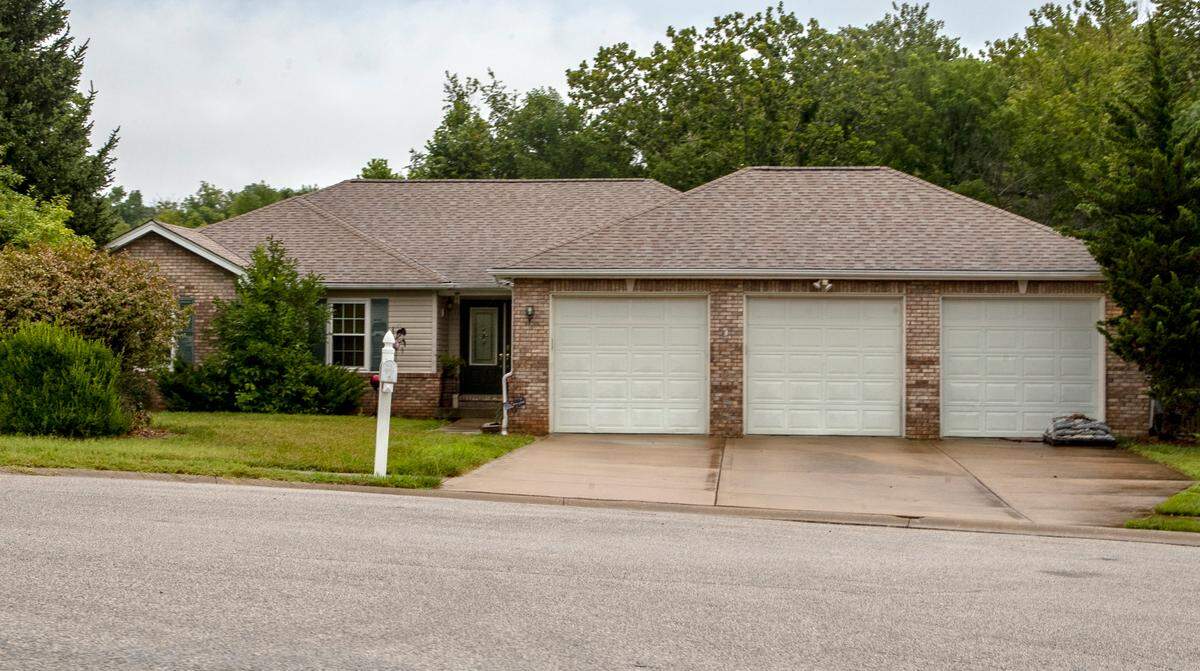
The St. Clair County state’s attorney’s office charged Bailey Hamor on July 20 with first-degree murder in the death of Goodwin, 33, of Belleville. Sheriff’s deputies had found his body early that morning outside a home at 1034 Golfview Court.
Goodwin was a friend of Bailey Hamor’s mother, Cheri Koene, who lives in the home with her husband, Leonardus “Loek” Koene. They declined comment for this story.
“(Bailey R. Hamor) stabbed James Goodwin about the head and body with a knife, thereby causing the death of James Goodwin,” states the complaint filed in St. Clair County Circuit Court.
The case is under investigation. Authorities haven’t publicly discussed a motive. Bailey Hamor is being held in the St. Clair County Jail on a $2 million bond. Robert Hamor said jail employees have told him that his son is in a “quiet room” and can’t speak to outsiders.
Goodwin lived on Cascade Drive in Belleville. He was the son of the late Melody (Bohannon) Goodwin, according to his obituary with Kalmer Memorial Services in Lebanon. He’s survived by two brothers, Ian and Joe Bohannon, a niece, a grandfather, uncles and cousins.
The obituary provided no further information about Goodwin. His visitation was held Wednesday, July 27. Family members couldn’t be reached for comment.
“I was shocked (about the stabbing), but I can’t say it was a surprise, to be honest,” said Nick Sternfeld, 24, of Wood River, a drummer who formerly played in a band with Bailey Hamor.
“It just felt like something was bound to happen, just from his behavior. He just seemed very detached since I got back in touch with him (in the past year). He was into his guns and weapons. He used to be into playing music and reading books.”
Ineligible to possess firearms
The St. Clair County state’s attorney’s office charged Bailey Hamor on Jan. 16 with possessing firearms while ineligible for an Illinois Firearms Identification Card, a felony, according to court records. Sheriff’s deputies had confiscated guns and a safe from his room at his mother’s home two days earlier.
It’s not known what made Bailey Hamor ineligible for a FOID card. The Illinois State Police is legally prohibited from releasing that information, according to spokesman Master Sgt. Chris Watson.
Reasons for FOID card ineligibility can include mental-health issues, drug addiction and convictions for felonies or domestic battery, the ISP website states.
Bailey Hamor was charged Sept. 21, 2021, with first-degree assault and armed criminal action in St. Louis County Circuit Court for allegedly shooting a man in the leg, but the case was dropped in May, according to court spokesman John OSullivan. Robert Hamor said his son was defending a female friend from her abusive husband.
“The state’s witness never showed up, so the motion to dismiss the case was approved,” OSullivan said.
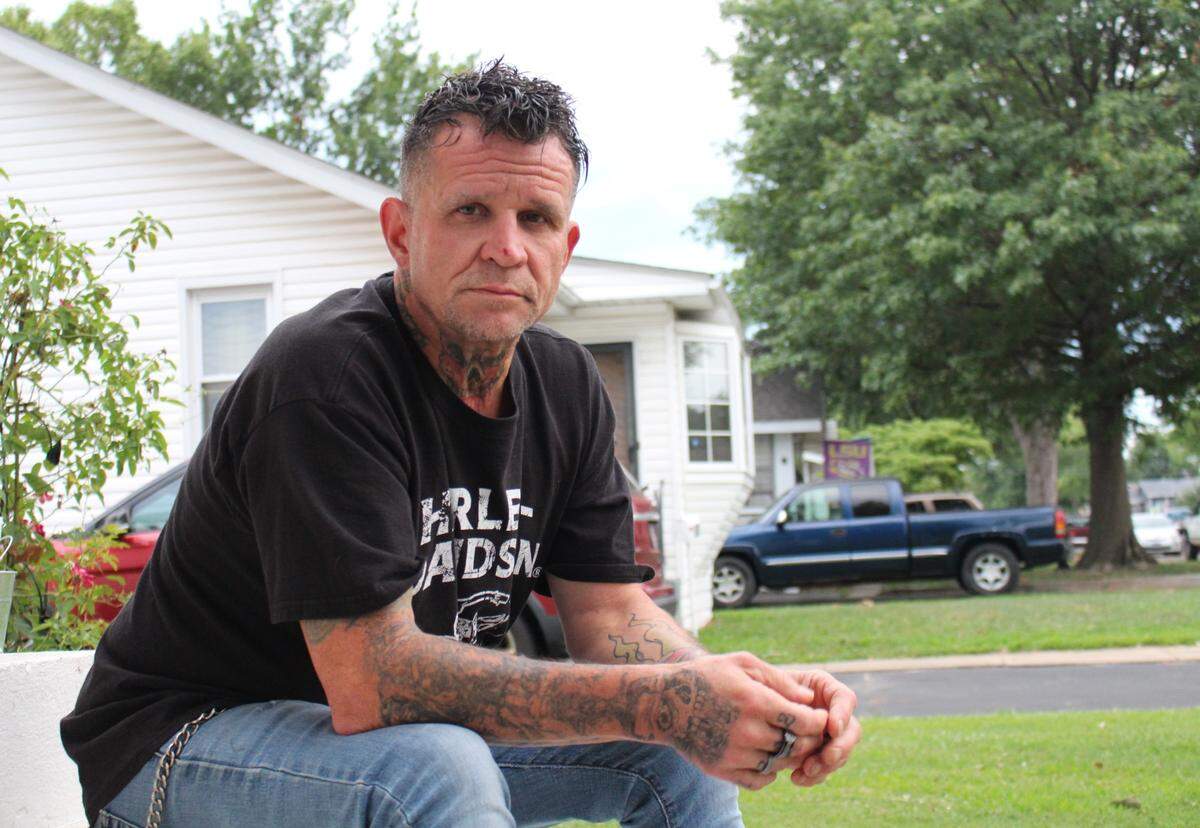
Robert Hamor said his son has seemed particularly affected by TV images of Russians invading Ukraine, and he frequently called military recruiters, offering to sign up and help on the battlefield. He owned a gas mask, bulletproof jacket, metal chest shield and other combat gear.
One afternoon, Bailey Hamor was helping to cut down a tree, heard a blast in the distance, became delusional and insisted that Germany had been “annihilated” before bursting into tears, his father said.
Bailey Hamor’s Facebook posts in July ranged from detailed, well-written explanations of his anti-abortion stance and his plan for reducing gun violence to expressions of his Christian faith, Bible verses and comments about his mental illness.
“I’m so tired of being f---ing schizophrenic,” he wrote on July 5. “I’m seriously crying about it.”
Police called to home twice
Golfview Court is a quiet cul-de-sac in an unincorporated area west of Belleville, near Elmwood Golf Course on Eiler Road. St. Clair County sheriff’s deputies and Millstadt EMS personnel responded to a 911 call from the Koene home about 10 p.m. Tuesday, July 19.
Cheri Koene expressed concern about her son’s behavior, but an EMS evaluation determined that he “wasn’t a danger to himself or others,” according to Capt. Bruce Fleshren, sheriff’s department spokesman.
“The police can do very little,” he said. “We have certified intervention officers who can commit somebody involuntarily, but it’s for three days. Generally, it’s a walk-in and walk-out situation. We still do it at times, but (subjects) still have to be evaluated, and they still have to meet certain criteria.
“Just because a mom or a family member says this or that happened, if a person is lucid and answering questions with responses that are coherent, there’s not a whole lot we can do.”
Fleshren pointed out that the trend in mental health has been to eliminate facilities that “house” people long term in favor of outpatient services.
The Koenes made a second 911 call from their home at 12:54 a.m. Wednesday, July 20, to report Goodwin’s death. Deputies arrived four minutes later to find his body lying in a pool of blood at the entrance of the three-car garage.
Belleville and Millstadt police departments and Smithton’s K-9 officer and his dog also were dispatched to the scene to help with the search for Bailey Hamor.
“The suspect was still on foot in the area, said to be armed with at least one knife, wearing fatigue camouflage clothing, body armor and a ballistic helmet with light,” Belleville’s incident report stated.
The search crew found Bailey Hamor about 1:50 a.m. in nearby woods and arrested him, police said.
Years of treatment and rehab
Bailey Hamor grew up in East Alton, played Alton Renegades football and attended East Alton-Wood River Community High School.
His father said he was an excellent student but got expelled his junior year after a fight and earned a GED before enrolling at Southwestern Illinois College to study music then deciding to work as a carpenter.
Bailey Hamor also is a skilled guitar player, according to Robert Hamor and former bandmate Sternfeld. He enjoyed going to the gym and attending concerts but mostly hung out at home with his father and stepmother, Savana Hamor, when not visiting his mother and stepfather in Belleville.
“He was so smart and gifted,” Robert Hamor said. “When he was in fifth grade, he was reading entry-level college books.”
Bailey Hamor was diagnosed with paranoid schizophrenia about four years ago, according to his father. He has been in and out of psychiatric units, mostly at Gateway and Touchette Regional Hospital in Centreville, and saw a psychiatrist regularly at Touchette.
Spokesmen for both hospitals declined to comment on the case.
“Under federal HIPAA (Health Insurance Portability and Accountability Act) law, we can neither confirm or deny anyone’s health records,” said Steve Tomaszewski, Touchette’s spokesman.
Robert Hamor said Bailey Hamor also has spent time in rehab centers for methamphetamine and alcohol problems. The Madison County state’s attorney’s office charged him with meth possession in 2016. The charge was later dropped with a notation in court records that he had undergone residential treatment.
Despite all his issues, Bailey Hamor still has periods of relative normalcy, according to his father, who describes him as a respectful, sensitive, compassionate and loving “kid” who reads the Bible regularly and recently was baptized in the Church of Jesus Christ of Latter-day Saints.
“He’s my best friend, and I’m his best friend,” said Robert Hamor, noting he had his own problems with drug addiction before turning his life around several years ago. “You can’t get any closer than us.”
Robert Hamor said he’s speaking publicly about his son’s struggle with mental illness because he wants other people to know about problems with the system.
“I just hope this can change something and that no other family has to go through this,” he said. “I’m going crazy, and I have a great support system. This is a nightmare.”
65 police contacts in hometown
Metro-east and St. Louis police departments have filed more than 100 incident reports involving Bailey Hamor, not including traffic tickets.
East Alton police made 65 contacts from Nov. 8, 2013, to July 19, 2022. The vast majority were for welfare checks, disturbances, suspicious behavior, disorderly conduct or domestic disputes. A few resulted in arrests for battery, trespassing or possession of drug paraphernalia.
The BND took a closer look at incidents involving Bailey Hamor in July, starting on July 6, when a neighbor called East Alton police to complain that he had come into her yard and accused her of being a racist because she was flying a Confederate flag.
“(The officer) knows Hamor to suffer from mental health related issues,” the report stated.
Police warned Bailey Hamor not to trespass again on the woman’s property. Later that day, they returned to the Hamor home on Lincoln Avenue due to an argument between Robert Hamor and his son.
On July 8, East Alton police responded to a call from Robert Hamor, who told them that his son and two friends refused to leave his home after a confrontation in which Bailey Hamor threw away his father’s motorcycle helmet because he thought it was a Nazi war helmet.
Robert Hamor said East Alton Police Chief Scott Golike showed up at his home personally for that visit and seemed to think Bailey Hamor was troubled but also manipulating the situation.
Golike didn’t return calls for comment for this story.
On July 11, East Alton police checked on Bailey Hamor’s welfare upon request by his mother. He apparently had lost his cellphone.
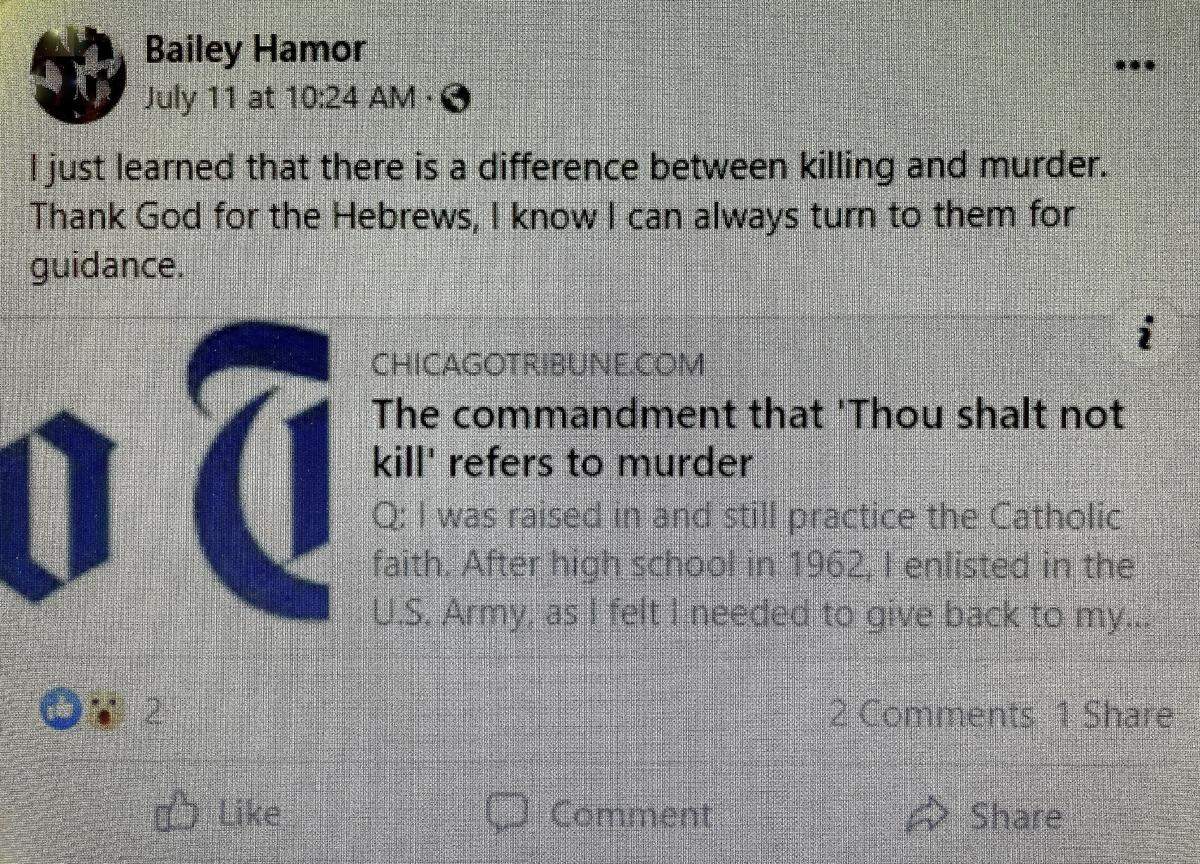
The same day, Bailey Hamor posted a link to a newspaper Q&A column that discussed the context of the commandment “Thou shalt not kill” on one of his Facebook pages. The columnist argued that killings by soldiers and others with moral justification isn’t murder.
“I just learned that there is a difference between killing and murder,” Bailey Hamor wrote. “Thank God for the Hebrews, I know I can always turn to them for guidance.”
Last hospitalization at Gateway
On the night of July 11, Bailey Hamor called 911 from his silver Nissan Altima as he traveled southbound on Illinois 255. He was identified as a “homicidal male” in a incident report by Roxana Police Department, the responding agency.
When asked about weapons, Bailey Hamor told officers he had a knife, and they found it on the right side of his waist, according to the report.
“I asked Bailey why he was having homicidal thoughts,” an officer wrote. “Bailey said he was on his way to Granite City to kill a guy for raping a female. I asked Bailey who he was trying to kill. Bailey said he just keeps having thoughts that he needs to kill this guy for raping a female.
“Bailey reported he did not know the person he wanted to kill but he feels like the person was raping a female.”
The officer arranged for Bailey Hamor to be transported to Gateway Regional Medical Center by ambulance for psychiatric evaluation, and he went voluntarily.
According to Robert Hamor, Bailey Hamor spent three days in the hospital’s psychiatric unit and told him during a phone call that there was a scaly “demon” in his room that was ordering him to kill someone.
Robert Hamor said a doctor later called to tell him that his son was being released on July 14 but warned that Bailey Hamor had been making “death threats” against his father, and Robert Hamor objected to the release.
“(The doctor) said, ‘I would suggest you get an order of protection. It’s for your own good,’” Robert Hamor said.
More ‘homicidal statements’
On Friday evening, July 15, Robert Hamor called East Alton police to warn that his son was making “homicidal statements” about an unknown suspect in Granite City who had supposedly hurt a female.
Officers arrested Bailey Hamor after he spit whiskey in his father’s face in their presence and later broke a wall panel and cabinet at the police station, according to the incident report.
“Bailey continued to state that he only wanted to kill the individual in question and nobody else,” the report stated.
The Madison County state’s attorney’s office charged Bailey Hamor, who had spent the weekend in jail, with battery and criminal damage to property on Monday, July 18, according to court records. A judge set bond at $50,000.
Bailey Hamor was released on his own recognizance on Tuesday, July 19, and he returned to Robert Hamor’s home, despite a judge’s order that he stay away from the home and his father. East Alton police drove by, saw him talking to Robert Hamor and confronted him about 4:30 p.m.
“(The officer) stood by while Bailey collected his items and left the residence with his stepfather, without incident,” the report stated.
Five and a half hours later, Bailey Hamor was talking to St. Clair County sheriff’s deputies and Millstadt EMS personnel at his mother’s home in unincorporated Belleville, persuading them that he wasn’t dangerous.
The next morning, Wednesday, July 20, Bailey Hamor was arrested for murder.
“It’s crazy how many times the cops got called (over the years),” former bandmate Sternfeld said. “The whole situation could have been avoided. It was kind of like the butterfly effect.”
Cracks in mental health system
Illinois reached a peak of 33,000 beds in state-operated psychiatric hospitals in the 1950s, according to Mark Heyrman, an expert on the state’s mental-health system who helped write its main law, known as the Illinois Mental Health and Developmental Disabilities Code.
That number has been reduced to about 1,150 beds today.
“Illinois has done just what the other 49 states have done,” said Heyrman, a retired law professor who now serves as chair of public policy for the advocacy group Mental Health America of Illinois and facilitator of an informal coalition of 40 related organizations.
“We’ve eliminated 95% of our state-operated psychiatric hospital beds, and the reason we did that primarily was because we discovered medications that allow people to be treated in the community.”
However, experts widely believe that medications must be paired with other community mental-health services, and that Illinois doesn’t have enough of them. This could include individual and group therapy, supportive housing and employment and drop-in locations for crisis management.
The shortage of services, in turn, limits the tools available to law enforcement, hospitals and other medical providers, experts say.
“Since the pandemic, things have changed in terms of having support for investments in mental health,” said Andy Wade, executive director for the Illinois chapter of the National Alliance on Mental Illness. “But prior to that, our state went through decades of consistent cuts.”
Other problems cited as reasons that people with mental illness fall through the cracks is that some police departments and EMS agencies don’t have personnel with training or expertise to properly conduct psychiatric evaluations.
“Competent mental-health professionals don’t base their assessments on just what a patient says,” Heyrman said, adding that they also consider health history, police records and testimony by others on the scene.
The state code gives law enforcement authority to force people to go to hospitals for treatment if they fit one of three definitions for those who can be involuntarily committed, including:
“A person with mental illness who, because of his or her illness, is reasonably expected, unless treated on an inpatient basis, to engage in conduct placing such person or another in physical harm or in reasonable expectation of being physically harmed.”
Decision-making by hospitals
Illinois law allows for both inpatient and outpatient involuntary commitments, although the latter occurs much less frequently. Some people agree to voluntary admissions. Bailey Hamor often did this, according to his family.
When police take people to hospitals against their will, staffs must prepare petitions for involuntary commitment with supporting documents within 24 hours to keep them for up to three days. The petitions must be filed in court within 72 hours for stays to continue.
That prompts a series of hearings, judicial authorizations and sometimes even jury trials that can lead to hospitalizations lasting weeks, months or years, depending on a person’s reaction to treatment. Sometimes hospitals prepare petitions but don’t file them in court.
“Hospitals are sometimes reluctant to do that because they don’t want to go through the burden of participating in an involuntary commitment, which will take up their time and for which they will not be compensated,” Heyrman said.
“Insurance companies don’t pay for the time psychiatrists and other hospital staff spend to participate in court proceedings.”
Cost also is a factor in treatment, whether cases involve voluntary admissions or involuntarily commitments, according to experts.
Insurance companies, Medicare and Medicaid have requirements that must be met before hospitals and outpatient treatment centers can get reimbursed for psychiatric care, just as they do with other medical care. Inpatient stays are shorter for a wide variety of illnesses and procedures.
“If you look at the reasons why people don’t get the inpatient treatment that they need or inpatient treatment is not sufficient, insurance is part of the story,” Wade said.
This story was originally published August 2, 2022 at 5:30 AM.