
St. Elizabeth’s $50M expansion needed for ongoing growth in O’Fallon, CEO says

Surgical costs, time, and adapting to a changing healthcare landscape are at the forefront of HSHS St. Elizabeth Hospital’s $50 million expansion project at its O’Fallon medical campus, its CEO says.
Construction has started on a new surgical treatment center that is expected to accommodate more same-day procedures than before. The expected completion is spring 2027.
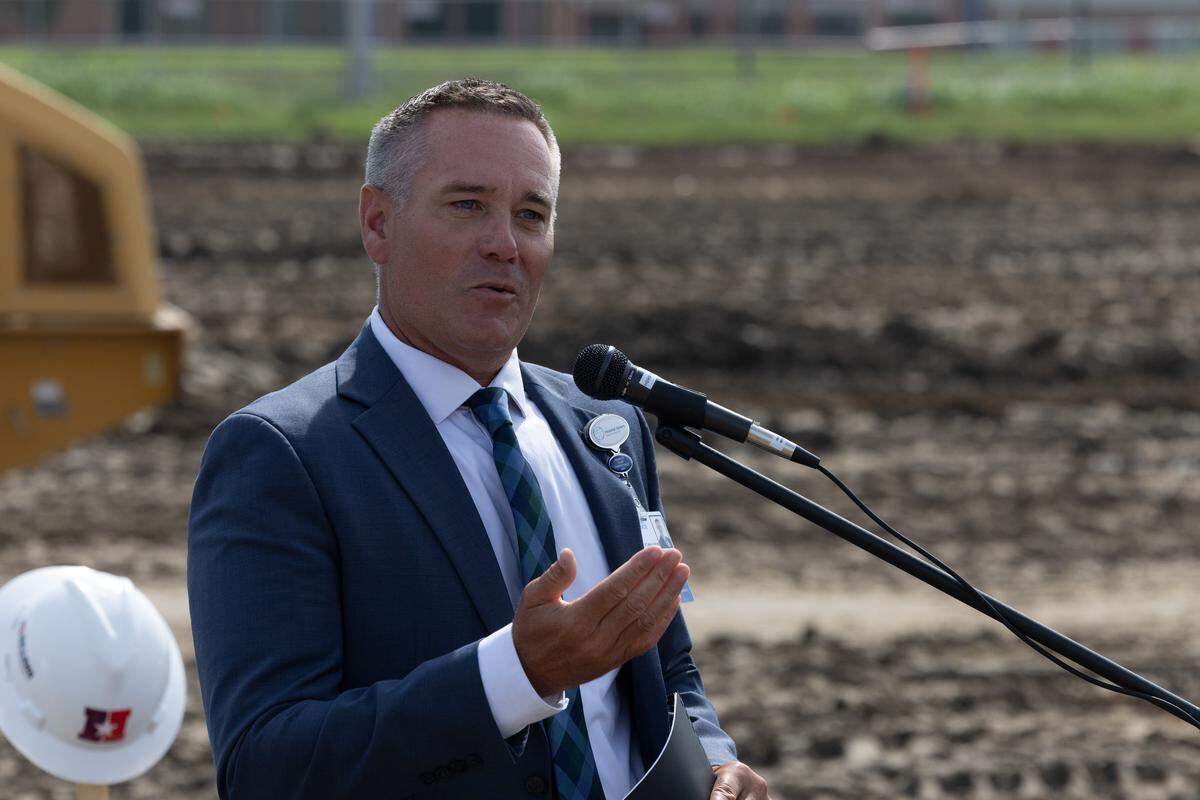
St. Elizabeth’s Hospital President and CEO Chris Klay said current medical practices demanded this new direction in outpatient care, citing efficiency as a key factor.
“It used to be a total knee replacement meant 4-5 days in a hospital, but now standard procedure is surgery in the morning and at home in the afternoon,” he said.
Many providers – spanning general surgery, urology, neurosurgery, otolaryngology, gynecology, gastrointestinal and orthopedic specialties – asked the hospital improve operating room access to meet the needs of their patients on an outpatient basis, he said.
“We can be more efficient. We had to take a closer look at same-day surgeries,” he said. “Now we still must have longer stays – ICU, critical care, where it makes sense. We offer complete services, specialized services.”
The expansion project also includes a medical office building, plus additions and renovations to the existing hospital to meet increased patient demands.
A new 70,000-square-foot medical office building will have three floors. It will include the 20,000-square-foot ambulatory surgical treatment center, with four operating rooms, two procedure rooms, along with post-acute care unit rooms and prep and recovery stations.
The medical office features space for physician specialty clinics and new providers to serve patients on St. Elizabeth’s campus as well as diagnostic imaging services.
Renovations to the existing hospital includes an 8,500-square-foot dietary department, a 15,500-square-foot emergency department addition and renovation of the existing dietary department to become 32 inpatient hospital rooms.
Klay said when St. Elizabeth’s opened in O’Fallon on Nov. 4, 2017, business growth was immediate.
“We were quickly at capacity,” he said, noting the bed count was 144 and as of last Tuesday, had a patient census of 187.
“The timing is right. We had to do something,” he said.
Klay told the BND earlier this month that the expansion also helps the hospital diversify its services to brace itself from an anticipated loss of revenue related to cuts in Medcaid by President Donald Trump and his administration’s “Big, Beautiful Bill.”
Hundreds of thousands of people in Illinois are projected to lose their health insurance through Medicaid, and the state expects a $52 billion drop in funding to finance the program as part of more than $1 trillion in health spending cuts that will be phased in over the next decade in the U.S.
At HSHS, one of the region’s largest health care systems, individual hospitals receive about $2 million to $15 million from Medicaid annually. The low-income public health insurance program accounts for 6-12% of the revenue in their budgets on average, according to annual questionnaires hospitals submit to the Illinois Health Facilities and Services Review Board.
The new services create a new revenue stream to help offset Medicaid losses, Klay said.
The new facility will be located adjacent to Green Mount Road, directly north of the main entrance/roundabout. St. Elizabeth’s is operated by parent company Hospital Sisters Health System.
“Access is really important to patients. People want choice and they want options. We want to make it easier,” he said. “Today, 40% of patients within our service area travel to St. Louis for healthcare services. A majority say they would elect to receive their healthcare in Illinois if access to specialized care was improved.”
Citing the medical schools at Washington and Saint Louis universities, he said: “In the metro-east, we have great access to some of the best academic medicine people in health care.”
Large neurosurgery, urology, podiatry, and pediatric physician groups have asked for new or additional space on St. Elizabeth’s campus, including Cardinal Glennon and Urology and Neurology of St. Louis, he said.
“It will be a significant expansion of the marketplace,” Klay said.
Challenges from the COVID-19 global pandemic continue to be a factor, he said, but staffing issues have improved.
“We are extremely proud of our workforce. We had a workforce shortage across the country, and it has stabilized. At that time, we had a 37% turnover, but now it’s 19%,” he said. “In reality, we can’t take care of our patients without good people. We work at earning the community’s trust.”
Klay said quality metrics is important, and St. Elizabeth’s has not only met but exceeded the benchmark in preventing infections.
“We keep people healthy and safe, and it comes through in our quality employees,” he said. “We are celebrating our 150th anniversary. We’re still here today. We’ve changed, evolved and grown. I’m extremely proud of our resilience. One thing hasn’t changed – we are absolutely committed to take care of our community.”
The Illinois Health Facilities and Services Review Board approved the hospital’s expansion request on March 27.
O’Fallon Community Development Director Greg Anderson said the city approved the site plan through their internal review process but did not require council approval.
“We are currently working through their building plans,” Anderson said.

‘The Medical Mile’
O’Fallon Mayor Eric Van Hook said the growth along the Interstate 64-Green Mount Road corridor has grown exponentially since St. Elizabeth’s opened there eight years ago.
“It’s an excellent project, one that’s needed, well-thought-out, with the goal to provide great service locally. It’s going to have a positive impact,” Van Hook said. “They’ve always been great partners with the city.”
Dubbed ‘The Medical Mile,’ the stretch that starts with St. Elizabeth’s and ends with BJC Health Care’s Memorial Hospital East in Shiloh is actually two miles’ long on North Green Mount Road. In between, there are numerous health care facilities, including Siteman Cancer Center, Cancer Care Specialists, in addition to medical offices and satellite businesses.
“It has an economic impact, with more jobs available and all the revenue from restaurants, hotels and gas stations,” Van Hook said.