
Workers at metro-east Boeing plant among thousands on strike
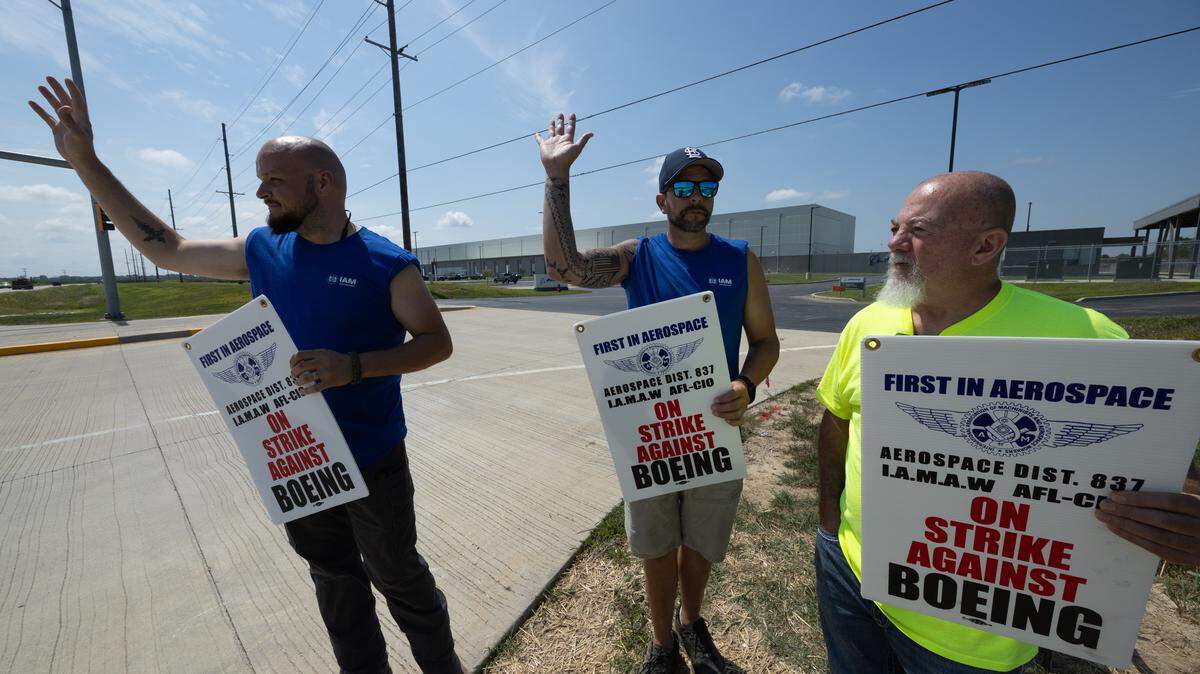
Three Boeing defense plants, including those at a manufacturing plant at MidAmerica Airport in Mascoutah, face a strike as 3,200 hourly machinists walked off their jobs. Members of the International Association of Machinists voted to strike at about noon Monday.
“3,200 highly-skilled IAM Union members at Boeing went on strike at midnight because enough is enough,” the union wrote on X.
IAM Midwest Territory General Vice President Sam Cicinelli on Sunday urged a new contract for the workers.
“IAM District 837 members build the aircraft and defense systems that keep our country safe. They deserve nothing less than a contract that keeps their families secure and recognizes their unmatched expertise,” Cicinelli said.
The striking members work at facilities in St. Louis and St. Charles, Missouri, and the metro-east manufacturing plant at MidAmerica, the union said.
On July 27, they voted to reject a four-year contract proposal by the company.
“We’re disappointed our employees rejected an offer that featured 40% average wage growth and resolved their primary issue on alternative work schedules,” Boeing said in a statement on Sunday, titled “Last, best and final offer.” “We are prepared for a strike and have fully implemented our contingency plan to ensure our non-striking workforce can continue supporting our customers.”
The workers on strike build and maintain fighter jets, including the F-15 and F/A-18 models. They also build the T-7A Red Hawk trainer and, in Mascoutah, the MQ-25 Stingray unmanned refueler.
It’s not clear how many metro-east jobs are impacted by the strike. Boeing moved 150 jobs from facilities throughout St. Louis and expected to create 150 new jobs for engineers, mechanics and other staff once the facility became fully operational.
Dale Rhymer, a 40-year employee who was standing on a picket line outside the MidAmerica Airport Monday morning, says the latest contract “falls short” for the younger workers.
“The younger guys are wanting a faster wage progression to get to the top. Now, when they hire in, it takes 16 to 19 years to get to the top of the wage scale,” said Rhymer, a Troy resident. “And, there needs to be general wage increases for the guys that are maxed out that don’t get them in years two and three of the contract; they want general wage increases for all four years instead of lump-sum bonuses.”
Rhymer said there was a narrower gap between the bottom and top of the wage scale when he started working for Boeing in 1985.
“I could have lived with (the contract), but I understand the younger crowd and I feel the pain,” he said. “When I hired in, I started at $8.40 an hour in 1985 at the bottom of grade 2. The top of grade 1 was like $13.54 or $13.55, so you’re talking about like $15-per-hour difference. Now you’re talking about $25-per-hour difference. It just takes so long to make what the guys next to you make. It’s pretty archaic.”
Ryan Lehrman called himself “the newest guy” on the picket line. He echoed Rhymer’s concern about wage scale disparity.
“I don’t appreciate being there for a year and half and seeing younger guys starting above where I’m at,” he said. “It’s like spitting on my experience and tenure thus far.”
Boeing leases 34 acres from MidAmerica and began construction on the 300,000-square-foot plant in 2021. There are two additional parcels adjacent to the site for possible future expansion. The agreement includes an option for three 20-year renewals, totaling 80 years of possible tenancy.
The facility accommodates the company’s contract with the U.S. Navy for the manufacture of MQ-25 Stingrays, an unmanned aircraft (tankers) that can refuel fighter jets in the air, extending their combat range, according to the company’s website.
The F-47 stealth fighter jet, the Pentagon’s next-generation fighter plane, is planned to be built at a Boeing plant in the St. Louis area, though the company hasn’t said which plant will build it or when production will begin. Boeing also operates some nonunion plants in the area.
Boeing Defense, Space and Security unit has recorded nearly $11 billion in losses from late 2021 through the end of 2024. Pentagon contracts that made the company responsible for cost overruns, including two new Air Force One jets, are the main cause. But this year, the unit has made profits.
In the Boeing earnings call last week, CEO Kelly Ortberg said the company can weather the costs of the strike. He said it would be far less than the cost of last year’s strike of 33,000 commercial plane unit workers.
“The order of magnitude of this is much, much less than what we saw last fall,” Ortberg said. “I wouldn’t worry too much about the implications of the strike. We’ll manage our way through that.”