
Metro-east employees are first in Illinois to get workers’ comp for radiation

Roughly 70 former employees of a metro-east factory tied to the Manhattan Project—and the spouses of deceased workers—have become the first group in Illinois to receive workers’ compensation for radiation exposure.
“I am literally a landmark decision,” said Larry Burgan, one of the former employees of Spectrulite Consortium Inc.
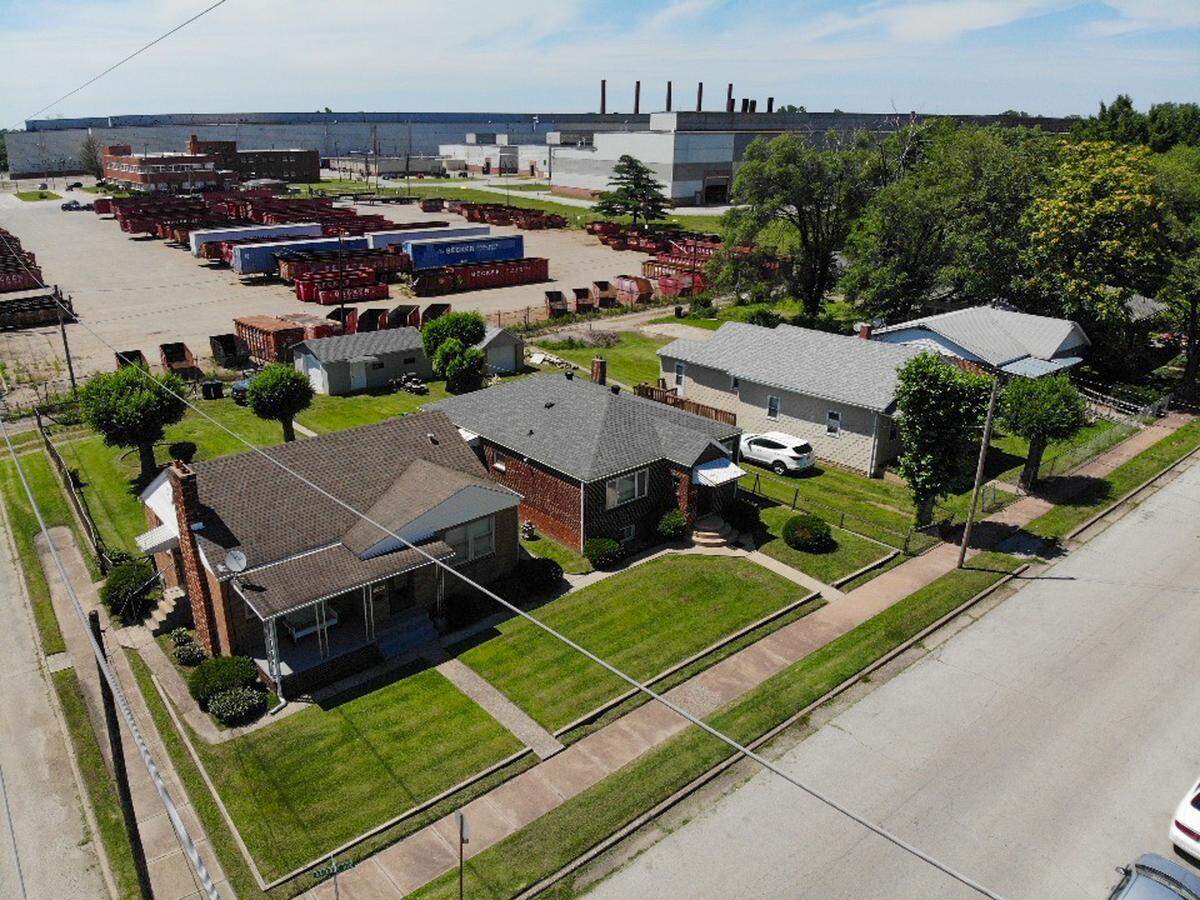
The old Spectrulite facility, which straddles the municipal boundary of Venice and Madison, was owned by Dow Chemical Co. It processed uranium and thorium in the 1950s and early 1960s. The cleanup of millions of pounds of radioactive waste was not completed until 2007.
While 170 other former employees have been eligible under a federal program for more than $32 million in compensation, this group of employees never tested positive for any of the 22 cancers required for eligibility, leaving them in a gray area.
Even though this settlement—a $7,500 payment per employee—isn’t as much as some had hoped for, it reaffirms that they had been wronged, Burgan and another former employee, Calvin Ratliff, said.
“It’s not as much as you’d like,” Ratliff said. “But some compensation is better than none.”
Rachell Horbenko, a Chicago-based attorney who represented Spectrulite’s interests, could not be reached for comment.
Ratliff and Burgan have been at the center of efforts to secure compensation for local workers and residents exposed to radiation.
U.S. Rep. Nikki Budzinski, D-Springfield, has pushed to get a ZIP code covering Venice, Madison and parts of Granite City included in a federal compensation program for residents with radiation illnesses. However, advocates have been unable to convince other lawmakers to include Metro East communities.
The attorney representing Burgan and Ratliff pursued claims for about 70 former employees dating back to 2009. This group never tested positive for cancer that could be tied to the factory, but they say they have been plagued with autoimmune diseases, thyroid issues and respiratory problems.
About 20 people have died since the claims were first filed, which is why some spouses are receiving the settlements, Burgan said.
If a recent DNA test had confirmed genetic anomalies tied to radiation exposure, the dollar amount could have been much higher, they said.
Their longtime attorney, David Jerome of Collinsville, had to be creative with his approach because there was no similar case, Burgan said.
“We always knew we were chasing what you would consider a ghost,” Burgan said earlier this year. “You can’t see it; you can’t feel it; you can’t touch it, but we had to prove that it harmed us. We knew from the very beginning of getting any compensation whatsoever, it was going to be hard—if possible at all.”
Their compensation marks the end of half of the duo’s goals. In their view, both employees with and without cancer have now had opportunities to be compensated. Now, they plan to turn their attention back to the residents who have never been eligible for compensation.
An informal survey by Burgan and Ratliff, conducted over several years starting in 2009, found 368 cancer cases among residents within a six-block radius of the site. No government agency appears to have formally documented cancer rates or health outcomes for the community surrounding the plant, but that will soon change.
The Illinois Emergency Management Agency signed releases with all residents surrounding the factory, and the state agency plans to test their yards for radiation, according to Burgan and Ratliff.
A spokeswoman for the state agency has not responded to multiple requests for comment.
If radiation is found in residents’ yards, Burgan and Ratliff hope the formal state testing could help get the 62060 ZIP code added to the Radiation Exposure Compensation Act, which now provides payments to Missouri residents near Coldwater Creek.
“It’s been a slow process, but we’re making progress,” Ratliff said.