Belleville police partner with faith-based group to curb violence
The Belleville Police Department has agreed to share information and otherwise cooperate with a faith-based, nonprofit organization to help prevent community violence.
Juard Barnes, a strategist for Metro East Organizing Coalition, said the organization sends trained staff and volunteers to talk to residents in at-risk neighborhoods, offers counseling and other social services and presents options for conflict resolution.
“Community violence intervention is deeply researched,” Barnes said. “Our work is steeped in data. It’s been going on for decades, and it’s actually been very successful in many cities.”
Barnes said key premises are that violence is a public health problem that needs more attention and that “racial and economic dignity” are vital to any solution.
Barnes is a community organizer and retired pastor who’s married to the Rev. Larita Rice-Barnes, executive director of Metro East Organizing Coalition and senior pastor at Empowerment of Grace, a nondenominational church in Fairview Heights.
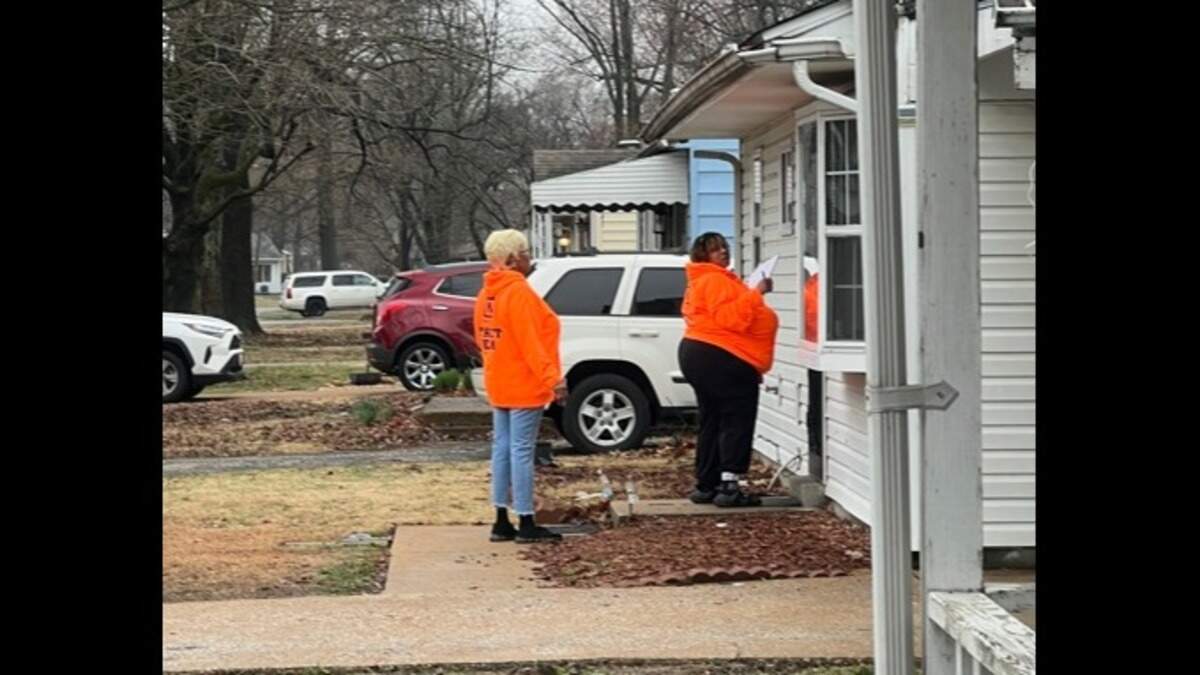
Rice-Barnes regularly leads “Peace Walks” with staff and volunteers going door to door, wearing bright-orange hoodies and T-shirts that read “Street Team.” They cover Belleville and Cahokia Heights and recently expanded into Madison, Lovejoy and Venice.
“It’s very dangerous work, but it’s very needed, and someone needs to do it,” said Barnes, who also is founding principal of The Rehoboth Project and former Midwest regional director of Faith In Action.

Formal agreement
Belleville City Council voted Monday night to approve a memorandum of understanding to formalize a relationship between the police department and Metro East Organizing Coalition.
The six-page memorandum specifies what information police will share, how and when they will share it, how the information will be used and what activities are prohibited.
“We will notify them of violent crime incidents in the city, and they will take it from there,” said Acting Police Chief Mark Heffernan.
“Obviously, we won’t give out any information related to victims or locations, but we will provide them with information that is generally available to the public.”
In some cases, the goal is to “reduce the chances of retaliation” after a crime is committed, Heffernan said.
Police also will collaborate with the organization on an as-needed basis if they detect “hotspot issues” or patterns of crime in certain neighborhoods, so it can “mobilize” action.
“There’s been similar efforts and groups across the country,” Heffernan said. “This is the first formal agreement of this nature for Belleville Police Department that I’m aware of.
“Anything we can do to partner with local organizations that have a shared goal of reducing crime in the city, we’re 100% behind the effort.”
Metro East Organizing Coalition is funded through donations and grants.

Crime down slightly
Crime was down about 9% in Belleville the first three months of this year comparied with 2025, according to a report from the FBI’s National Incident-Based Reporting System on the city’s website.
The report shows 110 crimes against people, including three murders, four rapes, 70 assaults and 22 aggravated assaults, compared with 128 last year; 291 crimes against property, down from 314; and 60 crimes against society, down from 64.
Barnes said some crimes can be prevented if people have tools to settle disputes between groups peacefully. When asked if he was talking about gangs, he said “no.”
“A dispute between groups could stem from social media interactions, neighborhood disputes, relationship issues that involve multiple people, or other issues,” Heffernan wrote in an email.
The memorandum states that the purpose of the agreement between the police department and Metro East Organizing Coalition is to “reduce interpersonal violence, retaliatory harm, and community destabilization” in the city.
Police agree to provide the organization with guidance to support “hotspot deployment, community stabilization, street outreach, mediation, and victim/family support services.”
The organization has five staff members and dozens of volunteers. In training, they learn about community resources and de-escalation techniques, according to Barnes.
To get their anti-violence message across, sometimes they join forces with people who have committed crimes in the past, including former prison inmates now on a better path.
“We call them credible messengers,’” Barnes said.
Information to be shared
In the memorandum, the police department agreed to notify Metro East Organizing Coalition rapidly (within four to 12 hours if possible) of homicides, shootings with injuries, credible retaliation risks and major disturbances following violent events.
Police and organization staff will hold quarterly strategy meetings and monthly or as-needed operations meetings. In addition, briefing packets may include:
- Block-level hotspot mapping
- Summary of recent violent incidents (date/time/general location/type)
- Calls-for-service trend clusters correlated with violence risk
- Retaliation-risk indicators (non-investigative framing)
- Community stabilization advisories
Police won’t be allowed to provide restricted Criminal Justice Information Services data, suspect identities, confidential informant information, surveillance materials, detailed investigative reports or victim identifying information without consent.
The memorandum emphasizes that Metro East Organizing Coalition isn’t a law-enforcement agency, and its effectiveness and credibility depend on its independence.
“Information shared is for violence interruption, mediation, and stabilization – not for investigative purposes,” it states.

This story was originally published April 22, 2026 at 5:30 AM.