
The story behind the proposed Gateway Arch National Park expansion into Illinois
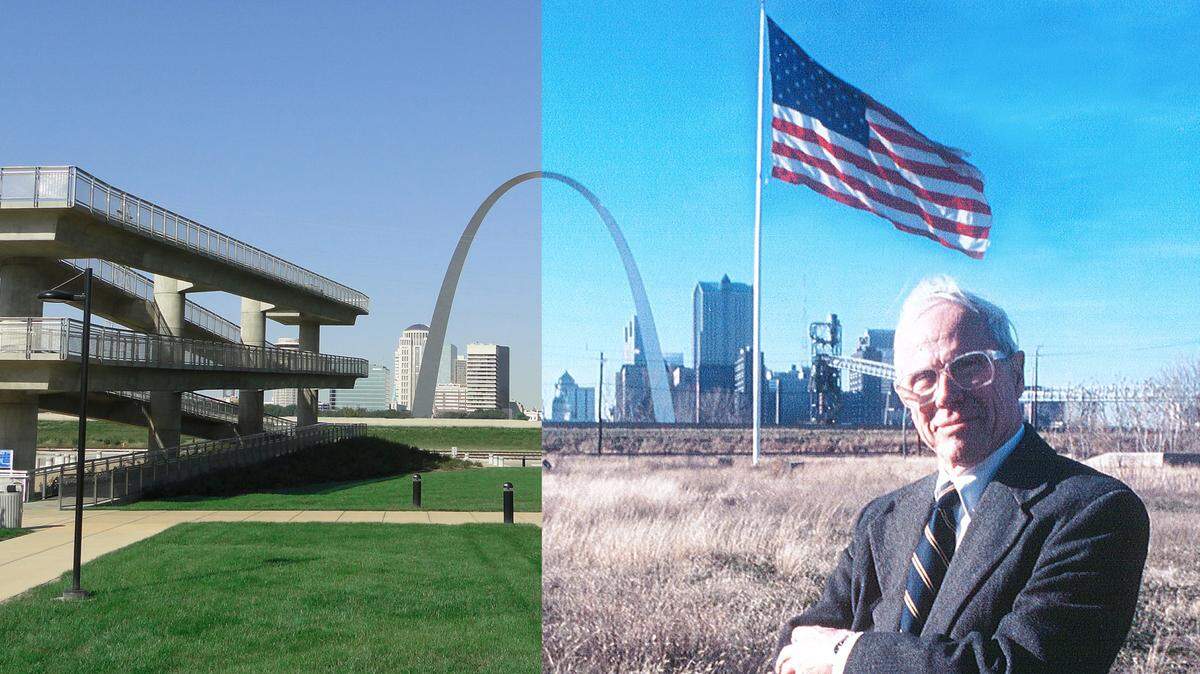
Marshall Hier has a dream.
But it wasn’t his, originally — or even that of his mentor.
The dream began with the architect who designed the symbol that represents the St. Louis region: the Gateway Arch.
In the late 1940s, architect Eero Saarinen envisioned more than a soaring stainless steel monument on the west bank of the Mississippi River. His proposal also imagined development on the Illinois side of the river — an east bank park with playgrounds, sports facilities and a boat basin.
That portion of Saarinen’s vision has never been realized.
But nearly 80 years later, the idea is closer to reality than it has been in decades.
U.S. Rep. Nikki Budzinski, a Democrat who represents East St. Louis, in March introduced legislation in Congress that would expand the boundaries of Gateway Arch National Park across the Mississippi River into Malcolm W. Martin Memorial Park — a grassy overlook directly opposite the Arch on the East St. Louis riverfront.
Supporters see the effort as more than expanding a park. They also see it as a symbolic attempt to bridge a river that has long divided the St. Louis region economically and psychologically.
Generations of civic leaders have carried that dream forward, believing the Mississippi River should connect the region rather than divide it.
Few carried that dream longer than Malcolm W. Martin. And few knew him better than Marshall Hier.
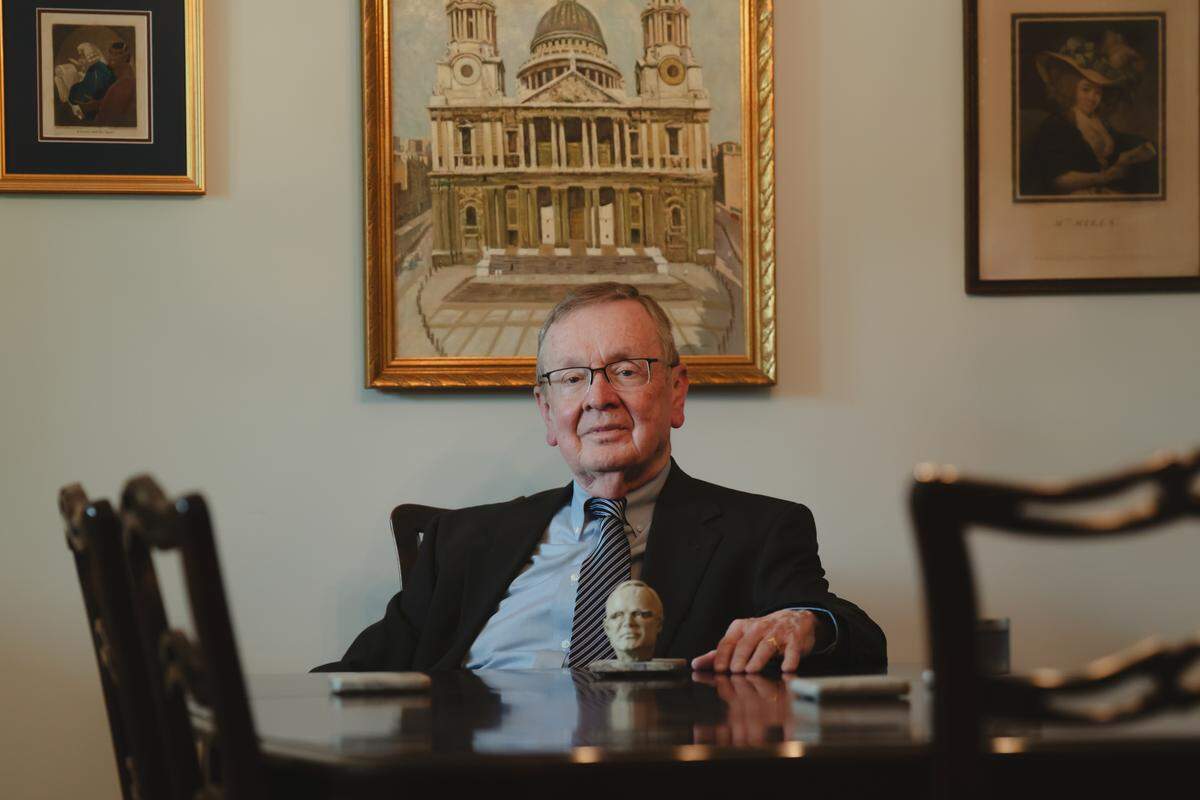
On a recent morning at Hier’s home in south St. Louis County, the 80-year-old retired attorney, writer and historian showed off a carefully curated collection of documents and artifacts from Martin’s life, or as Hier called it, “a temporary shrine.”
The collection included a small bust of Martin and even two paintings he once owned.
Hier first met Martin in 1968 after arriving in St. Louis as a young attorney.
“I was by myself. I knew basically no St. Louisans and so I was on my own,” Hier said.
Martin, already an established attorney decades older than Hier, invited the newcomer to lunch. Afterward, Martin suggested they drive to a railroad crossing to watch a specific locomotive come through.
“I thought to myself, ‘Oh, golly,’” Hier said.
The episode made Hier question what would become of his time in St. Louis, but the older attorney with an interest in watching trains became a mentor to the young Hier, and they would become close friends.
Martin came from a prominent family and was the descendant of enslavers from Kentucky. His father served as the first chairman of the board of the Federal Reserve Bank of St. Louis in 1914 and later became the bank’s president. His brother, William McChesney Martin Jr., became the longest-serving chair of the Federal Reserve in U.S. history.
Both brothers served in World War II.
Malcolm Martin was awarded a Bronze Star for helping plan the D-Day invasion. But the Army captain was most proud of his advocacy and commitment to racial equity.
When a base commander threatened to disband his integrated company made up of both white and Black soldiers, Martin leveraged his connections and successfully kept the unit together.
When Martin returned from the war to St. Louis, he had been away from his law firm for four years and had no client base. His father directed him to Luther Ely Smith, an attorney and civic booster.
Today, Smith is known as the father of the Gateway Arch. He conceived of the idea to create a memorial to President Thomas Jefferson and to westward expansion.
But while many St. Louisans focused on the Arch itself, Martin became passionate about another piece of Saarinen’s proposal: the east bank.
“He realized that the Arch was only part of Saarinen’s dream,” Hier said. Saarinen envisioned a park on the east side where people could get a good view of the Arch.
When the Arch was completed in 1965, the vision for Illinois remained unfunded and unfinished.
Martin spent the rest of his life trying to change that.
In 1969, he founded a nonprofit, the Gateway Center of Metropolitan St. Louis, with the goal of expanding the Arch grounds across the river.
Martin, using much of his own money, and the nonprofit he founded slowly began acquiring industrial land on the East St. Louis riverfront.
“The property had some problems with it in terms of contamination and everything else because it was used as railroad yards,” Hier said. “But Malcolm said, ‘Let’s begin buying it.’”
In 1984, Congress passed legislation authorizing an expansion of the Jefferson National Expansion Memorial into Illinois. President Ronald Reagan signed it into law, but the project was never funded.
When Congress later allocated money to start buying land in East St. Louis in the early 1990s, the prospect of expanding the park got complicated when some of the land was sold to casino developers.
Instead, the Gateway Center nonprofit raised $4 million and installed a pool, geyser and four smaller fountains on the property it had acquired. The geyser first gushed in 1995 and on a calm day could reach a maximum height of 630 feet, matching the height of the Arch.
There was another setback toward national park expansion.
Martin’s health began to decline. He was struck by a driver while crossing Fourth Street near the Arch grounds and never fully recovered. Members of the nonprofit board, including Hier, started discussing how to preserve Martin’s dream after his death.
They eventually approached the Metro East Park and Recreation District with a proposal: Take ownership of the 34 acres the organization had acquired and maintain it.
There were two conditions.
First, the taxpayer-funded district would need to turn the land over to the National Park Service if it agreed to take ownership. Second, the park the district would maintain in the interim would need to bear Martin’s name.
Martin initially resisted the idea.
“Malcolm said, ‘No, no, no, please don’t,’” Hier said. “We said, ‘Malcolm, you know that you’ve been told you’re dying. We’ll just wait till you’re gone and you won’t have anything to say about it.’ He laughed and said, ‘Go ahead.’”
Martin died in 2004.
In 2009, the park district officially opened Malcolm W. Martin Memorial Park.
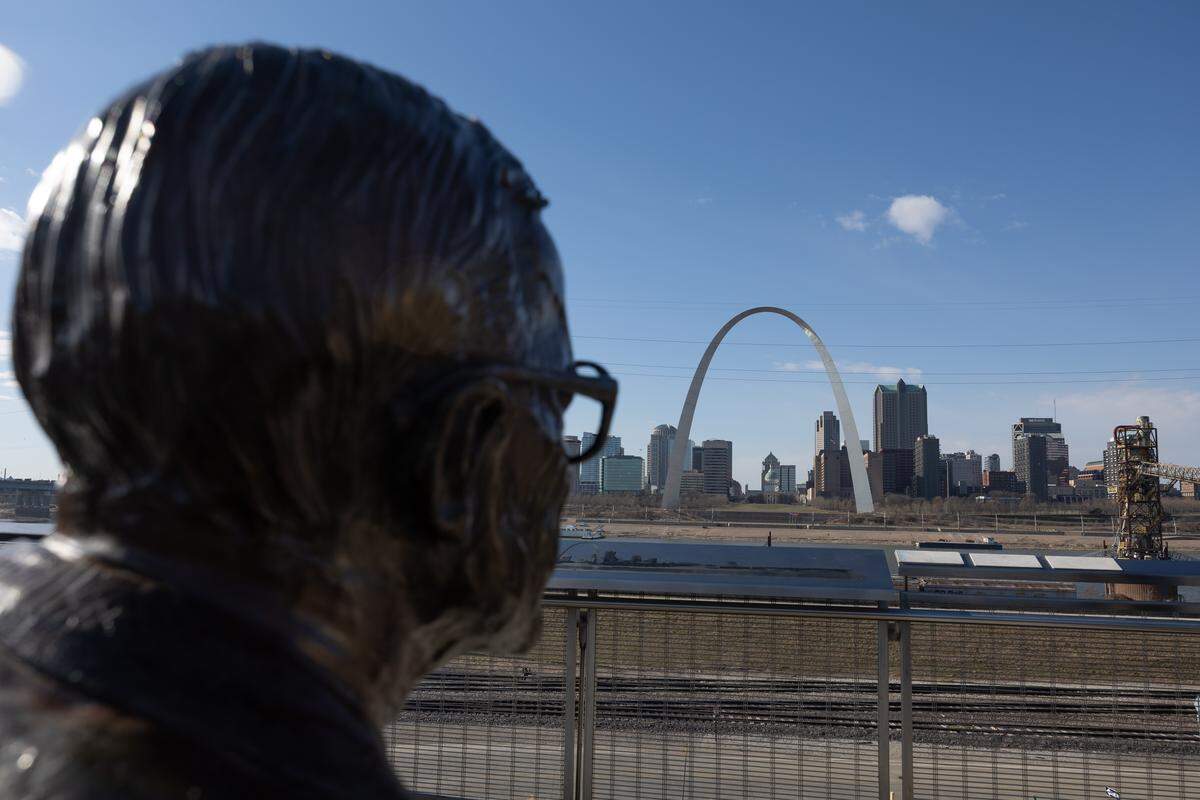
Land of possibility
The park itself embodies contrasts.
A massive American flag waves above the carefully maintained park, and its multistory overlook offers one of the most dramatic views of the St. Louis skyline. The view is obstructed by power lines, and nearby, there are railroad tracks and a towering grain elevator. The geyser no longer operates because of maintenance costs.
Yet, supporters of the expansion, including the Gateway Center nonprofit, which still exists and supports the park’s upkeep, see possibility.
Ryan McClure, executive director of the Gateway Arch Park Foundation, said the region has an opportunity to finally complete Saarinen’s vision.
“This park was really set aside and created to interact with Gateway Arch National Park,” McClure said, standing on the overlook platform earlier this year. “We have an opportunity now to finally see that vision through, and we’re really committed to that.”
McClure acknowledged the industrial and landscape obstacles surrounding the site but said they are not insurmountable.
“Things that are worth doing are often hard,” he said.
McClure also has a track record of delivering big projects. He’s leading a $670 million project to demolish and develop the long-vacant Millennium Hotel site downtown with the Cordish Cos. He also played a major role in the CityArchRiver effort, a $380 million, decade-long project to revitalize the area around Gateway Arch National Park.
The highlight of that project was building a land bridge over Interstate 44 that connected the Arch grounds to downtown St. Louis.
Other supporters, such as Debra Moore, an East St. Louis resident and government leader in St. Clair County, say the expansion would bring new attention and a worthwhile development to East St. Louis.
“We’re at a place now that we’ve never been before,” Moore said. “You hold on to the dream until it becomes a reality.”
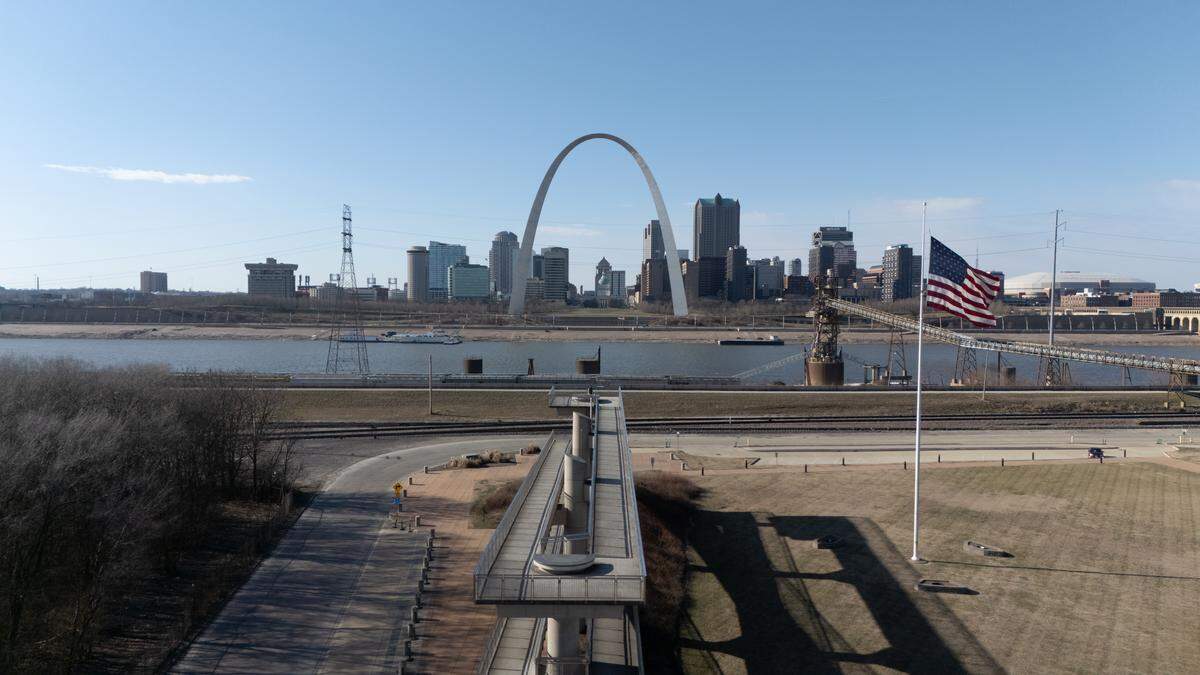
Budzinski’s legislation is now in committee and has bipartisan support from members of Congress on both sides of the river — Republican Reps. Mike Bost and Ann Wagner and Democratic Rep. Wesley Bell. Still, no timeline or funding plan has been released for the project. Whether the national park expansion ultimately succeeds remains uncertain.
Hier understands that better than most.
For decades, he watched Martin pursue the idea of Gateway Arch park expansion only to see it repeatedly stall. Yet Hier watched him persist.
Now, Hier persists, too, carrying forward his mentor’s unfinished dream.
At the top of the overlook platform at Malcolm W. Martin Memorial Park is an inscription Hier often reflects on.
“Malcolm Martin represents the need to dream,” it reads.
Hier became emotional recalling the words.
“Dreamers don’t always see fulfillment of their dreams,” he said. “If Malcolm didn’t get discouraged in his 92 years, neither should we, nor the generation that follows, because it’s for their benefit, ultimately, that all of this might come to pass.”