Does Belleville give out ‘no-bid’ contracts for roadwork engineering?
During her campaign for the April 6 election, Belleville Mayor Patty Gregory promised “to put an end to no-bid contracts.”
But current city officials and former Mayor Mark Eckert have responded that the city has not signed any “no-bid” contracts and that it is illegal for the city to bid out contracts for professional services such as engineering for roadwork and sewer projects.
Instead of bidding for professional services, the city follows a “quality based selection” process of reviewing a firm’s qualifications, selecting firms and then negotiating with them. A traditional bidding process is used to buy items or contract for construction work.
“It is illegal to bid out professional services,” City Engineer Michael Velloff said during the Streets and Grades Committee meeting on April 19. “We just can’t do that.”
Since Gregory defeated Eckert in the April 6 election, the contract issue has been debated by city leaders.
The focus of the dispute has been over contracts issued to Belleville-based Kaskaskia Engineering Group for five contracts, including engineering services for a Centreville Avenue roadwork project that is expected to be finished soon.
The debate prompted Gregory to post a Facebook comment supporting an alderman who questioned the Centreville Avenue contract, which she later deleted because she didn’t want this distraction before she took office.
“I just took it down because I thought, ‘You know what, this is not the way I want to start my administration by having questions about this and I just did not think that it was productive to move forward,’” she said in an interview.
Gregory acknowledged in the mayoral debate before the election that it is “legal” to award contracts for certain services, she said she wanted it to stop the practice.
“When I am mayor, I will stop the practice of no-bid contracts,” she said in the debate on April 1. “Not only because I don’t consider it fiscally responsible but, ... just because no-bid contracts are legal, doesn’t mean that it is right.”
The process continued after she took office as the council approved contracts with Kaskaskia on May 17. But Gregory said after the meeting that she wants to see more documentation that the quality based selection process was followed.
Latest contract vote
The council voted 13-1 to approve two contracts with Kaskaskia on May 17.
The council has 16 members but two members didn’t vote on the motion. Joe Hazel of Ward 1 was absent from the meeting and Mary Stiehl of Ward 6 abstained from the vote. During the meeting, she didn’t say why she abstained and she could not be reached for comment after the meeting.
The lone dissenting vote was cast by Ward 1 Alderman Bryan Whitaker, who was elected to the seat last month and supported Gregory during the campaign.
Whitaker, who said in a campaign video that “there seems to be a lot of no-bid contracting occurring” in Belleville, raised questions about how the Kaskaskia contracts were negotiated.
“Are we reviewing any other engineers that could possibly save us any money as we go through this process or we just simply going to award the same one because they have done business with us previously?” Whitaker said.
Whitaker also asked that the packet of information provided to aldermen before City Council meetings include documentation of the selection process. Gregory said after the meeting that she agrees with Whitaker’s comments.
After Whitaker raised his point, Velloff told the council he preferred negotiating with Kaskaskia on the inspection service contracts approved on May 17 because Kaskaskia also had done the design engineering work on the two roadwork projects in question and that it was more efficient for him to go this route.
“It would be my preference to use the same engineering firm for construction inspection,” Velloff said.
Also, he said the “past performance” by Kaskaskia was a key criteria in selecting the firm.
The two projects cover work on West A Street from 10th to 13th streets and on Forest Avenue.
Velloff gave the council an example where he worked on a roadwork project in which the design engineer was a different company from the inspection engineer. He said that process is not his preference.
Contract selection process
Roger Wigginton of Ward 8, who supported Eckert during the campaign, voted in favor of the contracts with Kaskaskia and defended the process the city has used to hire engineers. He praised the services provided by Kaskaskia and the president of the firm, Geri Boyer.
“Everybody thinks that these are behind the door, under the table, backroom dealings,” Wigginton told the council. “There are checks and balances. They have to meet the qualifications.
“If contractor A doesn’t work, they’re out. If contractor B doesn’t work, they’re out. If contractor C fits the qualifications, they’re in.”
“Everybody’s concerned about Kaskaskia Engineering,” Wiggington said while noting that Boyer previously worked with the Illinois Department of Transportation before she founded Kaskaskia.
Gregory didn’t comment specifically on the Kaskaskia contracts during the City Council meeting but in an interview she said she agrees with Whitaker.
Also, in an effort to improve “transparency,” she said she wants to move the time and date of the Streets and Grades Committee meeting where engineering contracts are discussed. The committee currently meets an hour before a City Council meeting and she wants to move it so there is a week or two between the committee meeting and the council meeting.
“We’ve gotten to the point now where if anybody asks a question, it suddenly becomes an accusation,” she said. “Questions are not accusations. Aldermen should be asking questions. That is what they’re being paid to do.
“I am not going to be a mayor that just wants all yes votes. We’re all in this together and I don’t expect all yes votes. We all bring different things to the table. We’re going to be bringing different opinions to the table.”
Centreville Avenue engineering
It was a Belleville alderman’s question about how the city handled the engineering contract for the Centreville Avenue roadwork project that prompted Gregory’s Facebook post she later deleted.
A middle turn lane on Centreville Avenue had been proposed at one point for the project but Eckert said the lane was not added because it would cost too much money to move utilities, build retaining walls and acquire additional property. Instead, bike lanes will be included on the street as initially planned.
Ward 4 Alderman Raffi Ovian referenced the engineering contract and change of plans during the Streets and Grades Committee meeting on April 19.
“The money that was appropriated for that, what happened to it?” he asked. “Was it returned to the city or will it be returned to the city?”
Eckert, in an interview after the committee meeting, defended the Centreville Avenue engineering contract with Kaskaskia and that payment for engineering would be due whether or not the turn lane ended up in the project.
Eckert, whose last day in office was April 30, called Ovian’s comments “grandstanding.” Ovian supported Gregory in the April 6 election in which she defeated Eckert.
“The part that really gets me is why are we trying to throw a Belleville engineering firm under the bus?” Eckert said. “(Boyer) is a local, female contractor right here in town who has done nothing but give us good performance.
“I don’t understand what the beef is when you have somebody that’s done nothing but give us good work at a good, decent negotiated price.”
Boyer defended her company’s actions on the Centreville Avenue project in examining the possibilities of a center turn lane and bike lanes. She said her firm “actually did more engineering than we normally would have done because we analyzed it for two different scenarios.”
Gregory, whose term began May 1, said in the since-deleted Facebook post after the April 19 meeting that she questioned why Eckert asked the City Council to pay for engineering fees on the Centreville Avenue project if the turn lane was not included.
“Very interesting streets and grade meeting tonight. Alderman Ovian asked a question about the 3rd lane design on (Centreville) Avenue street project,” Gregory wrote. “He also mentioned the signed contract for the design. The current administration noted that that design was never put into the proposal because it couldn’t be done, therefore no money was spent. Then why did the current administration have to get the aldermens’ approval to pay $197,000 for the design.”
The actual amount of the engineering contract with Kaskaskia was $195,971, according to city records.
“Under the new administration independent thinking will be welcomed and honesty will always be expected,” Gregory wrote in the Facebook post. “Not only from City Hall employees but from our elected officials too.”
Gregory said she deleted the Facebook post after getting some “nasty” responses about it.
Eckert said he was “disappointed” in Gregory’s Facebook post.
He also questioned why this issue was raised in the final days of his administration and not during the previous years the project was discussed.
“You all know that this is federal money that is monitored by IDOT and is scrutinized by IDOT so if we weren’t doing something right, believe me there would have been a red flag a long time ago,” Eckert said.
In commenting about the Centreville Avenue Facebook post being deleted, Gregory said, “It’s over, it’s done, it’s time to just constantly move forward.
“When aldermen ask questions and I expect them to ask questions of me, or if they have questions, it shouldn’t be viewed as somebody making accusations. It should be viewed that these are people that are interested in having money spent correctly,” she said.
“They’re asking not only as aldermen but also as taxpayers in representing the taxpayers.”
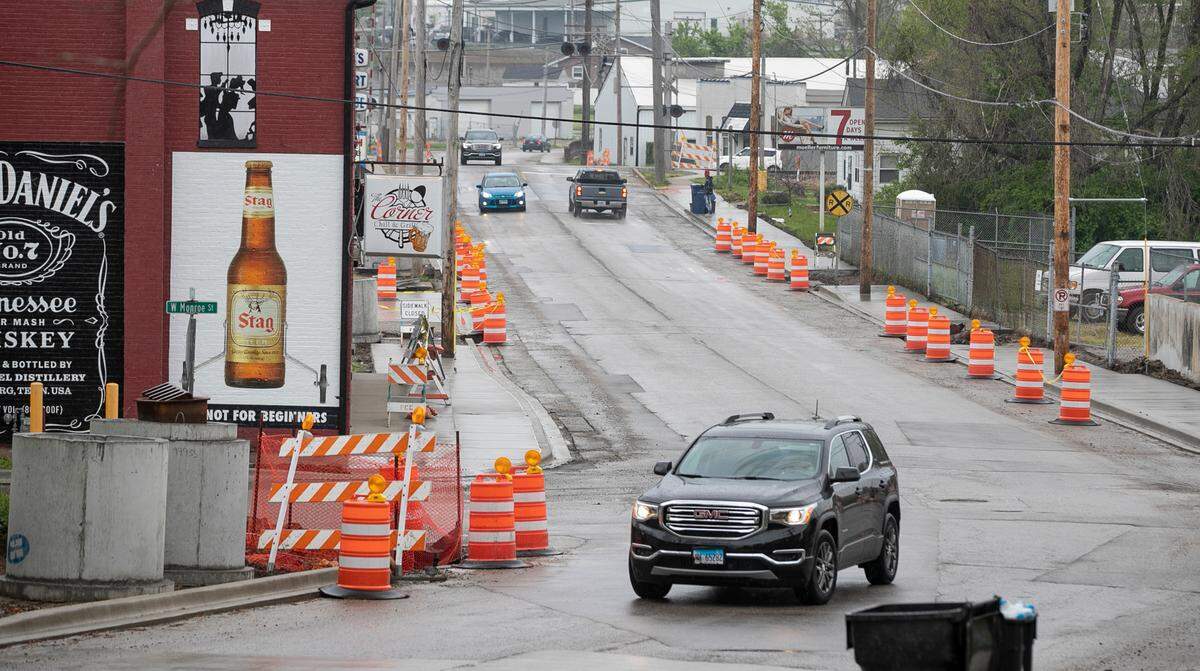
Centreville roadwork
The Centreville Avenue project has been discussed for several years but the city wanted to wait for Ameren to finish its cleanup of coal tar off South Sixth Street because trucks were making thousands of trips along Centreville Avenue.
The total cost of the Centreville project is about $1.2 million and it is expected to be finished this summer. It will include new sidewalks, curbs, pavement and two bicycle lanes. The work extends along Centreville Avenue from near West Lincoln Street to near the roundabout intersection with South Belt West.
Here’s a breakdown of the costs and funding sources:
▪ The construction contract was for $922,944.
▪ The engineering fee of $195,971 with Kaskaskia was approved in February 2018. Kaskaskia also was paid $85,000 for construction inspection services
▪ A federal grant of $540,000 was used to help pay for construction.
▪ The city also obtained $333,059 from Ameren for construction costs. Eckert said it was Boyer who noted that the city could seek the funds from Ameren because of the number of trips made by trucks leaving the coal tar cleanup site. City Attorney Garrett Hoerner negotiated the payment with Ameren, Eckert said.
▪ TIF 3 funds were used to pay for the construction costs not covered by the federal grant and the Ameren payment. This amount would be $49,885 after Ameren’s portion, barring any changes or unforeseen field conditions, according to Finance Director Jamie Maitret.
▪ TIF 3 funds also were used to pay for the engineering costs.
This story was originally published May 27, 2021 at 7:00 AM.