Q & A: Belleville native Sandy Magnus on induction to Astronaut Hall of Fame, future in space
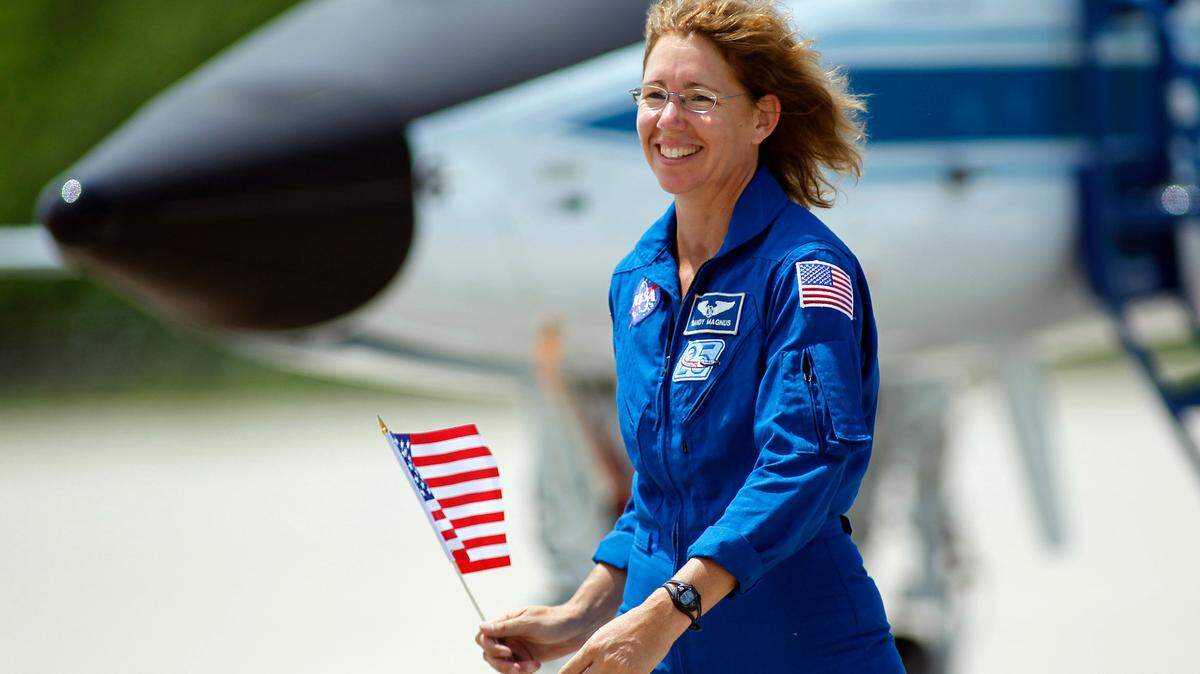
A member of the Belleville West High School Hall of Fame has joined the ranks of another hall of fame.
Sandy Magnus, who flew into space three times as a NASA astronaut and traveled more than 60 million miles on those trips, is now a member of the U.S. Astronaut Hall of Fame at the Kennedy Space Center in Florida.
Magnus, 57, first rocketed into space in 2002 on the space shuttle Atlantis. She spent four and a half months on the International Space Station in 2008 and she was on the crew of the final space shuttle mission in 2011.
She was selected to the NASA Astronaut Corps in April 1996 and was inducted into the Astronaut Hall of Fame on June 11.
Magnus, a native of Belleville, now has a consulting business in the aerospace industry called AstroPlanetview LLC and she’s a part-time professor at Georgia Tech.
The graduate Belleville West’s Class of 1982 talked to the BND on various topics including her support for science, technology, engineering and math (STEM, for short) training for girls, her thoughts about the future of space travel and her favorite, and least favorite, space foods:
What are your thoughts about being inducted into the Astronaut Hall of Fame?
“It was a wonderful opportunity to have a reunion with my siblings and see a lot of my friends.
“The nice thing about it was the fact that it is a peer recognition kind of an award. You’re … selected by a group of your peers, not just astronauts, but people of prominence in the aerospace industry.
“It’s very flattering, always, no matter what profession that you’re in to be recognized by your peers, that … you’ve contributed something. That’s something we all want to do is contribute something.”
You volunteer as president of the nonprofit group AstraFemina, which is dedicated to encouraging girls and young women to pursue a career in the STEM (science, technology, engineering and math) fields. Why are you involved in this group?
Magnus said a group of women who are STEM professionals started AstraFemina.
“We founded that organization as a way to provide women role models for groups that already engage with girls. We wanted to be able to provide a place for them to find women to engage with the girls because role models are so important for anyone to be able to talk with an adult. … It allows you to envision a future for yourself in a way that perhaps you didn’t already have.
“When I was in Belleville wanting to be an astronaut, I was focused on studying physics because I didn’t know engineering existed and so broadening the horizons of young people as soon as possible about all the opportunities there are around them is really super important. So that’s what we want to do with AstraFemina.”
The organization works with several groups, including the Girl Scouts, she explained.
“It’s basically groups that already have programs with girls to introduce them to STEM and then we come in and talk about what we’ve done and … provide them with some role models so they can see themselves doing what we do.”
Can you tell us more about the groups AstraFemina works with?
“They’re all trying to do programming and implementing programs that introduces girls to the world of STEM and builds their confidence in it and gives them an opportunity to find out if that’s something they might be interested in.
“You expose it to them so that they can explore. If they don’t get exposed to it how would they know? It’s all very important.”
When you were on the International Space Station, were there other women on board?
“During my four-and-a half-month stay, there were only three of us on board. I was the only woman.
“In engineering in general, it’s about 20% women. It varies from types of engineering so biomedical engineering, environmental science, civil engineering have slightly more. Aerospace engineering, mechanical engineering, electrical engineering have slightly less. We still need to really harness the power of women in engineering. The Astronaut Corps is probably about 25% women at any given time.
And then on a mission, you may have one woman, you may have two women. There have been a few missions with three women. But … when you think about it, if the Corps is 20 to 25% women, you’re not going to have a bunch of them on any given flight.”
What advice would you give girls and young women who want to be an astronaut?
“This is equal for young men and young women — If you have a dream, you should go for it.
“I wanted to be an astronaut since middle school and it would have been real easy to talk myself out of it and think, ‘Oh gosh, why would … a young girl from Belleville, Illinois ever get to fly in space?’ It’s really easy to talk yourself out of things like that.”
Magnus said she talks with students and young people, she gives them this message:
“If you have a dream, you need to go for it. If it’s your passion, if it’s what you are interested in doing, you need to go for it. You never know unless you try. Don’t let anybody tell you you can’t try. And you never know what’s going to happen and what twists and turns your life is going to take. But if you don’t try, you never know. So believe in yourself and go for it. It takes hard work and time.”
What was the best space food? And the worst?
“I think one of the all time favorite foods is shrimp cocktail. Believe it or not, they found a way to dehydrate the shrimp and then you can rehydrate it and it’s actually pretty tasty. I also like the cream spinach, the soups are really good.”
And her least favorite?
“I’m not a big meat eater but for me the meats. You know trying to manage the meats that way were not good, like the teriyaki steak, not so good.
“I always missed crunchy foods. Crunchy and fresh was what I was looking for when I came back.”
Where do you see space travel going in the next 10 years? And then beyond that?
“It’s really interesting right now in the space program because the private sector is really developing a lot of capabilities.”
Magnus noted the private operations in space include efforts by Amazon founder Jeff Bezos and Virgin Galactic.
“It’s like climbing Mount Everest, now — you can pay to do that even though you’re not a professional mountain climber because you have people helping you up.
“So in the next 10 years, that’s only going to grow as these vehicles get a little bit more mature. There’s going to be a broader array of people who are able to experience space, not just professional government astronauts.
“NASA is going to push to the moon. China is also interested in sending people back to the moon and so there’s going to be not just one country but two countries.
“The next decade, the next two decades, the next three decades are going to be very interesting for the space domain, and for young people there’s going to be so many different opportunities for them to be a participant in all of this activity.”
What are your favorite memories of growing up in Belleville?
“Belleville was a wonderful place to grow up.
“We had in our neighborhood a bunch of dead end streets and so we would just ride around. It’s one of those places where you can turn your kids out in the morning and you’re outside all day riding bikes doing kid stuff and then you can hear your parent yelling to come in for dinner.
“There’s not too many places in the country like that, but the Midwest has those places and I think growing up in the Midwest, growing up in Belleville, gave me a really good set of grounding principles and a very strong, practical outlook on life that is extremely valuable.
“I treasure the fact that I grew up in the Midwest in a place like Belleville. It was just very special and gave me a lot of tools for dealing with everything else that I’ve done since.”
Sandy Magnus’ career highlights in space
2002
Mission: Magnus operated the International Space Station’s robotic arm during three spacewalks as astronauts on the mission activated a new component of the station, according to NASA.
Duration: This mission lasted 10 days, 19 hours, 58 minutes and 44 seconds.
Miles traveled: 4.5 million.
Magnus spoke to the BND in 2002 ahead of the launch and shared her excitement (and nervousness) about her first mission.
“I’m really anxious to make sure I get everything learned and studied and absorbed that I need to do on the flight,” Magnus said. “It’s like, oh my gosh, I’ve got so much to learn.”
2008
Mission: Magnus served as flight engineer and science officer in Expedition 18 as the astronauts upgraded the International Space Station to support a six-person crew.
Duration: Magnus remained on the station for four and a half months.
Miles traveled: 50.3 million.
2011
Mission: Magnus was responsible for the transfer of nearly 10,000 pounds of supplies to the International Space Station, as well as 6,000 pounds of equipment for return. She was also the primary robotics officer and worked with a pilot to install another component on the station. This was the final mission in NASA’s space shuttle program, which helped construct the International Space Station.
Duration: 12 days, 18 hours, 27 minutes and 56 seconds.
Miles traveled: 5.2 million.
Career milestones
Magnus worked for McDonnell Douglas from 1986 to 1991 where her assignments included “studying the effectiveness of radar signature reduction techniques,” according to her resume.
Her duties with NASA included working with the European Space Agency as well as with officials from Brazil, Canada, Japan and Russia.
After her last space flight, she has served as the “chief engineer” for the Department of Defense’s engineering policy and she was the executive director of the American Institute of Aeronautics and Astronautics.
College highlights
Magnus attended the Missouri University of Science and Technology in Rolla, graduating in 1986 with a degree in physics and earning a master’s degree in electrical engineering in 1990. She received a doctorate from the School of Materials Science and Engineering at Georgia Tech in 1996.
She now serves as a part-time professor at Georgia Tech, where she is a resident on campus for one week each month and teaches a variety of classes.
Her position is designed to let students get practical training from professionals who have extensive experience in industry and government.
Magnus’ appointments at Georgia Tech include working with students in the aerospace department, the material science and engineering department and the international affairs department.
BND reporter Lexi Cortes contributed information for this article.
This story was originally published June 15, 2022 at 12:49 PM.