Belleville woman accuses City Council of ‘ambush’ on Airbnb request
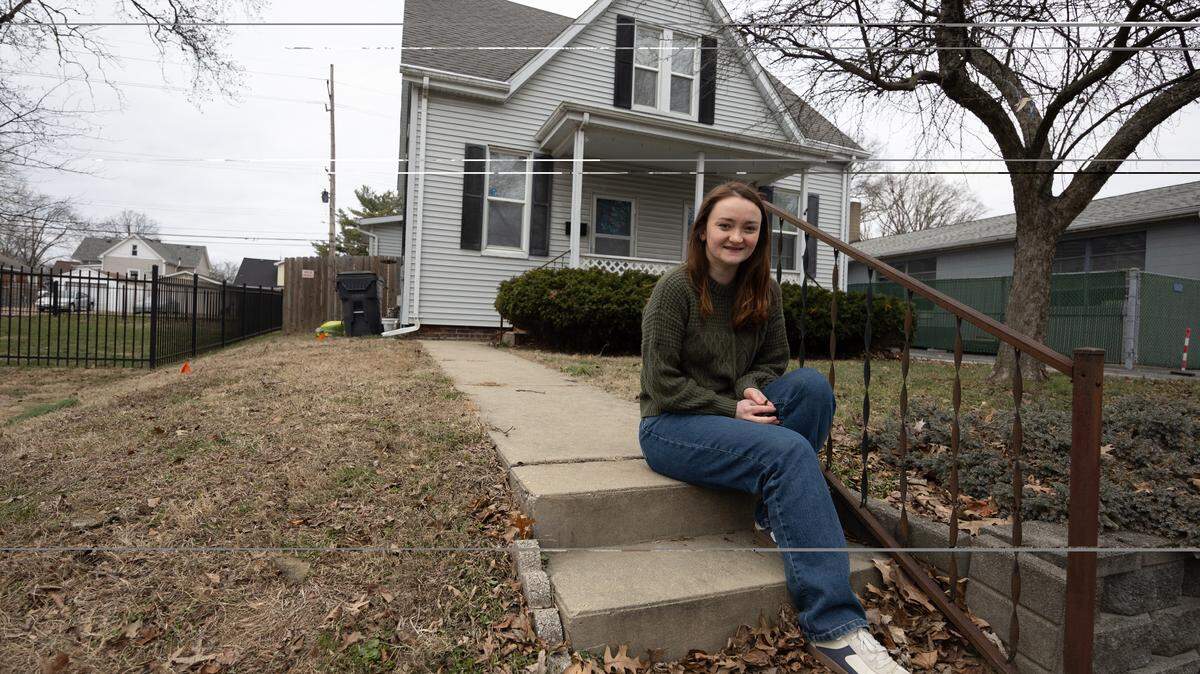
A Belleville woman is pushing back against a City Council decision that will keep her from expanding her Airbnb, and she is accusing an alderman of lying about neighborhood “concerns.”
The controversy has resurrected the issue of whether the city has sufficient policies in place to control the burgeoning short-term-rental market while treating property owners, neighbors, landlords and hotel proprietors with consistency and fairness.
Last month, 14 aldermen followed Ward 1 Alderman Bryan Whitaker’s lead by denying Vicki Martin a special-use permit to expand her Airbnb from one side to both sides of a duplex on North Charles Street.
That decision came despite no residents opposing the request during a Zoning Board of Appeals hearing or subsequent City Council meeting. Zoning Board members also unanimously recommended approval.
“I know how due process works, and I knew immediately that my due-process rights were being violated,” Martin said last week.
Whitaker said neighbors were OK with Martin operating an Airbnb at her duplex when she was living on one side and able to monitor it to quickly address any problems, but they were concerned about her plan to move to another location and rent out both sides.
The city ordinance governing short-term rentals doesn’t require Airbnb owners to live on site, and many live elsewhere.
Martin said Whitaker has refused to identify the concerned neighbors or explain why they didn’t oppose her request publicly. She said she spoke with all contiguous neighbors, and they were fine with her plan.
Whitaker said short-term-rental requests must be considered case by case, accounting for factors such as Martin’s property being near Jefferson School.
“We’ve had some significant problems with rental property in that area, and neighbors are concerned, and it’s our job as the aldermen to represent everyone in the ward and bring forth issues on their behalf,” he said.
Martin said her Airbnb guests have caused no problems in the past three years, and people don’t seem worried about a Sav-On Liquor & Wine store in the neighborhood.
In January, the City Council approved a special-use permit for a new Airbnb unit at 1009 Lasalle St. That property isn’t owner-occupied, according to St. Clair County parcel records.
“It’s even closer to Jefferson School,” Martin said.
The roots of Airbnb go back to 2007, when two San Francisco roommates put an air mattress in their living room and turned it into a bed and breakfast.
The following year, the roommates and a friend launched a website, then called Airbed & Breakfast, that functioned as a marketplace for short-term stays, particularly in saturated markets. The company charged a commission for each booking.
“(Airbnb) has since grown to over 5 million hosts who have welcomed over 2 billion guest arrivals in almost every country across the globe,” according to the company’s website.
Short-term rentals can range from single bedrooms to entire homes or apartments.
As of early December, Airbnb.com listed 79 short-term rentals in Belleville, while only 28 property owners had obtained the required special-use permits. Three more permits were approved last week for a total of 31. It is possible some of the 79 rentals are outside city limits.
Dusty Hosna, the city’s new zoning administrator, said communities nationwide are struggling to get accurate inventories of Airbnbs and regulate them with limited resources.
“It’s really just to protect neighborhoods,” said Hosna, who’s been on the job for two months. “That’s what zoning is.”
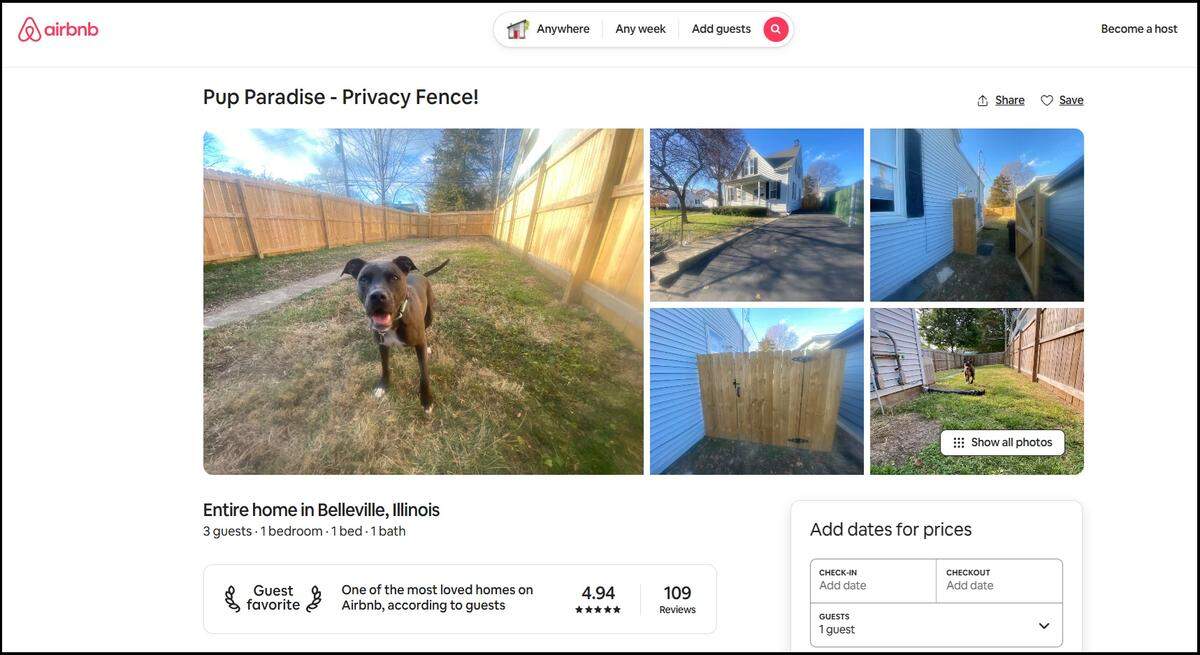
Promoted as ‘pup paradise’
Martin, 31, owns a historic white-frame duplex at 1639 and 1641 N. Charles St. The neighborhood is zoned single-family, but variances allow mixed use. Four commercial businesses operate in the same block. American Plating Co. is next door.
The City Council approved Martin’s first request for a special-use permit in 2022 to operate a short-term rental at 1641 N. Charles St.
Today, Martin advertises her Airbnb as a “pup paradise,” catering to guests with dogs. They pay about $150 a night, which allows access to a private fenced-in exercise area in back.
Stays range from a long weekend to three weeks, Martin said. She estimates that the unit is occupied 20 nights a month, generating hotel-motel taxes for the city. Former guests have given her an average rating of 4.94 out of five stars on Airbnb.com.
“I’ve never had the police called to my property,” Martin said. “I’ve never had any complaints from neighbors.”
Martin said she applied for a second special-use permit for 1639 N. Charles St. this fall so she could rent out both sides of the duplex while living elsewhere, but she planned to continue cleaning and monitoring them herself.
No residents or city officials spoke against Martin’s request at the Zoning Board hearing on Oct. 23, according to minutes. Board members voted 5-0 to recommend approval.
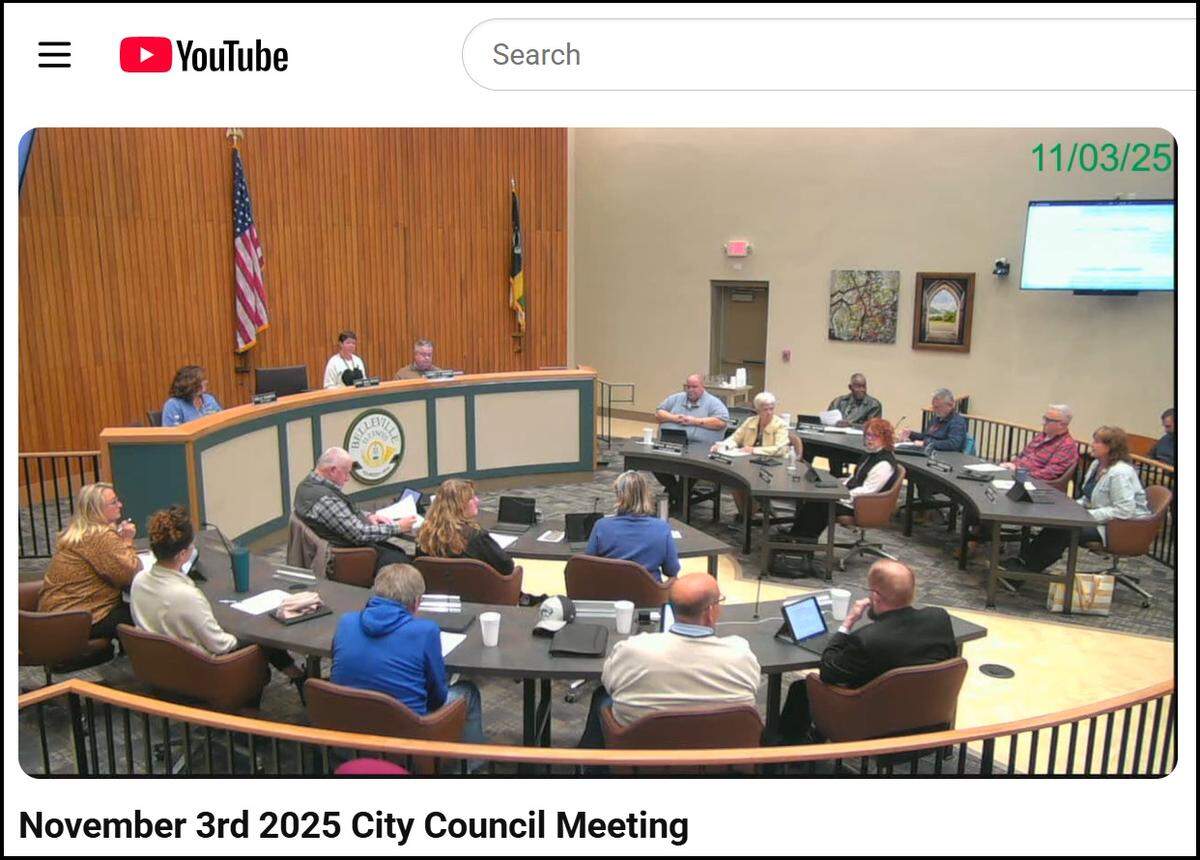
No one spoke against the request at the City Council meeting on Nov. 3, either. But just before the vote, Ward 1 Alderwoman Lillian Schneider motioned to deny. She said Martin did not seem “organized” at the Zoning Board hearing, and the unit had no dishwasher.
“Several of the neighbors have brought concerns regarding this property,” Whitaker said, later calling the concerns “severe” and warning that problems could arise in Martin’s absence.
No aldermen asked questions before voting 15-0 to deny Martin’s request. Ward 4 Alderman Raffi Ovian had stepped away from the meeting and was marked absent.
Martin said she was “shocked” by the vote. She called Whitaker’s comment about “several” neighbors being concerned a “lie” and accused him and Schneider of staging an “ambush,” noting neither had reached out to her before, during or after the Zoning Board hearing.
Hosna confirmed that the city’s zoning department received no complaints or letters of opposition to Martin’s request. Such materials are generally included in Zoning Board packets.
“The voting (at the City Council meeting) came as a surprise to all of us,” Hosna said. “I had no clue that it was going to go that way.”
Schneider later said she believes the city needs to do more monitoring of short-term rentals to make sure owners are following the rules and not being allowed to improperly avoid requirements of the city’s crime-free housing program for long-term rentals.
Martin must wait six months to reapply for a special-use permit, and there is no guarantee that the City Council will approve it.
Three of 34 requests denied
Cliff Cross, former director of economic development, planning and zoning, told aldermen in 2023 that the city needed an ordinance for short-term rentals due to the nationwide proliferation of Airbnbs.
Specifically, Cross said he wanted to ensure owners were getting business licenses and zoning permits, meeting building and occupancy codes, and paying the city’s 8% hotel-motel tax.
“We’ve had many discussions about this,” he said at the time. “The point I’ve made is, ‘We’ve got to get a grip on how we’re addressing Airbnbs,’ partly because of the hotel-motel tax and partly because this is a community that is trying to attract hotels, which in a sense could look at them as competitors.”
The City Council approved an ordinance requiring licensing and inspections and limiting stays to 30 consecutive days.
Since 2019, the city has received 34 requests for special-use permits for short-term rentals. Three, including the recent one from Martin, have been denied, according to a list provided by City Clerk Shelly Schaefer.
In 2020, Georgia Huelsman sought to turn a three-bedroom home at 220 Chevy Chase Drive into an Airbnb. Former Ward 8 Alderman Roger Barfield testified that 50% of area residents were against it. One person submitted a letter to that effect.
The Zoning Board voted 5-2 to recommend approval. The City Council voted 13-0 to deny.
“Alderman (Roger) Wigginton stated he is not against (Airbnbs),” meeting minutes state. “This property will probably go rental; the problem is the residents in Ogles Subdivision do not know what an Airbnb is.”
Last year, Thomas Davis requested a special-use permit to turn a home he had inherited from his late sister at 3713 W. Main Street into a short-term rental. But he did so only after officials had determined he was already violating code by renting it out.
A neighbor next door also opposed the request, complaining about vandalism on his property. The Zoning Board vote was split, and the City Council voted 16-0 to deny.
Ward 3 Alderman Kent Randle used the opportunity to voice his opinion that the city was not adequately regulating Airbnbs.
“I believe we have a responsibility to neighbors and fellow residents to ensure that we have a proper handle on Short-Term Rentals,” he said, according to meeting minutes.
“That we are one, able to account for all properties currently being used as Short-Term Rentals. That’s not being done. That we identify those that are not and enforce our ordinances.”
Randle voted with the majority on Nov. 3 to deny Martin’s request. After the meeting, he did not respond to requests for comment.
Martin said it is upsetting that someone like her, who is following the rules and operating a reputable business, is being treated poorly by the city when many Airbnb operators are not getting permits or paying taxes.
Last week, aldermen approved special-use permits for three new short-term rentals at 126 W. A St., 329 N. Illinois St. and 310 E. Washington St., increasing the number of permits from 28 to 31.
Martin spoke at the City Council meeting in favor of the three Airbnbs. She said they will benefit the community by bringing travelers to eat in restaurants and shop in stores, and by housing nurses, military personnel and others with temporary job assignments.
“I really do think Airbnbs are good for Belleville,” she said.