
O’Fallon ‘Cemetery Detectives’ leave no stone unturned
They call themselves Cemetery Detectives. But they are much more, as they traverse St. Clair, Madison, Monroe and Randolph counties, hunting for ancestral burial grounds and discovering local history on their excursions.
For the O’Fallon Historical Society “Cemetery Detectives,” an overgrown patch of land with broken gravestones has often become a treasure trove.
For instance, one Saturday last November, they had planned to finish repairs on the Noah Sparks gravestone in Sparks Cemetery on private property in O’Fallon, with permission.
Tim Ogle and the late James Papproth, a few weeks before he died, had found that grave the summer of 2018. Sparks was born in 1806 and died of cholera in 1850 in Caseyville Township.
James’ grandmother, Babe Papproth, discovered another cemetery during the regular group outing.
“Thanks to Whitney Wisnasky-Bettorf, Babe’s daughter, we visited another old historic cemetery in disrepair and found more lost buried grave stones,” Ogle said. “This old cemetery is associated with the oldest continuance Baptist cemetery in the State of Illinois, Bethel Baptist. The Cemetery is called Lemen Family Cemetery.”
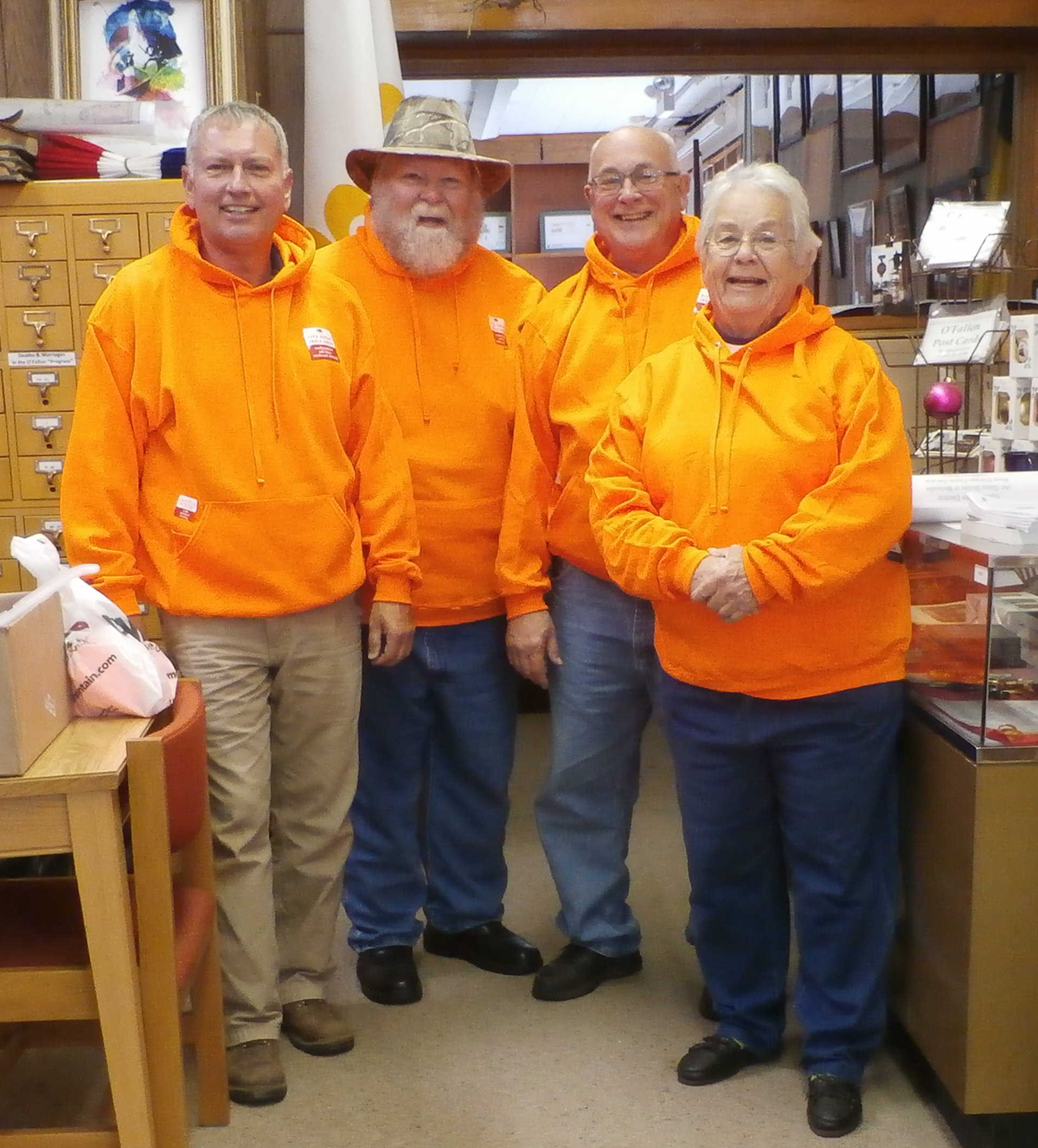
All in a day’s work, and more to do for the members, who have turned this into a fulfilling hobby.
“It’s hard to fathom how much work this is,” Ogle said.
They take care of the supplies and labor themselves, sometimes receiving donations. They usually meet the fourth Wednesday of every month for their outings.
They have purchased bright orange hunter’s hooded jackets and hats to be visible in case anyone deer-hunting in the area mistakes their rustling for an animal. The items are for sale at the O’Fallon Historical Society museum.
Members have grown over the years, but the nucleus is Papproth, Ogle, Tom Schwarztrauber and Vern Malare, all O’Fallon Historical Society members and ardent history buffs with a fascination about genealogy.
Tom Schwarztrauber started the group, first known as the “Cousins” Field Trips. He seems to be related to everyone — you might want to check to see if he’s connected to your family as a cousin.
Schwarztrauber, a retired pharmacist who grew up in Belleville and now lives in St. Louis, lived for a time at a family farm in Shiloh.
“A few years back, I started visiting more and more local cemeteries, influenced greatly by Cousins Dorothy Scott Falk and Babe Papproth. We would go visit a cemetery on Wednesday mornings, then have lunch. Afterwards we’d go to the O’Fallon Historical Society Museum for our Wednesday volunteer time from 1-4 p.m.,” he said.
Malare, a lifelong O’Fallon resident, started out as a volunteer, but put in more hours than any other non-member volunteer, so he joined.
Ogle, a retired firefighter in St. Louis, wanted to find out more about his relatives. He is related to O’Fallon’s first known resident, Capt. Joseph Ogle, a Revolutionary War veteran. Donn Beedle, who lives in Columbia, helps. He is related to the same Beedle family that counts actor William Holden, born Beedle, in their ranks.
Though Native American settlement dates back centuries, O’Fallon’s first modern-day settlement was made in 1802.
Papproth, who was born and has lived on the same street in O’Fallon for 83 years, has been visiting old cemeteries for many years. She located them through old Plat Maps — cemeteries are marked with a little cross on the properties. For many years, she was accompanied by her grandson, affectionately known as “James #13” to indicate he was her 13th grandchild.
A font of local history, Babe has her old plat books at the ready.
“I don’t remember not seeing cemeteries and wanting to find out more,” she said. “When my kids were little, we didn’t have a car, so we would walk. We’d take a lunch, sit and talk. The kids would see the cemeteries and notice the gravestones. ‘He was in the Civil War!’ one would say,” she said.
“There are a lot of old cemeteries here. The old farmers are buried on their grounds,” she said.
The area was settled by people drawn to the rich land well-suited to agriculture. John Mason Peck founded Rock Spring Seminary in 1827, the first college in Illinois. Coal mining began in the mid-19th century and the railroad was built, using the depot at O’Fallon Station.
Schwarztrauber said the group comes up with a list of projects each year. Besides Sparks and Shiloh Valley, cemeteries they have worked in or continue to work in, no matter how much mud, are: Simmons, Lemen, College Hill and other historic family cemeteries on private property, asking permission.
One of the most challenging repairs was the huge Rachael Dorey ledger grave cover stone, which they could not lift. Dated from 1845, it was 3 foot by 7 foot, the stone of Dorey and her infant son Lewis. It was their largest marker to date.
“The best we could do was encircle it with a protective paver edging — my idea and my wife, Sharon Danner-Schwarztrauber’s, design and installation, with the help of the entire OHS Cemetery Detectives team,” he said.
He had found this grave by grave dowsing, and then exposed it to sunlight again. Tom and his wife diagrammed the 44 stone pavers as a protective perimeter edge around it. They hauled the stone pavers from their home in Richmond Heights, Missouri, and at a monthly outing of the CD, they installed the pavers.
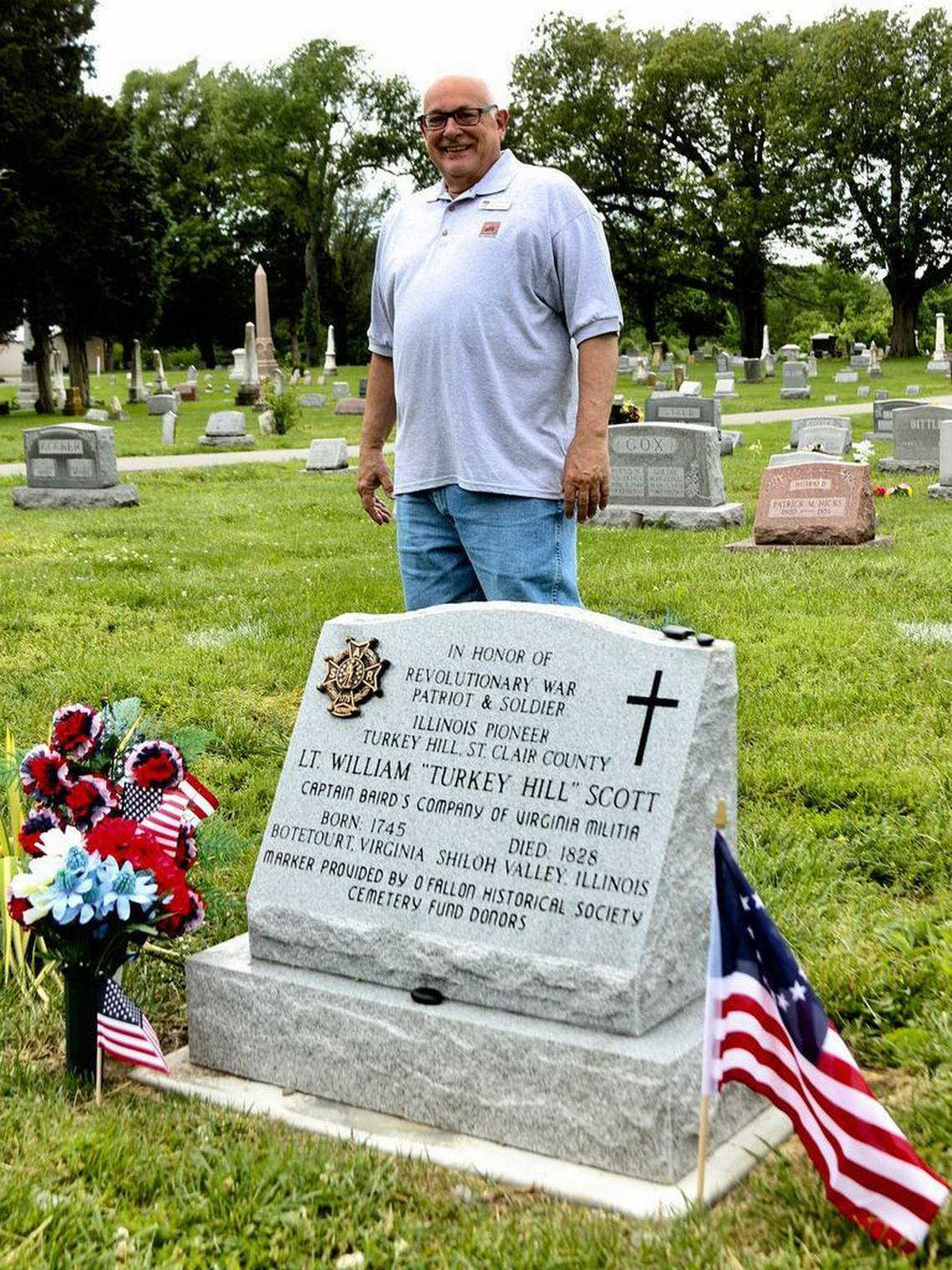
“Just the way it had been envisioned — a perfect fit!” he said.
Besides the original four and his wife, Tom said Janet Hinchcliffe-Alexander and Kevin Collins, who came from Ft. Worth, Texas, helped. Collins’ ancestral cemetery is the Simpson one.
They hoped the rains would wash the stone white again and be more legible.
“It has been an honor to bring to light and then to protect this 20-year-old mother and her 5-month-old child’s grave stone in Shiloh Valley Cemetery,” he said.
Through grave dowsing, Schwarztrauber found six more graves along Main Street, so his total is more than 60 unknown graves he has discovered, new and unknown, located in Shiloh.
The Sparks Cemetery was their pet project last summer and fall. An old family cemetery, it is off Taylor Road in O’Fallon, and has about 40 graves. The patriarch was David Sparks, Sr., who lived from 1770 to 1845.
The new owners of the 9-acre property, the Kreidells, gave the group permission to restore the cemetery. The group cut down and removed overgrown brush, honeysuckle bushes and trees ranging in age from 10-20 years, to reveal a beautiful scenic landscape by a small lake.
“They came into the O’Fallon Historical Society Museum and requested the help of the cemetery detectives to help them reclaim the cemetery that was now a thickly wooded lot and several gravestones in very sad condition,” Schwarztrauber said. “We were given the OK to do whatever we deemed necessary.”
They have built a brick platform to eventually put a rocking chair or bench there, for people to use while visiting.
Through grave dowsing, which is locating the graves, for many that have no visible gravestones, they have placed marking flags in either blue or pink, indicating sex.
Ogle said they can determine if it is the grave of an adult or child by the length.
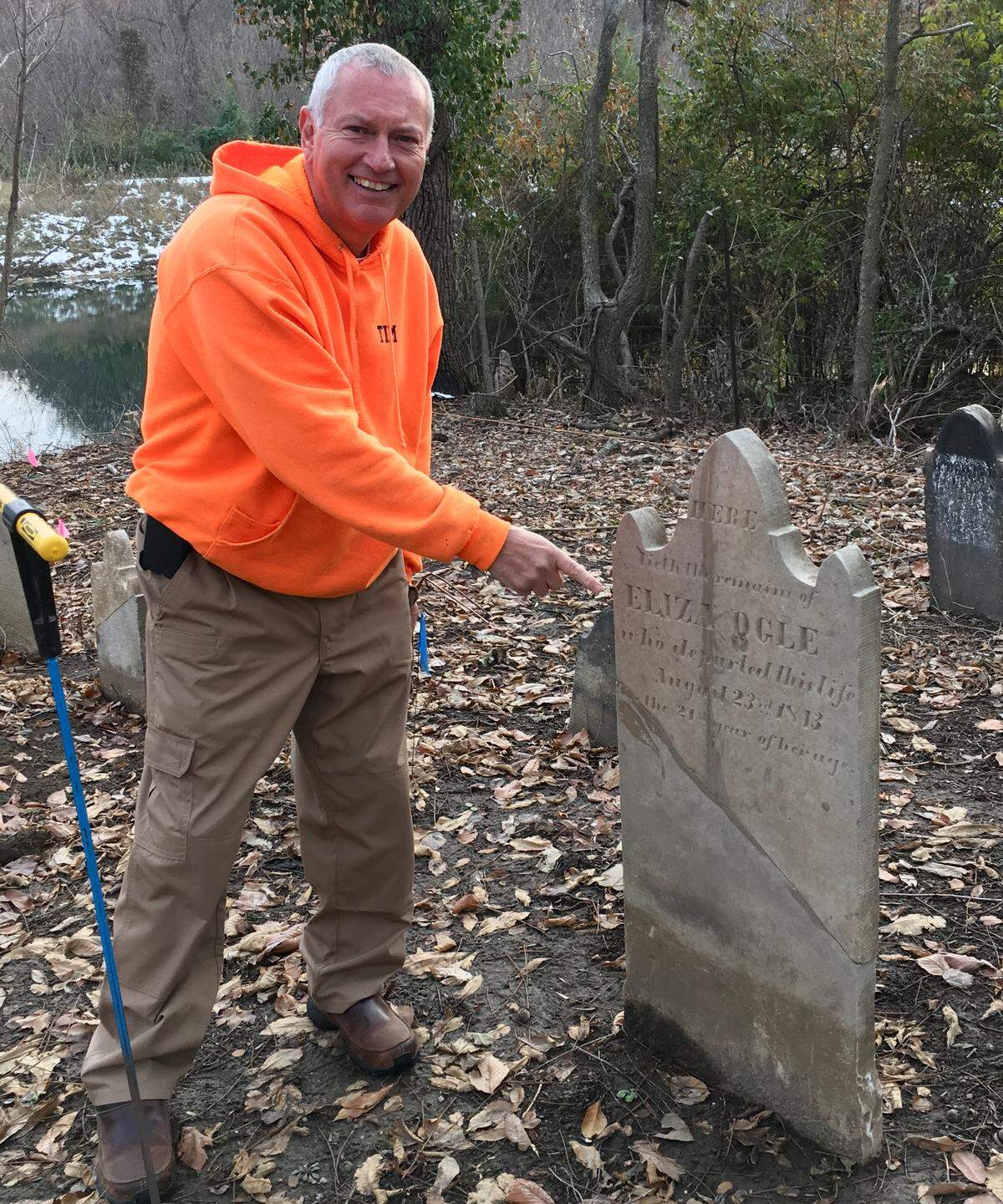
“Some people do not believe this, but it does work,” he said.
The St. Clair County Genealogical Society has presented grave dowsing programs. Ogle learned from expert Dylane Doerr of Columbia.
Ogle also explained probing, He said this is done to see if there is a striking sound of the probe hitting buried stone, which could be a base stone that the gravestone slides into or a foot stone, which only have initials and were placed at the grave’s foot, or the gravestone that identifies the individual.
“Some of the stones we have found are just below the surface — a couple inches down. But some of them are 3-feet below ground level, like someone buried them and then dumped a lot of dirt on the grave,” he said.
While showing the Noah Sparks gravestone’s specially designed stainless-steel brace, Ogle explained they could not repair gravestones in multiple pieces without this bracket.
“James #13 found this July 25, 2018, and sadly, a month later, Aug. 25, he died,” Ogle said. “Without his help, the pieces of this grave and its stones would not have been able to honor this pioneer farmer who was a cholera victim in 1850. Without him, we would not have found the bottom portion. The top portion had been visible, sitting next to a tree stump for many years in the cemetery.”
They attached a memorial plate on the top to honor James #13.
The deeply buried gravestone of infant John S. Bevirt (1859-1860) proved to be quite a chore.
“The stone was blocked by a tree’s roots and the tree growing over it — Tim Ogle and James Thomas Papproth (affectionately referred to as James #13), tried for an hour digging and chopping at the tree roots, but were unable to remove the 25 to 30 year-old tree, So it would require another day and other equipment to extricate the stone and bring it to the surface,” Schwarztrauber said.
“Tim Ogle returned and was able to remove the tree roots and release the gravestone, which was 35 inches’ deep. Now it is again in the sun lit Sparks Cemetery.”
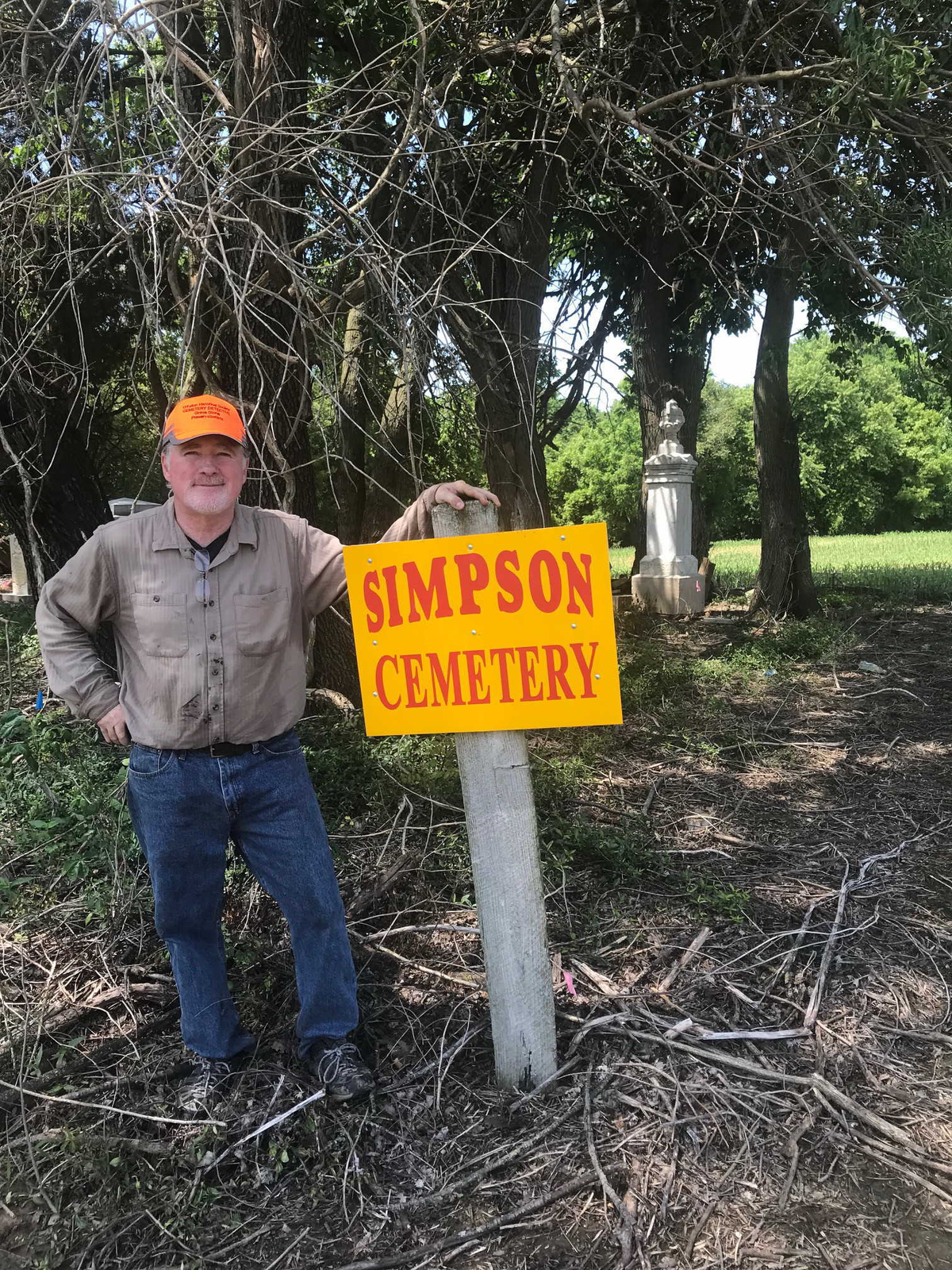
Schwarztrauber said he has placed markers for American Patriots Pvt. Larkin Rutherford and Lt. “Turkey Hill” Scott at the Shiloh Valley Cemetery in Shiloh Valley Cemetery Shiloh; and for Rev. John Mason Peck at the Rock Spring Cemetery, O’Fallon Township, St Clair County.
The Bridges research began in hopes of it being the next project after Sparks. The Bridges Family decided to purchase a memorial cenotaph.
Schwarztrauber sought permission of the property owner and arranged the SAR dedication at the historic family cemetery on Hagemann Road.
To repair gravestones of John B. Melvin and his brother, James Melvin, in the Rock Spring Cemetery, Schwarztrauber said he used injection grout to repair the broken pieces — 20 minutes to set and 20 days to cure — and they were re-set in new concrete bases.
His projects are vast, but there are a few “detective finds” that he lists as his greatest.
No. 2 occurred while visiting the Beedle Cemetery in October 2014 on “Cousin” Frank Niebruegge’s property.
“I decided to try to find, by grave dowsing, that second cemetery that was marked as just a cross on an old plat map at the extreme southwest corner. The area where I believed it to be was now part of the huge woods on the acreage. As I was telling cousin Tim Ogle that this is where I thought it should be, as I began stepping forward my copper dowsing rods crossed before me. I had found a grave. I continued the difficult dowsing process, as the area was filled with chest high weeds, which made dowsing nearly impossible. I found three graves. I placed perimeter caution warning tape,” he said.
That was the Piggott Cemetery in Caseyville Township.
During numerous trips back, he planted 100 daffodil bulbs and removed excess vegetation. He also located living descendants of the Levi 2 Piggott family.
More trips revealed victims of the cholera epidemic. In 2015, he visited the Baer Family Cemetery behind Fairwood Hills in O’Fallon, discovering several unmarked graves and three cousins who died on the same day.
He would visit the St. Clair County Poor House Cemetery, the Badgley Cemetery on Old Caseyville Road in Swansea, Simpson Cemetery on Old Collinsville Road in Caseyville, Widicus Cemetery in a wooded lot, and two cemeteries alongside Illinois 13, south of Eckert’s — the Spitznass-Wilderman Cemetery and another Wilderman Cemetery.
And they explored Monroe County — the Palmier Cemetery and the Eagle Cliff-Miles Cemetery on the Bluff.
But his greatest find would be the long-lost Turkey Hill Cemetery in April 2015. Years ago, a relative had said from her front room, just on the southside of Old Freeburg Road at Illinois 15, that she could see gravestones of the Turkey Hill Cemetery on a ridge. But a farmer that owned the property had later supposedly removed all the gravestones and threw them in the ravine near the railroad tracks.
“He would not allow any visiting family member access to the property — it remained corn fields for years and years, until that morning,” Schwarztrauber said.
He grave-dowsed the 41-acre field of cousin Arden Weiss, a Wilderman, and was walking back and forth slowly with the copper dowsing rods.
“I believed that was the area that Carolyn’s mother had described, that ridge between Wilderman’s Cemetery and the Illinois Central Railroad’s tracks. While growing weary and still praying that I could find a grave, my rods crossed!”
He had found the grave of his fifth-great-grandfather, American Patriot Corporal Joseph Carr of the Culpeper Minutemen, 10th Virginia Regiment. His coordinates through his iPhone compass matched.
Resources for research include the plat maps, area historical societies and genealogy societies. If it’s a sunny Saturday, people will find the OHS Cemetery Detectives at work.
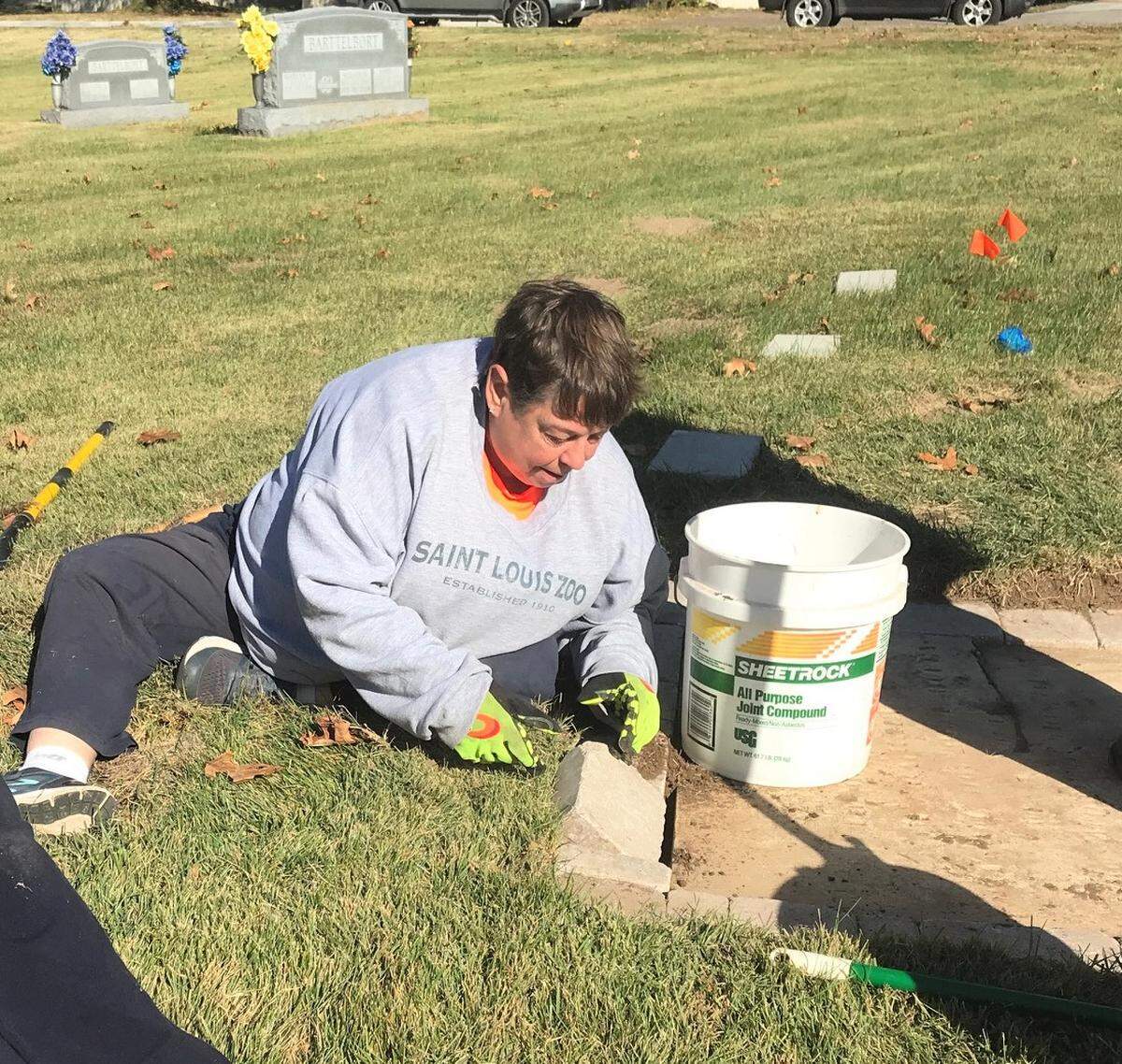
“While we were waiting for the ceremony and after the ceremony, we continued our work there and found three grave stone bases, bottom half of a grave stone probably George Bridges, two foot stones GB and JAB (Juley Ann Bridges) and the two broken pieces that completed the gravestone for Margaret Bridges. These two pieces were an answer to my prayers, as I thought these were lost forever,” Schwarztrauber said.
For more information, he can be reached at the O’Fallon Historical Society Museum every Wednesday, as he volunteers from 1-4 p.m., or by email: infot@ofallonhistory.net
The November meeting of the O’Fallon Historical Society is set for 7 p.m. on Tuesday, Nov. 19, at the OHS Museum, 101 W. State St., O’Fallon. The program will feature Randy Beck who will talk about The Civil War and discuss the 117th Illinois Infantry Volunteers, 1862-1865 — The McKendree Regiment (local O’Fallon, Shiloh, Lebanon volunteers). All are welcome and it’s a free event.
This story was originally published November 12, 2019 at 12:34 PM.