
How can Highway 50 be improved in O’Fallon? Designers want to know what you think
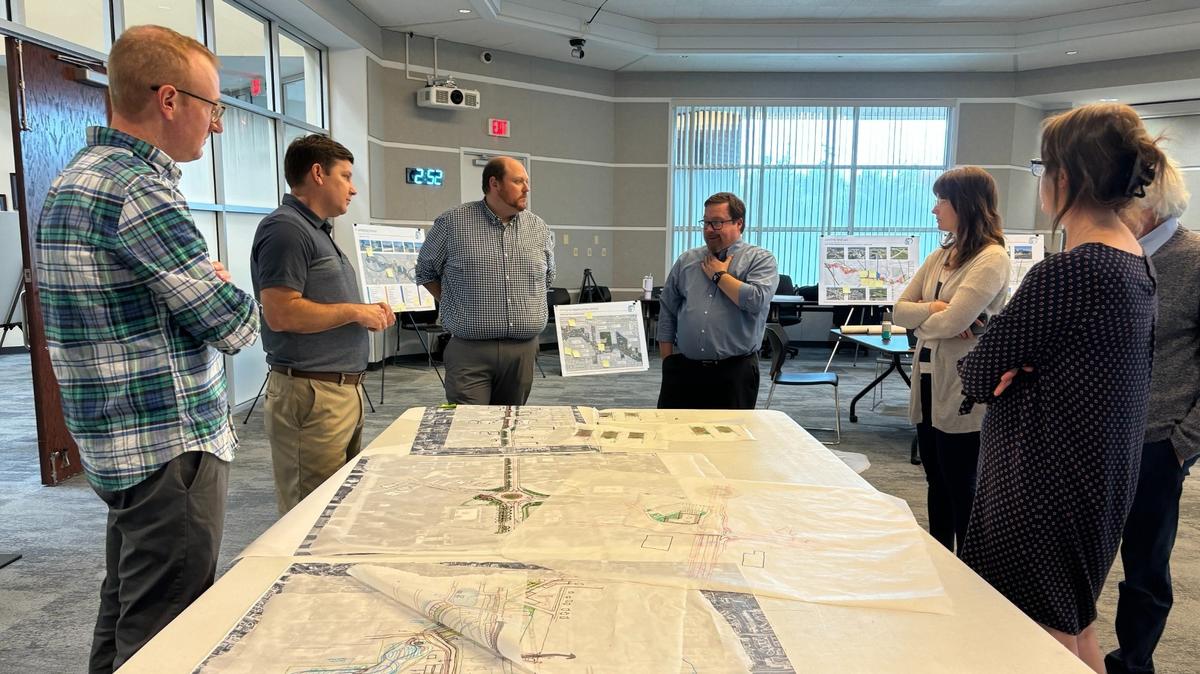
How would you define what makes a public space great? What don’t you like? What do you think is best for O’Fallon? Residents have been asked to help plan the city’s future by providing input for the U.S. 50 Highway Study now underway.
Called “Forward 50,” it is expected to improve the function and appearance of the O’Fallon community. In six months, refined plan concepts based on public feedback will be presented before the project’s expected completion next June.
Community Development Director Justin Randall said this public planning and engagement initiative wants to hear O’Fallon residents’ ideas, concerns, and preferences.
“You can ask planners to draw your ideas in real time and experiment with possibilities,” he said. “They will map your ideas and concerns.”
After a series of Design Workshops that are taking place with city planners at City Hall, Randall said feedback has been useful.
“We had several members of the community come to the design workshop, some for the first time and quite a few returning for the third time (Oct. 24),” he said. “Ideas continue to be explored and more feedback was received on some of the concepts that have been drawn up.”
The next opportunity is Thursday, Nov. 9, from 5 to 7 p.m. when all the concepts from the areas targeted – central, west, and east – are pulled together.
An open house is planned for Tuesday, Dec. 5, from 5 to 7 p.m. for the public to review emerging concepts in a storyboard format, with a presentation at 5:30 p.m.
Highway 50 was the main thoroughfare through O’Fallon until Interstate 64 was built in 1975, and its function has changed over the years.
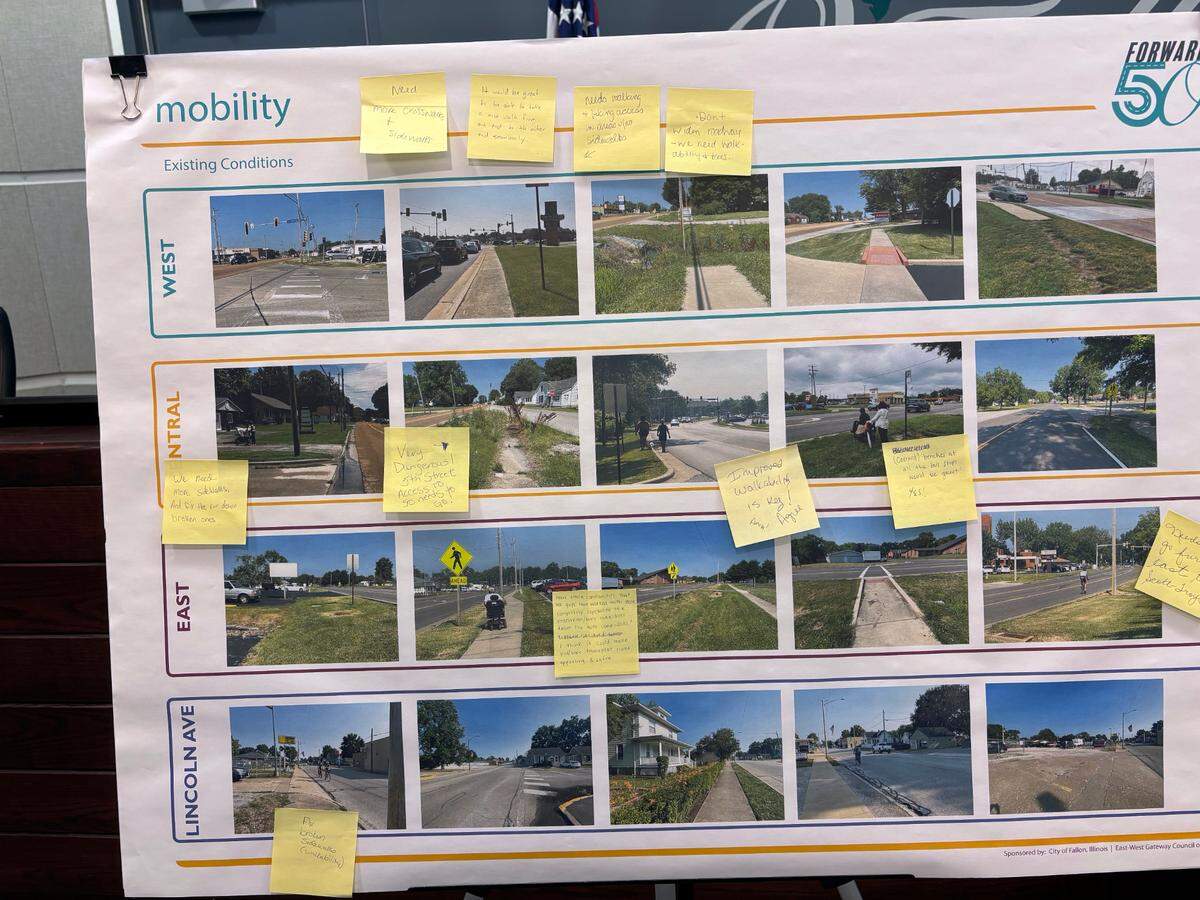
While it continues to support local access to businesses, schools, neighborhoods, health facilities, and parks for the city’s 32,000-plus residents, the town’s leadership believes segments of the corridor can operate better, especially when it comes to land use and mobility.
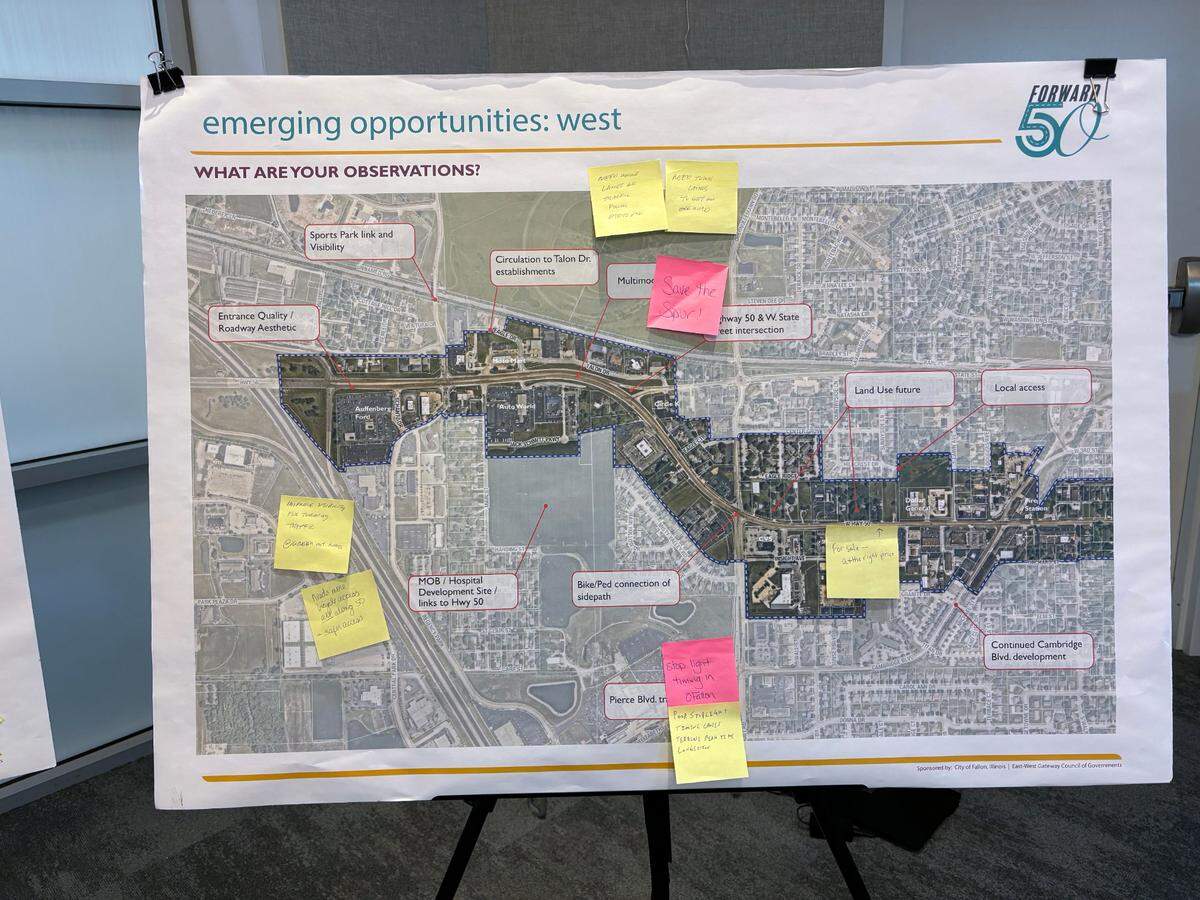
The study is to ensure the community is connected and supported throughout all the neighborhoods, look at market demands and potential changes in land use, identify strategies to improve safety for all modes of travel, and imagine aesthetic improvements to strengthen the area’s appeal.
RDG, a national planning and design group with an office in St. Louis, is the project director.
“This Great Streets Initiative allows residents to dream and plan for their ideal community asset - in this case, Highway 50,” said RDG Senior Manager Cory Scott. “These activities will help the team partner with the public to bring the best ideas to life.”
RDG has had ongoing conversations with city leadership and now, residents on mobility, land use and design, infrastructure, economic development and environmental and parks.
The project was launched in September after focus groups met – businesses, churches, educational groups, and civic and service organizations in August. Design meetings will continue this year, with a final open house set for April 2024 and completion expected in June 2024.
The west area is defined between I-64 and West 3rd St/Cambridge Blvd., while the central area is between West 3rd Street/Cambridge Boulevard and Weber Road, and the east is between Weber Road and Scott Troy intersection.
To see a schedule of events, a map of the project area, and more, visit: https://bit.ly/OFallonForward50
Marty Shukert, principal at RDG, has more than 40 years of experience in urban planning, and has been biking around town as he explores every facet of the city.
“We want to see what different options are feasible with the support of city staff and figure out the final piece of the puzzle. We’re trying to see if they work,” he said.
RDG has worked on similar-scale projects in Festus and Crystal City with Highway 61 in Missouri; Shawnee, Kansas, which is a city in the Kansas City metropolitan area; and Fayetteville, Arkansas.
“These are areas of real interest, corridors that have more potential than realized,” Shukert said. “We develop ideas with the community in mind, the connectivity that will benefit the district. We want to make it functional for everybody.”
Shukert has been impressed with the residents’ feedback.
“We have had a great turnout at meetings, there is a lot of enthusiasm,” he said. “It’s that feeling of community, that is real. And we need to look at a lot of little things.”
One area of dialogue is thinking of different ways to access high traffic areas, especially during rush hour. Safer environments are being discussed.
“There are some dangerous areas, with weird turns, and if we can convert these and other frustrations, if we can fix these, that’s progress,” Shukert said.
Pedestrian safety is another discussion, he said.
This highway study is part of the East-West Gateway Council of Governments’ Great Streets Initiative. It is funded, in part, through a grant from the U.S. Department of Transportation through the Illinois Department of Transportation.
In March, the city received a Great Streets grant for a detailed plan for Highway 50 from Exit 14 to Exit 19 and a portion of Lincoln Avenue. The grant is up to $500,000 and the city’s portion is $100,000.
Within the agreement, if the study doesn’t require the entire $500,000, East West Gateway will provide the city with a refund.
“Great Streets programs are often an endeavor to do some place making and space making along with economic development,” Randall said.
For more information about Forward 50, the city has begun putting information on their website:
https://www.ofallon.org/planning-zoning-division/pages/forward-50-great-streets-initiative.
If you have any further questions or comments, contact Justin Randall, Community Development Director jrandall@ofallon.org, or by calling (618) 624-4500.