Collinsville District 10 has long-term plan to maintain schools, but needs voters’ OK

Early voting in Illinois has started, and when some voters in Madison and St. Clair counties fill out their ballots, they’ll be asked whether Collinsville Community Unit School District 10 should increase the tax rate for its operations and maintenance fund from 50 to 72 cents.
It’s not a bond referendum, but rather a referendum requesting voter approval for the school board to transfer funds it will get from retiring bonds issued in the early 2000s to another part of its budget.
This would provide funding to make critical facility improvements at 11 out of the district’s 12 schools over the next several years, district officials say. The one not included is the new Caseyville Elementary School, which is currently being built and will open its doors to students in August 2024.
School district budgets are broken into separate funds. If the referendum passes, Collinsville 10 would redirect tax dollars it previously used to pay off bond debt from its debt service fund to its operations and maintenance fund. This would decrease the tax rate for the debt service fund by 22 cents and increase the tax rate for the operations and maintenance fund by the same amount.
The district’s overall tax rate — which is the sum of the tax rates for the separate funds within the budget and is what taxpayers see on their bill every year — would therefore not change, since the increasing tax rate in one fund would be offset by the decrease in the other.
The process, known as a “tax transfer,” would generate about $2.3 million annually, Superintendent Mark B. Skertich said. Combined with health and life safety money and accrued reserves, the transfer would allow the district to address the identified $35 million in needed facility improvements over the next seven to nine years.
Skertich said the alternative to the tax transfer would have been for the district to issue bonds anew and pay those off over the next 25 years, allowing the district to do the millions of dollars worth of work relatively quickly.
If the board did that, however, it would have to pay back about $20 million in interest on top of the principal amount of the bonds, which wouldn’t be cost effective, he said. The board felt strongly that it should avoid incurring new debt and paying millions of dollars in interest, he added.
The funding path proposed on the ballot would allow the money generated locally every year to go directly to the facilities improvements, which the district will tackle in chunks every summer.
“It’ll be the most cost effective way to complete projects,” Skertich said.
Facility needs
Over the past year, district staff, architects, and engineers worked to identify the most critical facility needs in the schools, focusing on safety and security, heating, ventilation and air conditioning, and accessibility for people with disabilities.
Then last August, the school board formed Kahoks Connect, a team of parents, community members and school staff charged with planning for the future of the district’s facilities.
In October, the committee hosted 11 tours at the schools and conducted a survey through November to get community input on how to address challenges related to the long-term maintenance and repair of facilities, the safety and security of students, and whether current facilities adequately meet student needs.
Nearly 200 community members, staff and committee members participated in the building tours, and the survey — which was administered over the phone and online — garnered more than 1,185 responses.
The Kahoks Connect team then compiled its key findings and recommendations based on the community feedback and presented a report to the school board in November. Among the recommendations were that the board use available reserves and put the tax rate proposition on the ballot to address immediate and future facility needs.
“Once that was done, not only did we have expert opinions from our architects and engineers, we had district staff, teachers, administrators, and then we also had community members coming in to voice what they thought was good and what needed to be improved, and that’s how we got to that $35 million number,” Skertich said.
“We had an estimated cost for everything, but it needed to be validated first, and then confirmed that they were, in fact, critical needs, not wants.”
He said safety and security is a primary focus not only for Collinsville 10, but for districts across the metro-east and the country. Heating and cooling is vital to maintaining a comfortable learning environment and reducing energy costs with more efficient equipment, he added.
“And then the last piece is — which is important as we foster independence — is to provide accessibility to all of our students and community members and staff members within our schools throughout the day,” Skertich said.
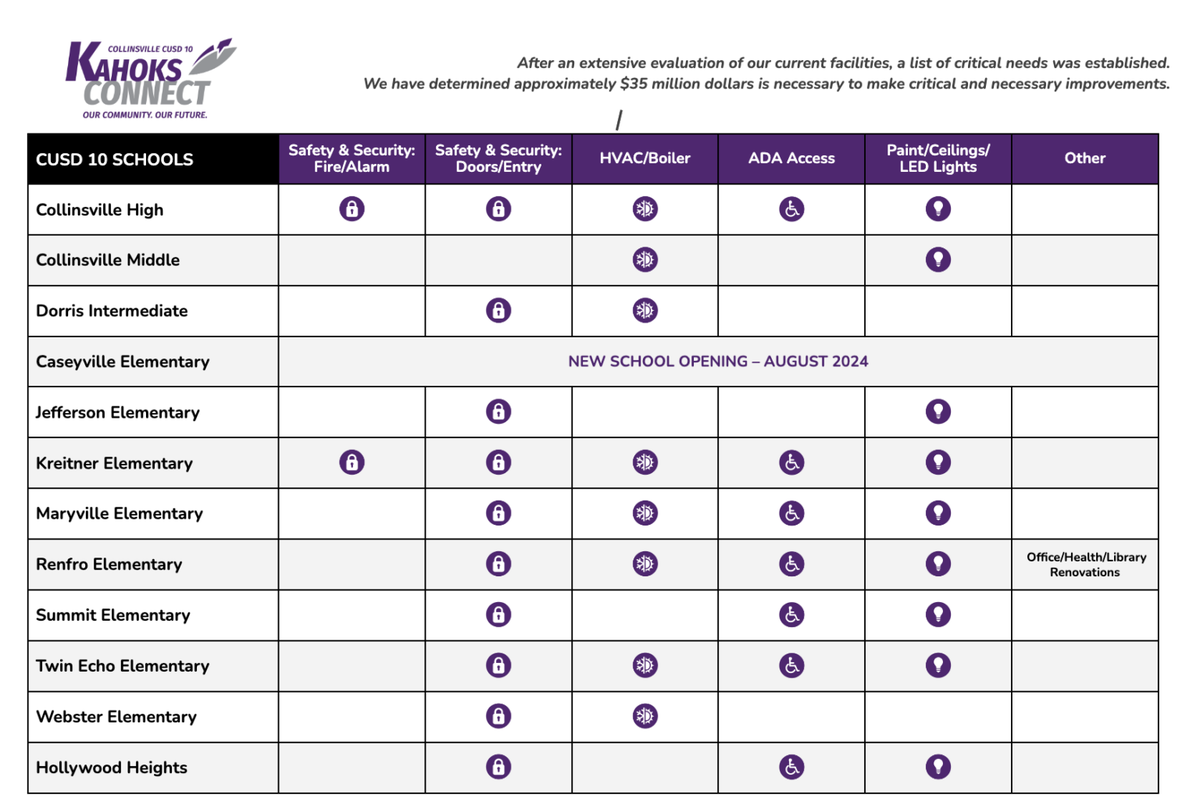
The tax transfer would result in a permanent change to the operations and maintenance fund tax rate. By the time the district catches up on the $35 million in identified improvements in seven to nine years, Skertich said, there will be more work to do.
The district’s schools have a value of more than $500 million, and the transfer would create a new funding source to continue paying for improvement projects as the schools wear down from thousands of kids and community members going through them every day, he said.
If there’s no work that needs to be done, the school board could abate those tax funds, Skertich said.
“But also the reality is, our facilities are going to continue to need work to maintain the quality of education that we provide.”
Here is the proposition that will be on the ballot for voters who live within Collinsville Community United School District 10:
“Shall the maximum annual tax rate for operations and maintenance purposes for Collinsville Community Unit School District Number 10, Madison and St. Clair Counties, Illinois, be increased and established at 0.72 percent upon all the taxable property of said School District at the value, as equalized or assessed by the Department of Revenue, instead of 0.50 percent, the present maximum rate otherwise applicable to the next taxes to be extended for said purposes?”
This story was originally published February 12, 2024 at 7:00 AM.