
Metro-east teachers fear closing the Department of Education will harm students. Here’s how
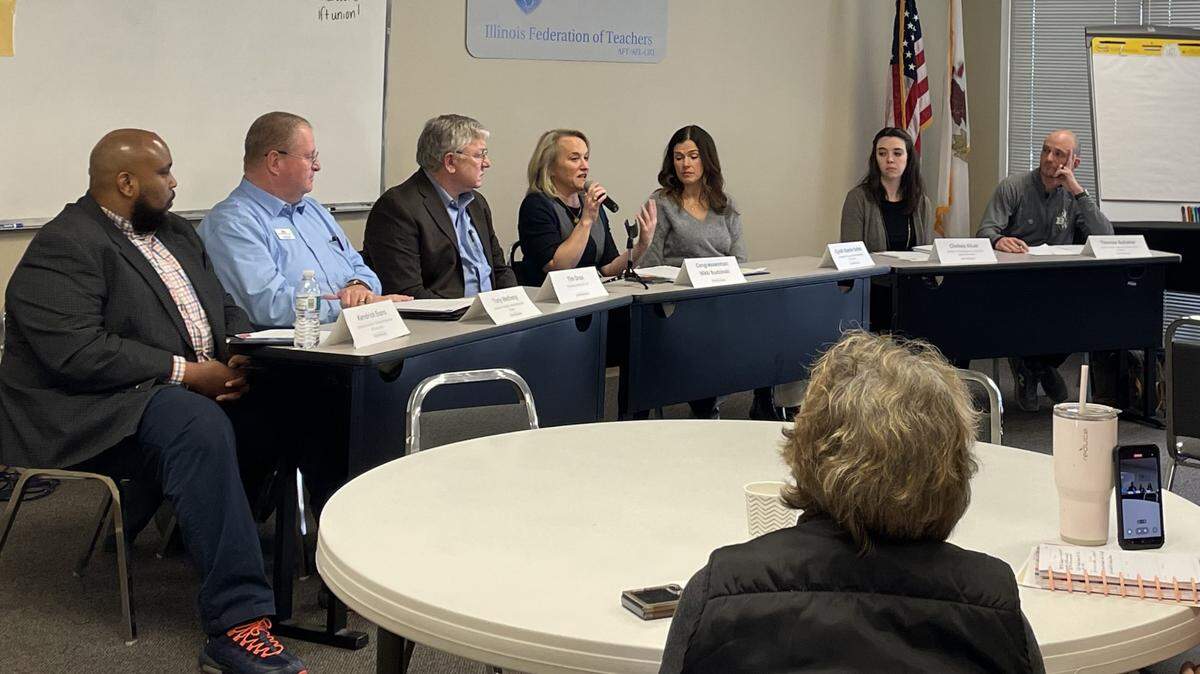
As President Donald Trump’s administration considers plans to dissolve the U.S. Department of Education, metro east educators are raising concerns about what that could mean for their most vulnerable students.
“I have nightmares about what’s going to happen to my children,” said Barbara Outten, a teacher with East St. Louis School District 189.
According to the Illinois State Board of Education, about 12% of Illinois school districts’ revenues for fiscal year 2023 came from the federal government. Most school funding comes from the state and local taxes.
But what that relatively small percentage of funding does is extremely important, said educators at a round table discussion hosted by the Illinois Federation of Teachers and U.S. Rep. Nikki Budzinski on Monday.
The federal government directs money to schools to serve low-income students through Title I funding and to support programs for students with disabilities under the Individuals With Disabilities Education Act (IDEA).
Completely abolishing the Department of Education would require an act of Congress, which could be politically challenging. Still, said Budzinski, D-Springfield, it’s important that lawmakers hear the concerns of educators before they act one way or the other.
“It is so important that I hear … the stories of what this will mean for our community, so that these cuts don’t feel like something that’s far away in Washington, D.C.,” Budzinski said. “It’s going to impact all of our school districts in Madison and St. Clair County if this administration moves forward with the elimination of the Department of Education.”
Teachers during the round table discussion zeroed in on three primary concerns related to the potential loss of federal funding and the elimination of the U.S. Department of Education. They are that:
Services for students with disabilities could disappear
Danita Springfield holds two roles in life: First, she’s the mother of a 13-year-old son who has autism and is nonspeaking.
“(He) has many skills that would not be able to be serviced in a traditional environment, but he flourishes at Illinois Center for Autism,” she said.
Second, she’s a special education teacher at East St. Louis School District 189.
Threats to the Department of Education impact both her family and the children she educates in her career, she said.
That’s largely because the federal department administers IDEA funding. It also contains the Office for Civil Rights, which is tasked with enforcing laws that protect against discrimination based on disability, race and more.
As Trump’s nominee for secretary of education Linda McMahon said during her confirmation hearing, moving duties of this office to the Department of Justice is being considered. The National Education Association said this would “severely weaken its ability to protect students.”
Low-income students could be hit disproportionately hard by funding cuts
As Outten pointed out Monday, Illinois State Board of Education shows 90% of students in the East St. Louis School District are considered low-income. In Belleville School District 118, nearly 70% meet this threshold.
These are all well above the statewide percentage of low-income students.
East St. Louis District 189’s fiscal year 2025 budget shows it received $6.7 million through Title I. Some of that money goes towards funding teaching positions. For Benitta Evans, a fifth grade teacher at the district, Title I funding pays her entire salary, she said Monday.
“I’m just really concerned about the number of staff who are going to be removed when that Title I money goes away,” Evans said. “We’re already suffering. I cannot think of one day this school year when we had 100% of staff in the building – not one day.”
Illinois’ teacher shortage could worsen
The present-day teacher shortage Evans alluded to was a recurring theme at Monday’s roundtable.
Zondra Moore, another teacher within the East St. Louis District, feared such federal shakeups would make an already hard job even tougher.
“I’ve been at this 23 years, and because of all of the politics and all of the mess with the adults, it makes it hard to stay,” Moore said. “They’re giving signing bonuses and all these balloons and ticker tapes – nobody wants to do it.”
U.S. Rep. Bost responds to teacher concerns
While it may be difficult to get a large majority of lawmakers to support dismantling the U.S. Department of Education, some are on board with the idea. U.S. Rep. Mary Miller, R-Hindsboro, whose 15th Legislative District encompasses parts of the metro east, recently co-sponsored a bill to terminate the department. She did not respond to requests for comment.
U.S. Rep. Mike Bost, R-Murphysboro, was not listed as a co-sponsor. The BND sent a list of questions to his office, asking his views of the Department of Education, its functions, and the concerns voiced by teachers at Monday’s round table. He responded with this statement:
“As the grandfather of 11 grandchildren, I fully understand the importance of a quality education. President Trump is rightly challenging the status quo in Washington to make government more efficient and accountable to the people. That doesn’t mean that core functions disappear or that important funding dries up. The goal is to empower parents and officials at the state and local level to make the best decisions for their children.
I believe that critical funding for important specialty programs will and must remain in place. That’s why I’ve previously cosponsored legislation, for example, to ensure that programs related to the Individuals with Disabilities Act are fully funded. We can hold on to and strengthen the programs that work, and we can improve those that haven’t given our children the foundation they need for success.”
This story was originally published February 20, 2025 at 6:00 AM.