Underwater salt kitchens reveal how ancient Mayans worked from home 1,300 years ago
Salt is a dinner-table staple, a cupboard must-have, and a pop-culture slang. It’s a culinary and dietary necessity for people today just like it was for the ancient Mayans over a century ago. But, unlike most households today, ancient Mayans produced salt in kitchens at their homes, according to findings from Belize.
Archaeologists mapped one of the largest ancient Mayans salt kitchens – a site called Ta’ab Nuk Na – submerged off the coast of Paynes Creek National Park in southern Belize, a study published in Antiquity on Oct. 7 said.
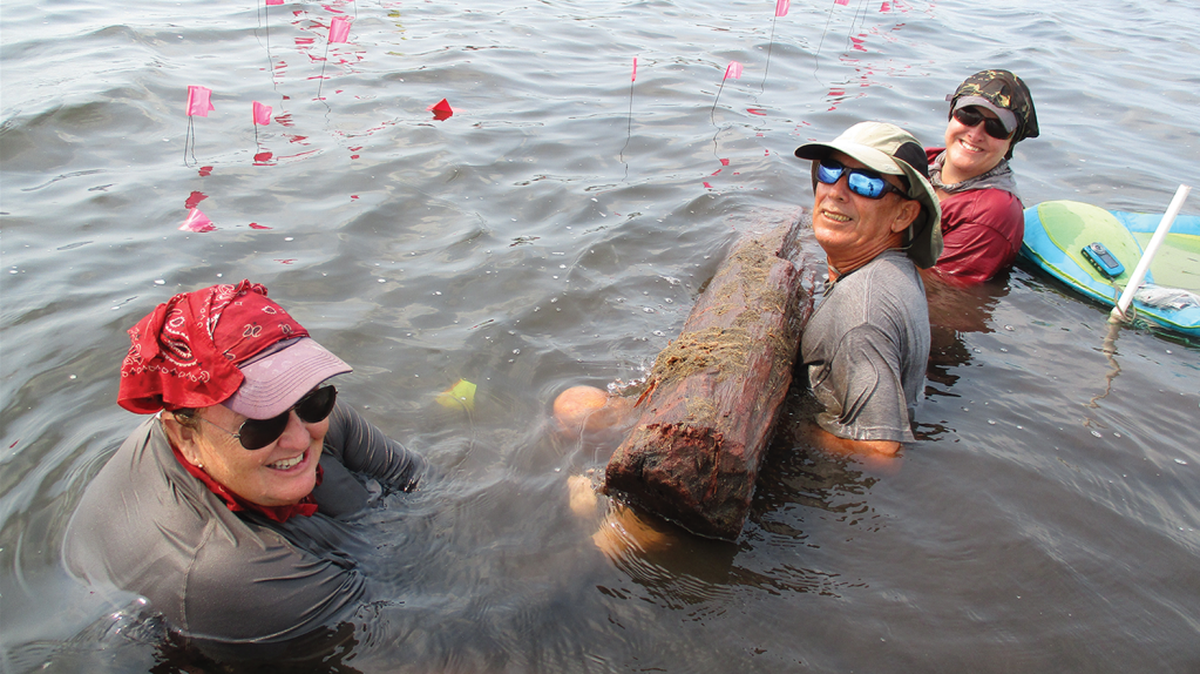
Researchers surveyed the submerged site and marked their discoveries – wooden posts, pottery fragments, and anything else noteworthy – with flags on the lagoon’s surface. The sea of more than 600 flags revealed 10 residential structures, three salt kitchens, and a glimpse into ancient Mayan life.
The wooden posts, remnants of pole-and-thatch buildings, were a rare find, experts said. “Since wood normally decays in the tropical landscape of the Maya area, the wooden buildings provide a rare view of the architecture that once dominated most ancient Maya communities,” E. Cory Sills, one of the study authors, told Louisiana State University. Sills works at the University of Texas at Tyler.
The oldest buildings dated to 300 A.D. with most buildings – and all salt kitchens – dating to about 700 A.D., the study said.
In the salt kitchens, people would boil a salty brine over a fire to evaporate the water and produce usable salt, researchers said in the study. These kitchens were found alongside the homes, indicating that salt production happened at homes likely in family-based groups, researchers said.
Household salt kitchens produced salt for their family and used the surplus at local or regional marketplaces, experts said. Ten salt kitchens would have produced about 7,500 pounds of salt every week – enough to support 24,000 people, according to expert estimates.
“The inland Maya needed salt — a basic biological necessity — which was scarce inland and most was supplied from salt works along the coasts,” Heather McKillop, one of the study authors, told Louisiana State University. McKillop is a professor in the LSU Department of Geography and Anthropology.
Ancient Mayan life at Ta’ab Nuk Na was not just salt production. Archaeologists found evidence of fishing gear, cotton-spinning, clay crafts, wood working, and even an ocarina, a flute-type musical instrument.
Paynes Creek National Park is about 85 miles south of Belize City.
This story was originally published October 17, 2022 at 5:11 PM with the headline "Underwater salt kitchens reveal how ancient Mayans worked from home 1,300 years ago."