
Rubio sanctions Díaz-Canel’s family, Castro’s son and entities ‘undermining’ the U.S.
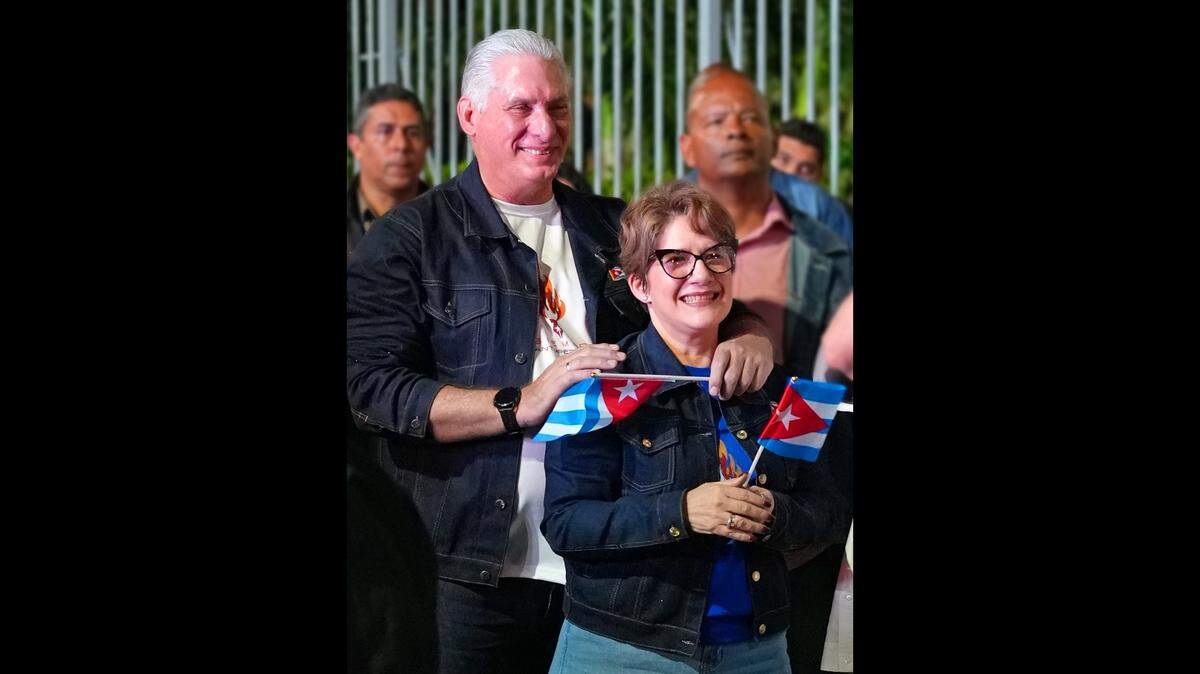
The U.S. State Department is imposing new sanctions Thursday on Cuba’s leader, Miguel Díaz-Canel, and his family, along with Alejandro Castro Espín, the son of Raúl Castro, and several other Cuban entities as the administration ratchets up the pressure on Cuban leaders to undertake democratic reforms on the communist-run island.
The administration is also sanctioning Díaz-Canel’s wife and Cuba’s unofficial first lady, Lis Cuesta Peraza, and Díaz-Canel’s stepson, Manuel Anido Cuesta, as well as Castro Espín’s son, Raúl Alejandro Castro Calis.
Díaz-Canel and Castro Espín had already been under U.S. sanctions, but so far their relatives had been able to travel, and in the case of Anido Cuesta, lived abroad with no repercussions. Miami Herald sources said Anido Cuesta, who lives in Spain, has been traveling to foreign nations lately as an unofficial envoy for his stepfather.
Castro Espín was the former head of Cuban intelligence services and was reportedly been promoted from colonel to general. He was the key Cuban negotiator with the Obama administration to establish diplomatic relations, and his designation signals the administration might see him this time as an obstacle in the ongoing talks with Cuba. The Trump administration has chosen a different person to negotiate with this time in the Castro family — Raúl Castro’s grandson, Raúl Guillermo Rodríguez Castro.
Secretary of State Marco Rubio is also sanctioning the Revolutionary Armed Forces, the Committees for the Defense of the Revolution and the Cuban Institute of Friendship with the People, an organization that disseminates “the Cuban regime’s radical ideology abroad” and supports Cuban intelligence and counterintelligence activities, he said in a statement. Also sanctioned is Amistur Cuba SA, the institute’s travel agency.
The sanctions block the assets of these individuals and entities in the U.S. and prohibit U.S. banks, companies, and individuals from making any transactions involving those designated.
The new designations stem from an executive order President Donald Trump signed on May 1 that also authorizes “secondary” sanctions on foreign companies and banks doing business in key Cuban sectors such as energy, defense and mining.
The State Department is also sanctioning another mining company, Minera La Victoria S.A., a Cuban gold-mining joint venture created by Australia-based entity Antilles Gold Ltd and Cuban SOE Geominera SA.
Earlier this month, Rubio announced sanctions on a Cuban mining company partnering with Canadian global mining giant Sherritt, which forced the latter to announce it was suspending operations and selling its interests in its Cuban business.
Last month, the administration sanctioned the military conglomerate GAESA and its president, Gen. Ania Guillermina Lastres Moreraas well as the Interior Ministry, the police, the head of the national assembly, and several generals and ministers.
In a statement, Rubio said the individuals and entities sanctioned Thursday “sustain the regime’s malicious campaign to subvert and destabilize U.S. national security.
“These sanctions target the Cuban regime’s wide-ranging and violent radical action network and the actors who implement and fund it,” he said. “Beginning with Fidel Castro’s program to globalize the so-called Marxist ‘revolution,’ Havana has served as a forward operating base for global irregular warfare against U.S. interests, recruiting, training and equipping violent left-wing militants across our region – including Marxist terrorist groups in the United States – with the ultimate goal of undermining U.S. national security.”
Sanctions on the Friendship Institute and the Committees for the Defense of the Revolution might have larger implications, since they sit at the center of Cuba’s “solidarity networks,” helping coordinate travel and meetings with government officials for groups of foreign activists who support the government in Havana.
Recently, Fox News reported that the Treasury and Justice departments have opened an inquiry into a recent trip by American left-wing activists to the island to find out if they violated U.S. sanctions on Cuba and laws regulating acting on behalf of a foreign government.
Cuban leaders are under unprecedented pressure from the Trump administration, which is pushing Havana to change its economic and political system. The new sanctions come as the administration is updating war plans to respond to potential turmoil on the island and after the Justice Department charged Raúl Castro for the murder of four people in the 1996 shootdown of two planes of the exile organization Brothers to the Rescue.
The administration has also sent a senior State Department delegation, the head of the CIA and, just last week, the head of the U.S. Southern Command to talk to Cuban officials, even as Rubio himself has hardened his rhetoric, calling Cuba a national security threat.
So far, Cuban leaders have signaled no inclination to make political concessions.
In a congressional hearing Wednesday, Rubio said the United States was open “to a negotiated situation that put Cuba on a path towards democracy, prosperity, freedom, normalcy,” but said it was difficult to find the person willing to do that.
“There are clearly people within the technocratic realm of a government that could play some role in all of this,” he said. “But ultimately, if you’re asking me, is there a singular individual right now that we would trust and rely on to lead this transition from start to finish? I can’t give you that name right now.”
Likely referring to Castro’s grandson, whom he had been in touch with in back-channel conversations, Rubio said that “there are clearly individuals within the apparatus of power in that country that understand that what they have now is not sustainable and needs to be fixed. But they don’t have power, do they? They cannot, even if they have power; they don’t know how to do it, or they don’t have enough power, because so much of it has to be consensus built internally.”
This story was originally published June 4, 2026 at 3:15 PM with the headline "Rubio sanctions Díaz-Canel’s family, Castro’s son and entities ‘undermining’ the U.S.."