Illinois House votes to place graduated income tax amendment on Nov. 2020 ballot
Voters in November 2020 will now weigh in on whether the state should be allowed to have a graduated income tax system.
The Illinois House of Representatives on Monday voted 73 to 44 to place a change from a flat income tax in the state’s income tax system on the November 2020 ballot.
All 44 Republicans voted “no” on the measure.
In order to make the ballot, 71 House members needed to vote yes on the measure.
Going from a flat tax system to a progressive income tax system has been one of the top priorities for Gov. J.B. Pritzker.
Pritzker and Democrats who control both chambers of the general assembly want to go a system where those who make more money pay a higher tax rate than those with lower incomes.
Under rates that have been proposed in tandem with the constitutional amendment, proponents say 97 percent of people would either pay the same or less in income taxes.
The state Senate earlier this month approved the measure in a 40-19 vote along party lines.
In a statement after the vote, House Speaker Mike Madigan said going to a progressive income tax helps middle class families.
“Reforming Illinois’ tax system to put middle-class families first by providing those families with tax relief is a major step toward a stronger Illinois, and I commend Governor Pritzker for his leadership,” Madigan said.
“Middle-class families bear too much of the burden under the current tax system, and a fair tax will enable us to make the wealthy pay their fair share to balance the budget and invest in critical resources like education and health care — all while providing relief for 97 percent of taxpayers.”
State Rep. Katie Stuart, D-Edwardsville, voted yes on the amendment. She said 98 percent of the residents in her district would see a tax cut.
“Throughout my time as state representative, I have fought against all new tax proposals, and voted against the income tax hike that took effect in 2017, because I know that local families are being crushed by an unfair tax system,” Stuart said. “Working families in the metro-east are struggling, so I supported a Fair Tax as a necessary first step in building a stronger Illinois by building a stronger middle class.
“I supported the Fair Tax Amendment to give local families a say in whether we should continue the status quo of our regressive tax structure, or if we should address our unfair tax system, and call on millionaires and billionaires to pay their fair share,” Stuart added. “The Fair Tax plan I fought for is a critical first step to help balance the state budget, invest in a growing economy that creates high-wage jobs, and move Illinois forward after four years of partisan gridlock.”
State Rep. LaToya Greenwood, D-East St. Louis, said 99 percent of residents in her district would receive tax relief.
“Illinois’ broken tax system places too much of a burden on middle-class families, who are forced to pay the same rate as billionaires,” Greenwood said. “A Fair Tax amendment is the first step toward fixing this. Not only does a Fair Tax cut taxes for 99 percent of people in our community, it will also help us balance the budget and invest in health care and job training, simply by asking the wealthy to pay their fair share.
During Monday’ Memorial Day debate, State Rep. Charlie Meier, R-Okawville, said going to a graduated income tax system would be detrimental to farmers and small business owners.
Farmers could have bad years because of weather or lower prices.
Meier, a farmer himself, said in good years farmers use money to invest back into their business, buy new equipment or to pay back money that is owed.
“The graduated income tax may take more of their money when they need it to improve their business and decrease debt load,” Meier said.
Other Republicans called for public votes on other possible reforms such as a Fair Maps amendment and term limits on elected officials.
Republicans also said there is no guarantee tax rates will stay the same once a graduated income tax is in place, and higher rates could slowly be extended to people income brackets. They also contend wealthier people will either hide their money, or leave the state, along with businesses.
State Rep. Blaine Wihour, R-Beecher City, voted against the measure and said low taxes are not a problem in Illinois.
“This body has done nothing to address the major issues that hold our economy at ransom,” Wilhour said. “We’ve done nothing to relieve the pressure on middle class homeowners . All we ever do in this body is ask for taxpayers to put up more money to prop up an unsustainable government system that’s led by politicians who have shown over and over they have proven themselves untrustworthy with that money.”
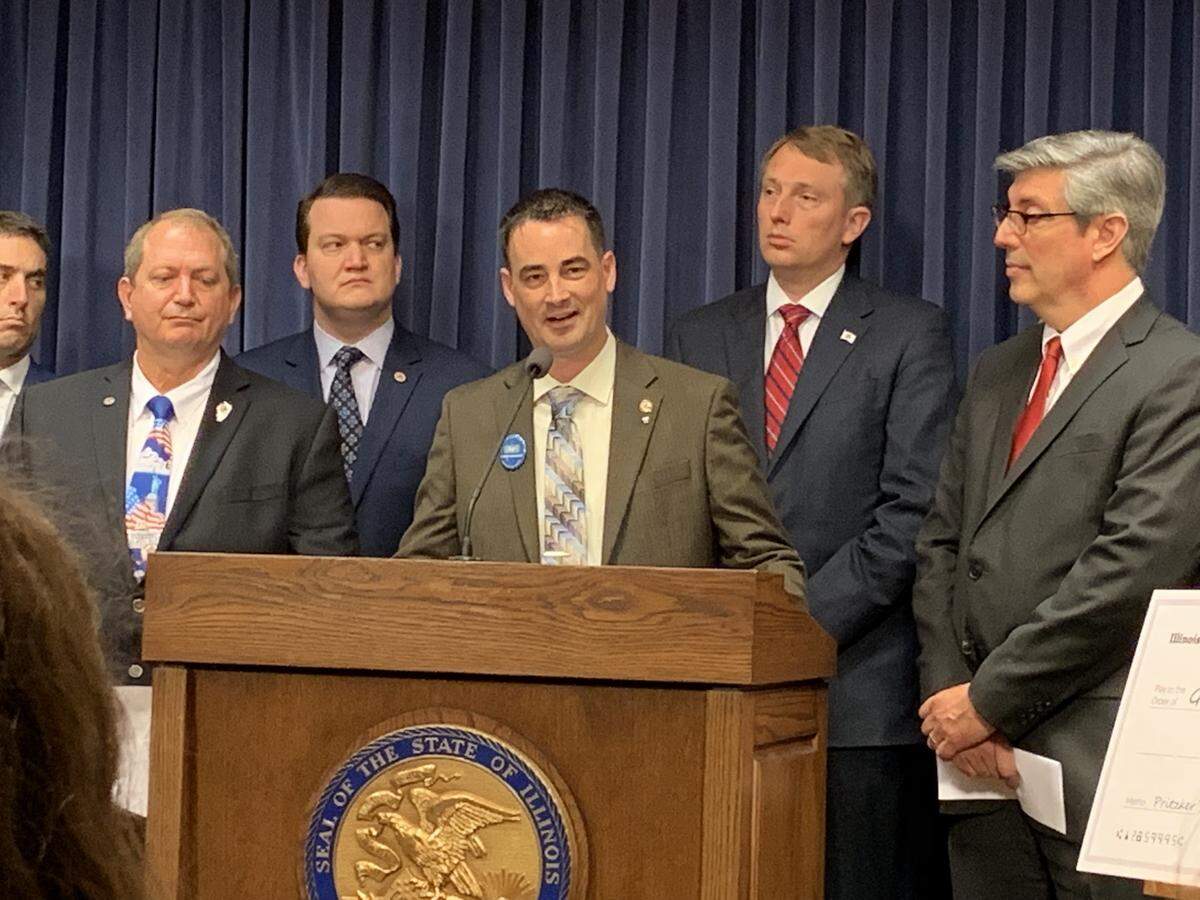
Votes potentially were difficult for members such as state Rep. Monica Bristow, D-Godfrey and state Rep. Nathan Reitz, D-Steeleville, who replaced conservative Democrat Jerry Costello II. Bristow won her election in November 2018 by one percentage point.
Costello, who won his election in November by seven percentage points, resigned from the House after he was appointed by Pritzker to be director of law enforcement for the Illinois Department of Natural Resources.
Costello had previously said he was against a progressive income tax in the state. Costello’s appointment to the IDNR position and Reitz’s appointment to the House led to the 116th House District vote being flipped.
Reitz said almost all of the residents in his district would receive income tax relief under the proposal and providing middle class tax relief is a goal of his.
“This amendment simply allows voters to make the first decision if our state should change its tax structure,” Reitz said in a news release. “When we talk about investing more in our local communities, our schools, our social services, the fair tax plan deserves to be part of that conversation.”
How metro-east legislators voted
State Rep. Monica Bristow, D-Godfrey: Yes
State Rep. LaToya Greenwood, D-East St. Louis: Yes
State Rep. Jay Hoffman, D-Swansea: Yes
State Rep. Charlie Meier, R-Okawville: No
State Rep. Nathan Reitz, D-Steeleville: Yes
State Rep. Katie Stuart, D-Edwardsville: Yes
State Rep. Blaine Wilhour, R-Beecher City: No
This story was originally published May 27, 2019 at 5:40 PM.