A white lawmaker for East St. Louis? Lawsuit says Black voters might not have a choice
Frank Smith, 75, has lived in East St. Louis nearly all his life and has had a Black lawmaker represent him in the state House since 1975.
But he worries changes to one of the East St. Louis area’s legislative districts means a white representative could be elected — one who might not care about the area or understand it as a Black lawmaker can.
A map approved by the Illinois General Assembly and Gov. J.B. Pritzker in September carves out a chunk of state House District 114 represented by Democratic Rep. LaToya Greenwood, who is Black. The map takes thousands of Black voters from the East St. Louis area and puts them into District 113, pushing another chunk of Black voters into District 112. White Democrats represent both.
A fifth of Black voters were moved out of East St. Louis, and thousands of white voters were moved in, a lawsuit challenging the map alleges. In the current map, Black residents of voting age represent 37.1% of the population, but only 33.4% in the new map, according to the suit.
The decrease threatens to diminish the influence of Black voters.
“I thought that Texas was passing a racist law on voter suppression,” Smith said, referencing a recent voting restrictions law in the state, “but when I looked here at home, I saw the same thing in just a different way.”
The new map redistricts dozens of blocks in the city’s northeast corner and in Washington Park from Forest Boulevard to Bunkum Road. It also shifts a cluster of homes off Exchange Avenue near the intersections of Interstates 55 and 70, while adding the mostly white communities of Dupo and New Athens.
“They put us over there in the white district where it’s going to be rough for us to try to win,” Smith said. “Dupo, Illinois? Who knows us in Dupo, Illinois? It’s going to be hard for us to win state rep.”
Democrats in charge of mapmaking used traditionally left-leaning Black voters to strengthen the white candidates in an increasingly conservative metro-east, according to the lawsuit filed on behalf of the East St. Louis NAACP branch and other groups, instead of protecting the interests of majority-Black communities.
Smith says the state’s Democratic leaders don’t seem to care if East St. Louis is represented by a Black lawmaker, even with Emanuel “Chris” Welch serving as the first Black speaker of the state House.
“I don’t think he really cares about what happens down here,” said Smith, who is also chairman of the East St. Louis Democratic Central Committee. “He only cares about what happens upstate.”
The lawsuit names Welch as a defendant. He did not respond to a request for comment.
An unknown problem
As much as redistricting influences civic life, it mostly flies under the radar. That’s because much of the public is not engaged and political parties usually avoid calling attention to it.
Only one elected official responded to requests for comment on this story.
Few people know about problems caused by redistricting until they go to the polls and don’t see any familiar names on the ballot, said Stanley Franklin, president of the East St. Louis NAACP branch.
“Once they realize that this has happened and when they go to the election poll and they find out they can no longer vote for the candidate of their choice, they’re going to be upset,” Franklin said.
East St. Louis lost 31.6% of its population from 2010 to 2020, according to the U.S. Census Bureau. The law requires congressional and legislative districts to be as equal as possible in population to preserve the one person, one vote principle.
A House District should have 108,581 residents, and District 114’s population didn’t meet the mark. Prior to the new maps, the district only had 97,701 people.
The maps should have kept Black people in the district instead of replacing them with white voters, Franklin said.
“They made it very safe for white Democrats to continue to be elected, and it has an adverse effect on state Rep. LaToya Greenwood,” Franklin said.
But Greenwood says the effects of redistricting are misunderstood.
“There has been a lot of misinformation about the intent and impact of the recent redistricting on the 114th District,” Greenwood said in a prepared statement. “For the past forty years, persons of all racial and ethnic backgrounds have come together to elect an African-American legislator in this district, despite the fact that the district was not a majority African-American district. Under the new map, I believe the 114th District will remain a strong district for African-American representation in Springfield, and I would not have supported the map if I believed otherwise.”
The most recent Census data shows Black residents of all ages make up 38% of the 114th’s population.
Hearings on the maps in the spring were poorly publicized and sparsely attended. Franklin testified at the metro-east’s hearing, but says his words were ignored.
“I’ve spoken at our meetings about how it’s important that in East St. Louis they don’t divide our community and weaken our power base, and that’s exactly what they did,” Franklin said. “They’ve weakened the power base in the Black community.”
Larita Rice-Barnes, president of the Metro-East Organizing Coalition, said her group focuses on voter engagement, especially in light of the redistricting problems.
“With what’s happening now, it’s more of a mandate for clergy leaders like myself and organizational leaders to organize, to continue to build Black independent political power so that people were there again understand the importance of voting,” Rice-Barnes said. “We’re going to make sure we’re pushing out as much information as we can so that they know what it means when a community becomes redistricted.”
The maps could still change after a federal court panel in Chicago ruled last week that the districts drawn in June were unconstitutional because it violated the one person, one vote principle. The panel said opponents of the map can submit their own version and that Democrats need to change theirs. The September map is a starting point, the panel ruled.
It’s up to lawyers in the District 114 lawsuit to demonstrate there’s a problem with the September maps too, said Jon Greenbaum, lead counsel in the case and an attorney for Washington, D.C.-based Lawyers’ Committee for Civil Rights Under Law.
“This is the only district in the area that’s represented by a Black representative, so the voice of Black constituents gets lost when you don’t have any representation at all,” Greenbaum said.
Politics behind the draw
Smith, who moved to East St. Louis from Scooba, Mississippi, with his parents when he was just 5 years old, says white people in the metro-east don’t always have to worry about the same thing Black people do. Access to health care, social support programs, paying the utility bill and putting food on the table are essential problems East St. Louis area residents care about.
But their voices seem like mere numbers for the Democratic party, Smith said.
Democratic State Rep. Katie Stuart’s 112th District is one of the more vulnerable in the metro-east. The three-term representative from Edwardsville has defeated Republican challengers since 2016, but the GOP candidates came close enough to cause discomfort.
Metro-east voters have increasingly leaned Republican, potentially raising concerns among Democratic party leaders about the security of seats like Stuart’s. Even in the Democratic stronghold of St. Clair County, a larger percentage of voters leaned Republican in 2020 giving Democrats enough of a reason to want to bolster the district held by state Rep. Jay Hoffman (D-Swansea).
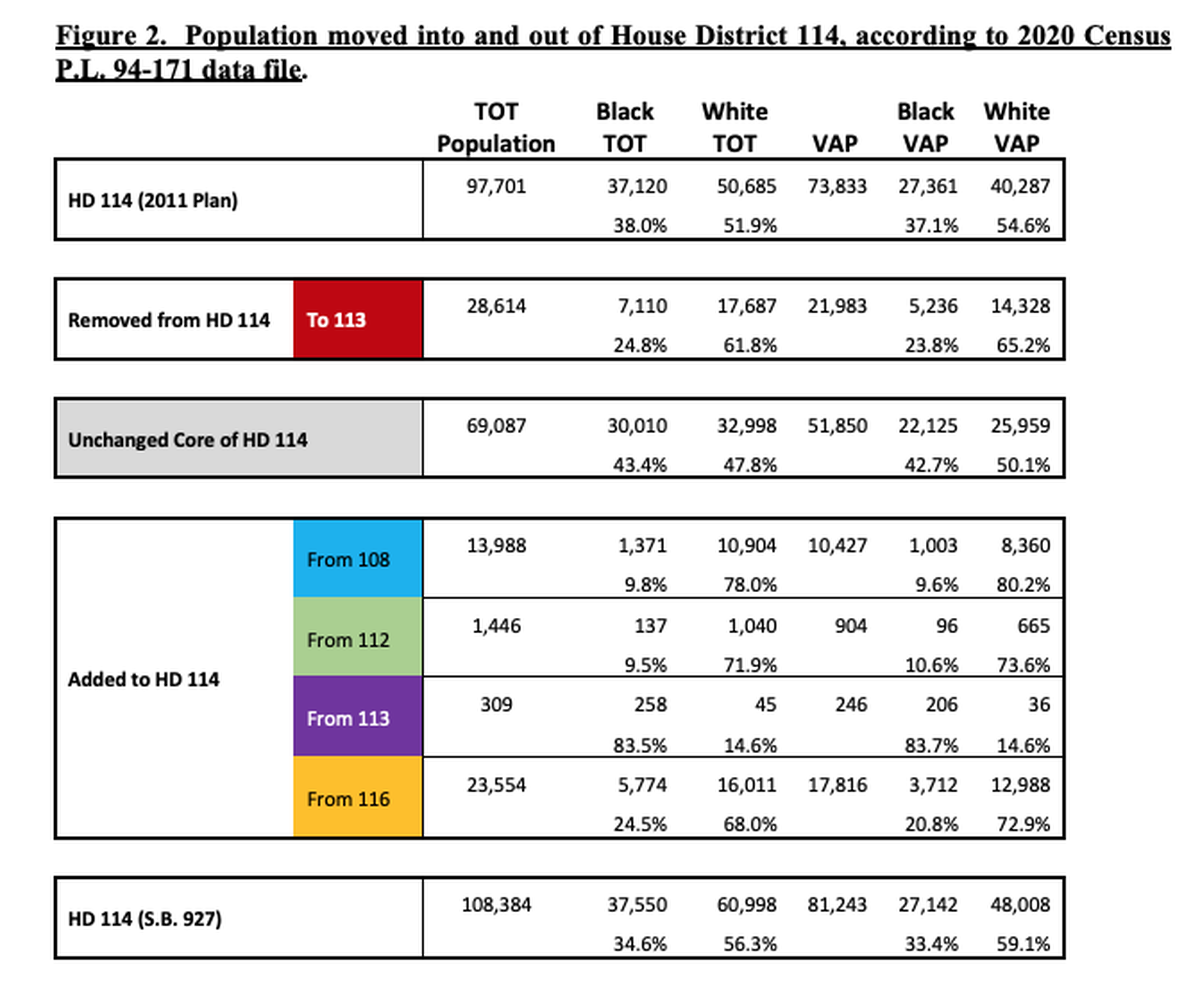
The map shifted 7,110 Black voters from Greenwood’s district to Hoffman’s, and 4,182 Black voters from Hoffman’s district to Stuart’s “to make it a safer seat,” the lawsuit alleges. Neither Hoffman nor Stuart responded to requests for comment.
Some states have measures to protect “communities of interest,” or groups who “are likely to have similar legislative concerns, and who might therefore benefit from cohesive representation in the legislature,” according to the Brennan Center for Justice. Illinois is not one of the 24 states with those protections.
East St. Louis voters have long delivered support for the Democratic Party in Illinois, and taking away their power disenfranchises them, Smith said.
“We have not been given our fair share for the votes that we have produced,” he said.