Thinking of buying an electric vehicle in Illinois? Here are 10 things to know
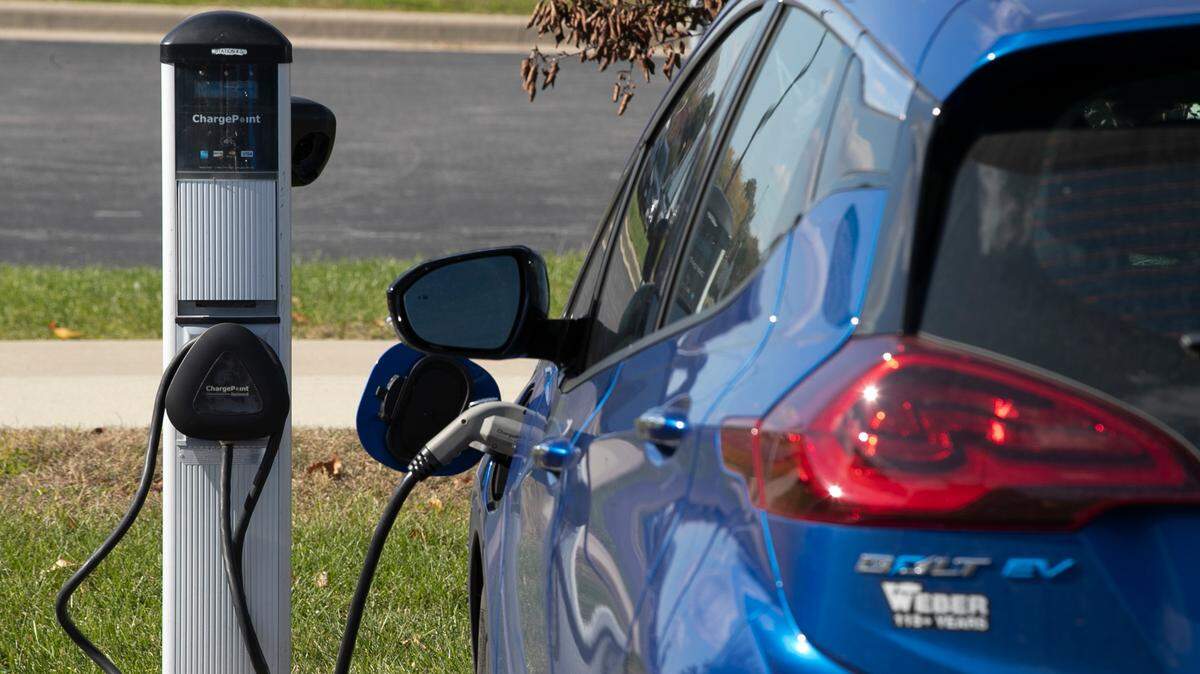
As government policies, lower prices and greater supply make electric vehicles more practical, some Illinoisans may start to wonder if giving up their gas-powered car might make sense.
Electric vehicle technology has improved dramatically over the past decade, as has the network of public charging infrastructure. Their initial cost is still high, but they can pay off in the long run considering savings on maintenance and gasoline.
Here are some questions consumers might ask themselves before going electric.
What do electric vehicles cost?
With no government incentives or tax credits, the manufacturer’s suggested retail price for a new plug-in electric vehicle was just over $50,000 in 2020, according to the Argonne National Laboratory in Lemont, the science and engineering research center near Chicago operated by the United States Department of Energy.
But with dealer discounts and rebates, you likely won’t be paying sticker price.
“The MSRP often is an overestimate on how much someone is going to pay,” said David Gohlke, an environment and energy analyst for Argonne. “They often get a better deal than sticker price, but if there’s a lot of demand (the price) could be more than the MSRP.”
New hybrid vehicles run $45,000 MSRP on average.
Those averages include prices for luxury brands such as Tesla. A 2022 Nissan Leaf starts at $28,375 and a 2022 Mini Cooper SE Hardtop can go for $30,750, according to digital marketplace company Cars.com.
While the purchase cost is higher than for a gas-powered car, electric vehicle owners don’t spend as much on fuel or maintenance annually because they don’t need oil changes or air filter replacements, the vehicle and service association AAA found in an analysis of motorist data.
Over 75,000 miles and five years of driving, a new compact electric vehicle costs $7,704 to own annually — $590 more than a similar gas-powered car, according to AAA.
Maintenance costs $949 per year, $330 less than gas-powered cars. The costs of electricity for charging is also a factor, but represents a savings. Driving 15,000 miles per year in an electric vehicle costs an average of $546 compared to $1,255 for gasoline, AAA said.
What incentives and credits are available?
Beginning July 1, 2022, Illinois will offer a $4,000 rebate for a new or used electric vehicle. That could be coupled with a $7,500 federal rebate for eligible cars. The credits phase out for automakers that sell more than 200,000 qualifying cars, and some electric vehicle manufacturers such as Tesla have already passed that threshold.
President Joe Biden aims to increase the federal rebate to $12,500 as part of his “Build Back Better” framework. Automakers who have already sold more than 200,000 qualifying cars hope to become eligible again for the credits under Biden’s plan.
Illinois will also offer rebates for up to 80% of the cost of installing a home charging station beginning next July.
How can I install a charging station in my home?
An in-home charging station uses the electric service you already have at home. There are two types of stations intended for residential use.
Level 1 is typically the cheapest but also the slowest. It plugs into an existing three-prong grounded outlet. For every hour of charging, an electric vehicle can drive two to five miles, according to the Energy Department. It costs between $300 to $600 and works well with a hybrid vehicle that uses both gas and electricity.
Level 2 stations use a higher volt circuit and charge much faster — 12 hours for 200 miles — but they also require a bit more adaptation in the home. They usually need the same type of plug you’d use for a dryer, which not everyone has in their garages. An electrician can run the right wires out to the garage, adding $1,000 to $2,000 to the cost of the station itself — between $500 and $700, according to the car e-commerce company Carvana.
Level 3 stations are for commercial use and cost tens of thousands of dollars to install.
How many charging stations are there in Illinois?
The top concern among motorists considering an electric vehicle is if there are enough places between destinations to charge their car if necessary, according to AAA.
The Energy Department maintains a map of public charging stations in the U.S. and Canada. There are nearly 45,000 in the U.S., hundreds in Illinois and dozens in the St. Louis region. Except for remote areas, the stations are distributed in a way that makes most driving trips possible.
How far can I go between charges?
From 2011 to 2015, there were very few electric vehicles with a range of more than 100 miles on a single charge and the network of public charging stations was still small.
“Since then, the range of electric vehicles has increased tremendously,” Gohlke said.
Now, an average electric vehicle can travel roughly 250 miles on a charge. That would put Louisville, Indianapolis, Nashville and Memphis within range without charging.
You wouldn’t need to chance it, though. Between St. Louis and Memphis are nearly a dozen charging stations. Unlike residential chargers, those on the road might have fast-current charging that can power 60 to 80 miles of range within about 20 minutes, Gohlke said.
For people who do a lot of rural driving, a hybrid vehicle may be a better option. Short distances can be done on electric power, but they can still be fueled up for long distances on gasoline.
Do you have to pay a fee at public charging stations?
Many are free and some require payment. Often stations have pay-as-you-go and monthly subscription options, according to station manufacturer Enel X.
Prices vary by location and time, but can range from less than a dollar per minute to $1.30 per minute, and between $4 and $8 per month.
What is Illinois’ plan for developing electric vehicle infrastructure?
The network of public charging stations is mostly sufficient for the number of electric vehicles driven now, Gohlke said, but it will have to grow along with the popularity and accessibility of electric vehicles.
“There’s definitely a push to get these along a network similar to the interstate system,” Gohlke said. “Are there enough for now? Probably. But as they continue to grow and as they are used by people who don’t have access to home-based charging, there will almost certainly need to be more.”
Under Illinois’ new green energy law, the Illinois Commerce Commission will work with utility companies to build out the state’s charging station network. Gov. J.B. Pritzker also joined a coalition of governors from Indiana, Michigan, Minnesota and Wisconsin who plan to create and align incentives to build charging stations.
What happens if I run out of power?
If your electric vehicle runs out of power with no access to a charging station, get ready to have your car towed.
In the future, it’s possible that tow truck could bring a battery to charge your car enough to make it to the nearest station.
“To charge these vehicles a few miles is on the order of a dime’s worth of electricity, like when you turn on your water kettle,” Gohlke said. “It would be very difficult to top you off to full, but to top you off to go a few miles could be doable.”
The technology has yet to surface.
How long do batteries last?
All-electric vehicles are still relatively new to the market, so there isn’t much data. But so far, they seem to break down at about the same rate as gasoline-powered cars.
The first generation models from 2011 to 2014 lose their range capability quicker than newer models, Gohlke said. Models after 2014 have “done very well at maintaining their overall electric driving range,” he said, especially for people who drive less than 20 or 30 miles per day. Driving in extreme weather, either cold or hot, can cause short-term reductions in range.
This likely means you wouldn’t have to replace your car’s battery anytime soon after purchase. If you did, the cost of a new battery depends on the automaker. It could cost a few thousand dollars or more.
Hybrid vehicles have been around for much longer than plug-in electric cars, and haven’t shown “a drastic need for battery replacement,” Gohlke said.
How is the performance?
Electric vehicles have become more powerful over the past decade.
It takes an electric vehicle an average of six seconds to hit 60 miles per hour, according to Argonne National Laboratory. By comparison, a common gasoline-powered car such as the Ford Focus gets up to 60 mph in roughly 7.5 seconds, according to auto enthusiast magazine Car and Driver. An electric Nissan Leaf takes 8.4 seconds to go from 0 to 60.
The Porsche Taycan and the Tesla Model S are the fastest electric vehicles available. They can both reach 60 mph in 2.4 seconds.
Have a question you don’t see here? Submit it using this form: https://forms.gle/on4fvV8ZvTmuedh4A
This story was originally published November 11, 2021 at 7:00 AM.