Amazon considered buying shelters after deadly tornado. What are they required to do?
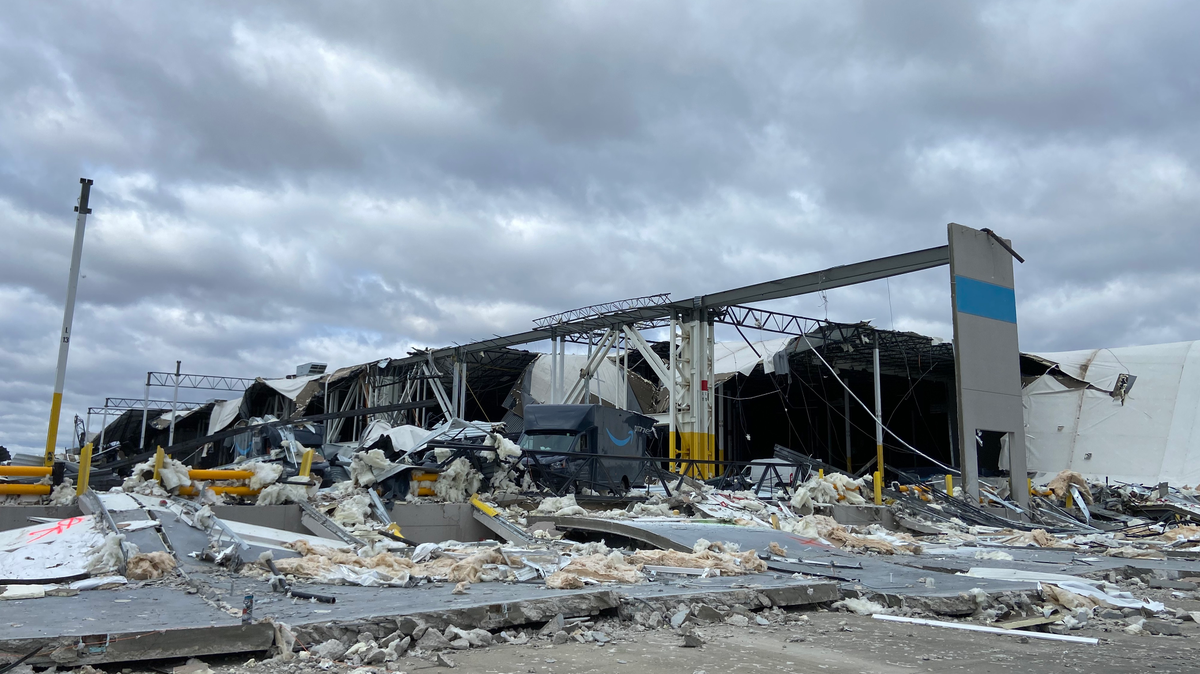
Jim Bell got his hopes up when he received an email from an Amazon representative earlier this month inquiring about prices for storm shelters. Maybe the online retail giant was considering taking steps to protect its workers from severe weather.
A member of the group he directs, the National Storm Shelter Association, forwarded him the email dated April 11, roughly four months after an EF-3 tornado ripped through an Edwardsville Amazon warehouse, killing six workers.
“We are looking to get 8x30 and 10x30 storm shelters,” the email from an Amazon representative stated. “Can you provide a quote along with lead times for these units?”
Bell responded asking for more information.
“I thought it was progress,” Bell said, but he never heard back from Amazon.
The company is “constantly looking to innovate and improve our safety measures,” a spokesman said in an emailed statement.
There are no federal requirements for private companies to have storm shelters. They don’t even have to have severe weather emergency plans.
The United States sees roughly 800 tornadoes on average every year, with the bulk of those happening during the month of May, resulting in 80 deaths and 1,500 injuries, according to the National Weather Service. Places with high ceilings and roofs that span across a wide area should be avoided, the agency says.
Everything beyond basic safety standards is purely volunteer. This lack of requirement is why Amazon won’t face penalties or fines after a federal agency investigated them for workplace safety following the tornado. The Occupational Health and Safety Administration released their findings last week.
OSHA recommends businesses have plans in place for severe weather, but there’s no mechanism to force their hand. Businesses have to have an “emergency action plan,” but OSHA’s requirements are broad.
Amazon’s emergency plan, for instance, wasn’t customized for the Midwest, where tornadoes happen every year, even in December. Illinois ranks sixth nationally for the number of tornadoes per year, according to the National Oceanic and Atmospheric Administration.
The plan discussed hurricanes and where to shelter in the 1.1 million square-foot facility during an emergency, but it didn’t specifically address dangerous weather employees are likely to face in Edwardsville. Furthermore, OSHA found Amazon had trained employees on “shelter-in-place” drills even though they’re not required to do so.
The only OSHA rule that Amazon could have potentially violated is one that says it has a “general duty” to protect workers from “known hazards.” They didn’t violate that, the agency found in its investigation, said OSHA spokesperson Rhonda Burke.
“OSHA’s inspection found that the procedures Amazon had in place, including documentation of employee training, met industry accepted practices, and OSHA did not believe it could establish a violation of the General Duty Clause in this case,” Burke wrote in an email to the BND.
The six people who died sought shelter on the south side of the building. Some workers who survived later reported to OSHA that they couldn’t recall participating in drills and said there was confusion on the night of the tornado about where they should shelter. Because a loudspeaker was locked up in a cage at the facility, managers had to rely on spreading word individually, according to OSHA’s findings.
Darryl Kinley of St. Louis worked at the Amazon warehouse from July to just hours before the tornado on Dec. 10, when he took disability leave. He believes Amazon won’t voluntarily improve their emergency response policies until there’s a fundamental change to how they treat people.
”If OSHA is not doing anything, then we have to change that in order to support low-wage workers,” Kinley said.
What does OSHA require?
What is required, ideal, feasible or affordable don’t always line up when it comes to businesses and severe weather preparedness.
“Ideally you should have a place that can protect you from what you anticipate from severe weather,” said Tim Peterson, vice president of operations for Minnesota-based consultant company OSHA Environmental Compliance Systems, “but we don’t even do that in our homes.”
OSHA has a few minimum emergency action plan requirements for companies with 11 or more employees:
An emergency action plan must be in writing, kept in the workplace and available to employees for review.
The plan must include procedures for reporting a fire or other emergency; for emergency evacuation; for employees who remain critical to plant operations before they evacuate; to account for all employees after evacuation; to be followed by employees performing rescue or medical duties; and the name or job title of every employee who may be asked about the plan.
Employers must have an employee alarm system that uses a distinctive signal.
Employers must designate and train employees to assist with evacuation.
Employers must review the emergency action plan with each employee when an employee is assigned to a job, if an employee’s responsibilities under the plan changes or if the plan itself changes.
None of these requirements apply specifically to severe weather, though OSHA does suggest tornado preparedness guidelines on its website.
After OSHA’s announcement about the Amazon warehouse last week, the BND reached out to area employers for information about their safety plans for hazardous weather conditions.
During severe weather, St. Elizabeth’s Hospital off Interstate 64 in O’Fallon has to look out for the safety of employees as well as some patients who are not able to walk.
“All colleagues are educated on the severe weather/tornado safety plan at orientation and on an ongoing basis through safety drills,” said Tim Claxton, director of facilities, in an email.
“The action plan is also posted throughout the ministry with instructions on moving patients, equipment and themselves to interior areas for safety.”
Claxton said the hospital has a “robust Emergency Preparedness team that completes a hazard vulnerability analysis annually to plan and prepare for natural, technical and other hazardous events that present risks to the facility, our patients and colleagues.”
On the west side of Belleville, the Permobil plant at 1501 S. 74th St. has 215 employees who produce seating and positioning cushions for wheelchair users. The plant was formerly known as ROHO.
The firm has safety advisers on duty, employees get text messages from the company and there are designated places for employees to shelter-in-place during inclement weather, according to Heidi Wilkinson, vice president of human resources for Permobil in the Americas.
Though the cost of storm shelters would be a fraction of total construction costs for a facility like the Amazon warehouse, companies often say shelters are too expensive, Bell said.
“A lot of businesses like Amazon use the best available refuge area, which means they don’t have to do anything. They just have to put a sign up on a door of a place that might not have any windows and call that their safe place,” Bell said. “Basically it comes down to expense.”
Could Illinois require storm shelters?
The Illinois lawmaker who represents the area where the tornado hit said she wants OSHA to have stronger requirements.
“I hope that OSHA will be revisiting the minimum standards of safety,” state Rep. Katie Stuart, D-Edwardsville, wrote in an email.
But the state hasn’t made much headway in changing its own requirements.
Lawmakers began exploring the possibility of creating statewide warehouse construction rules after the tornado hit, but they haven’t secured any changes yet. Other than holding a hearing on the issue in February, they haven’t gotten far.
Stuart introduced a bill that would have created a task force to study warehouse safety and the possibility of requiring storm shelters, but the bill stalled in the Senate after passing the House with broad bipartisan support.
Stuart said she’s not sure why the bill got held up, but she hopes lawmakers can revisit it when they reconvene in the fall. Meantime, she plans to continue to ask for public hearings and to stay in contact with Gov. J.B. Pritzker “to make sure we are doing all we can.”
“And as we set building standards for new warehouses, we certainly should be making sure any existing warehouses meet the same safety standards,” Stuart said, “because worker safety should depend on which building they are in.”
Scott Allen, an U.S. Department of Labor spokesman based in Chicago, said OSHA would like companies to be more proactive.
“OSHA would like employers to be more aware and to create better severe weather emergency plans and severe weather shelter-in-place drills.”
Kinley, the warehouse worker, says that’s not enough.
“So many families have been affected and we cannot continue to act like this,” Kinley said.