
Immigrants held by ICE are neglected at jail, southern Illinois lawmaker says
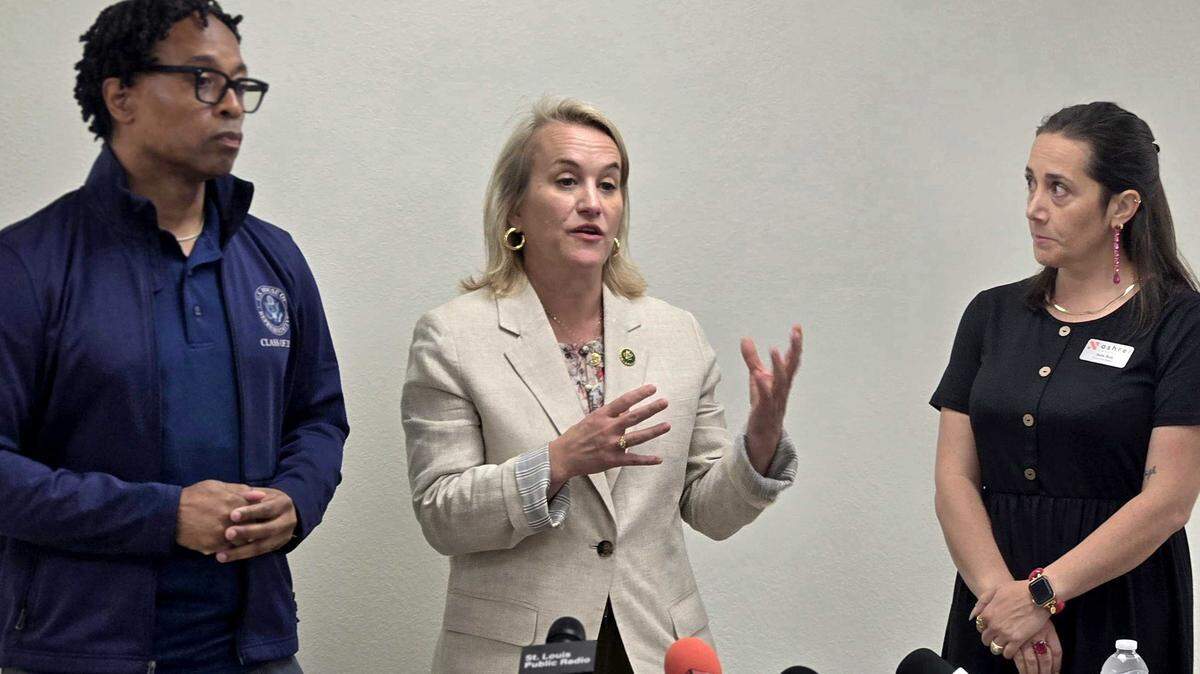
U.S. Reps. Wesley Bell of Missouri and Nikki Budzinski of Illinois say some detainees held by U.S. Immigration and Customs Enforcement at the Ste. Geneviève County jail are kept in overcrowded cells and others struggle to access necessary resources.
The representatives visited the Ste. Geneviève County Sheriff’s Office and Detention Center — located about an hour away from St. Louis in southeast Missouri — on Tuesday. They were provided a tour of the jail as members of the House Oversight Committee. The scheduled visit was not open to the media or the public.
The jail houses ICE detainees from counties across Missouri, including St. Louis, and southern Illinois.
Budzinski, D-Springfield, and Bell, D-St. Louis County, said they had a good visit with Sheriff Gary Stolzer and other officials at the jail, but when they got a chance to speak with ICE detainees directly, they learned conditions were not so good.
During the representatives’ tour of the jail on Tuesday, Bell and Budzinski said some ICE detainees complained about challenges in accessing notaries, despite jail officials’ claims that at least two notaries are always available. Immigrant detainees need notaries in order to sign off on important decisions, like child custody agreements.
Budzinski said they plan to follow up to ensure that immigrants at the facility are receiving access to legal representation and that pregnant women have access to adequate medical care.
Other detainees said they’ve had limited access to water, Budzinki said.
“One of the big concerns that we heard from [two] detainees was that they were actually using shower water for drinking water, because they weren’t provided enough water,” Budzinski said Tuesday. “We were given assurances [by jail officials] that those situations would be addressed.”
Representatives said the jail residents had been detained unexpectedly while moving through their asylum process, after initially being assured they wouldn’t be held.
“ICE is showing up and detaining folks at these hearings, and that’s happening all over,” Budzinski said.
Budzinski said several people were confined to one cell in some instances, which indicated a lack of space for detainees. She said they were also not allowed out of their cell for recreational time often.
“We saw rooms of various sizes,” Budzinski said. “There were smaller groups in some cells, but then there were up to 48, I think, in one. They’re using a very thin, gray, kind of tray that has an inflatable that brings you a few inches above the ground as a place to sleep. So to me that says that, if you don’t have enough beds, you’re reaching an overcrowding situation.”
The jail is overseen by the sheriff’s department and has a capacity of around 450 detainees. Unlike other jails in the state, it doesn’t post a public roster of detainees.
Seeking immigrant protections
Budzinski said it’s important for legislation like the Protecting Sensitive Locations Act to be supported and ultimately enacted into law across all states.
The federal legislation prohibits immigration enforcement actions within 1,000 feet of a sensitive location except in critical situations that involve risk of death or violence — providing safe havens at places like hospitals and courtrooms. The bill was reintroduced in February 2025 by U.S. Rep. Adriano Espaillat, D-New York, after it failed to gain momentum in the House in 2023.
Missouri hasn’t introduced similar legislation. Illinois Gov. J.B. Pritzker signed Illinois’ version, the Court Access, Safety, and Participation Act, into law late last year. The statute prevents immigration officers and others from making civil arrests at courthouses in the state.
As ICE detainments ramp up across the country, Bell said the federal agency isn’t trying to hide its racial discrimination amid the rise of 287(g) agreements with police departments. He said whether it’s traffic stops or other arrests, officers often target people who speak Spanish and others whom they perceive to favor immigrants.
“The narrative that these are criminals that are doing crimes and being picked up is completely false,” Bell said. “These are regular working people who are working their jobs, taking care of their families, trying to provide a better life for themselves and their families, and they’re being held as those who would have been charged as criminals.”
Incentives
The Ste. Geneviève jail is one of at least four in the state that contract with the federal government to house people awaiting immigration proceedings, including deportation.
The jail in Rolla is another. It briefly stopped holding detainees for ICE last year but resumed in October.
The Ste. Geneviève jail has an Intergovernmental Service Agreement, which allows ICE to house and detain individuals at the jail for federal immigration offenses.
Sara Ruiz, executive director of the Ashrei Foundation and the St. Louis Rapid Response Hotline, noted the federal government has been providing financial incentives for jails that agree to certain contracts with ICE. At the Ste. Geneviève jail, the contract allows ICE up to 400 beds, she said.
“Which is, I don’t know, like four-fifths of the entire population that could be [held here],” Ruiz said. “The people who are bearing the cost of that are the people who are separated from their families here.”
The Ste. Geneviève County jail has not confirmed how much it is making for housing ICE detainees, but Phelps County previously reported a rate of $85 per detainee per night.
Bell and Budzinski added that some ICE detainees in Ste. Geneviève have struggled to receive legal help because they don’t have the same access to their attorneys or even medical care as other detainees who are American citizens. Ruiz said the limited access to legal information is frustrating.
“It’s extremely difficult for folks who are being held here by an agency that isn’t here regularly, to access any information about what their removal process is looking like [or] what the immigration judge says after a court hearing,” Ruiz said.