
Jumping, destructive worms spread across IL. Expert tips to spot them, protect soil
An invasive species of earthworm — originally from East Asia and discovered in Illinois in 2015 — has been jumping to counties across the state in recent years.
The worms, which seem to jump and thrash about when you pick them up, have also been called crazy snake worms, Alabama jumpers and Jersey wrigglers.
To help gardeners know what to look for while working in the soil this spring and summer, we reached out to Christopher Evans, a forestry extension and research specialist with Illinois Extension.
Here’s what to know about jumping worms, or as they’re call by their scientific name, Amynthas agrestis.
Why are these worms a problem for soil preservation?
Like all true earthworms, these jumping worms feed on organic matter.
According to Evans, they spend most of their time and feeding effort in the top layers of soil or leaf litter. Able to live in high densities, the jumping worms break down organic matter quickly. Ultimately, this leads them to burn up soil nutrients.
“What happens is the worms basically eat through and process that stored fertility very rapidly — leading to an initial big increase in available nutrients — but that is followed by a crash as all of the nutrients are spent or leached out of the system,” Evans wrote in an emailed response to questions.
“So, instead of this slow release of nutrients and fertility over time to sustain plant life, you get a big pulse of nutrients, followed by really poor fertility conditions,” Evans continued.
The invasive worms also upset several other soil conditions native creatures depend on to survive.
Their heavy feeding makes the soil more susceptible to drought conditions. The pH, or acidity of the soil, is altered and habitat for invertebrates and other soil-dwellers is eroded. The fine roots of plants themselves may even be damaged.
“We have seen bare patches in the soil or forest floor, rapid depletion of mulch or compost layers and plants performing more poorly as well,” Evans said.
What should people know about the “jumping worms?”
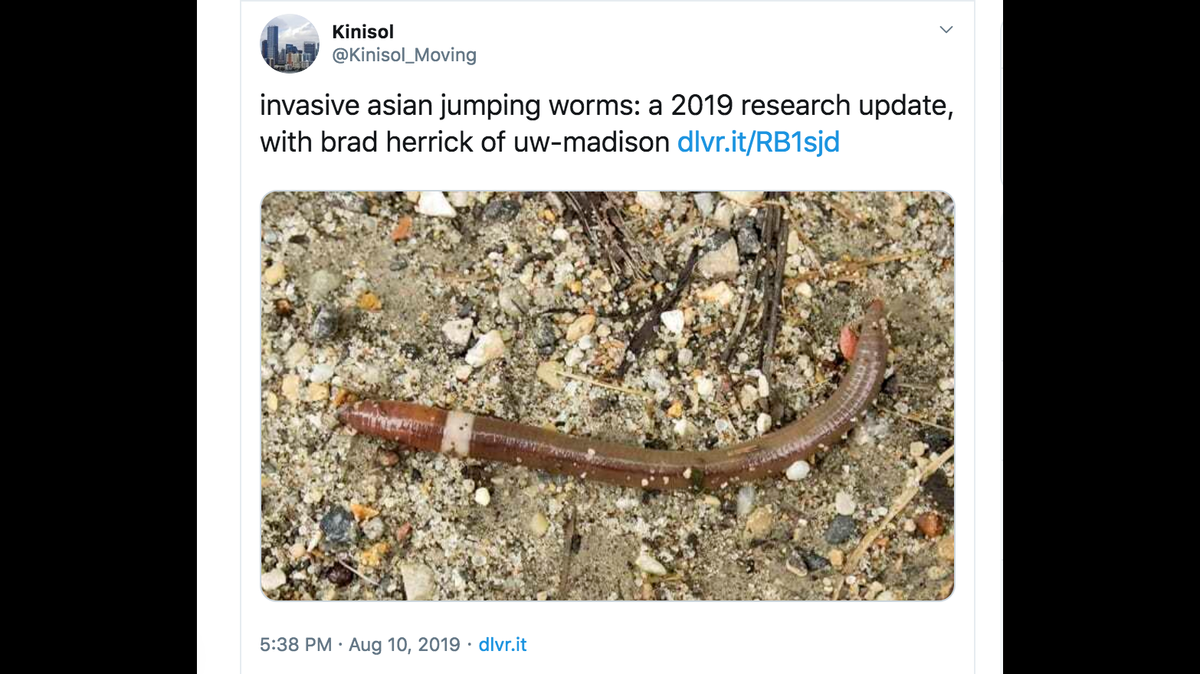
First, what they look like and how to spot them.
Jumping worms can grow large, sometimes as big or bigger than 8 inches.
According to Evans, look for “a stout, strong worm that thrashes about wildly if you try to pick it up. They tend to move side-to-side like a snake as they crawl.”
They’re marked by a band that is not raised. Other common worm species have a band that is larger than the rest of the worm’s body and generally appears further back on the worm than the bands on jumping worms do, Evans said.
As for the soil itself, Evans said large jumping worm populations tend to produce soil that looks like coffee grounds.
“The aggregate size is increased and more and more of the soil is made up of worm castings. This is what leads to the soil losing nutrients and having a harder time holding moisture,” he said.
What should I do if I find a jumping worm in my backyard?
According to Evans, finding them on your patch of soil isn’t cause for panic.
“The other important thing to know is that having jumping worms on your land doesn’t mean that you are not going to be able to grow anything. While they do change the soil and make it harder to grow some things, you can still have a productive garden and a beautiful yard and landscaping,” Evans said.
“The big change is in how you manage your soil,” Evans continued. “Having jumping worms means you will likely need to fertilize, mulch and water more often than you would otherwise and may need to switch to some different plant species that can withstand heavy jumping worm infestations easier.”
What can people do to stop the spread of destructive worms?
Jumping worms leave behind microscopic egg cocoons, and sharing contaminated mulch, plants or compost with other gardeners can spread them.
“Be careful getting mulch or compost from community piles,” Evans said. “Consider solarizing the material by placing it on a hard surface (like a driveway) in the sun and covering it in black plastic for a few days to let it heat up enough to kill any worms or eggs that might be in the material. Bagged mulch and compost is generally at lower risk for jumping worms because it heats up and dries out during storage and transport.”
Can gardeners report jumping worms in IL, and if so, how?
According to Evans, yes. Gardeners can report jumping worms to their local extension office with samples or close-up photos. You can find an office in Illinois near you online.
“We are tracking the distribution of jumping worms across the state. For other states, start by asking Extension, but it might be the Department of Agriculture or Department of Natural Resources that would ultimately be taking the reports. Either way, reporting sightings is very important, and I encourage any gardener that sees jumping worms to take good photos and report that sighting in their state,” Evans said.
This story was originally published May 25, 2022 at 1:07 PM.