Southwest Illinois is home to 3 venomous snakes. Here’s what to know, how to spot them
If you spot a snake slithering across your yard, it’s likely harmless. However, the dangerous species are typically camouflaged and can be hard to see.
Benjamin Jellen, associate professor of biology sciences at the University of Health Sciences and Pharmacy in St. Louis, focuses on snake-related research. He said there are about 40 species of snakes in Illinois, and about 20 to 25 species found in the St. Louis metro area.
Four of the snake species in Illinois are venomous, and three of those are in the greater metro-east area. There are two rattlesnakes in this category, the timber rattlesnake, which is threatened, and the Eastern massasauga rattlesnake, which is endangered.
The venomous snake species that’s found in Illinois but not in the metro-east is the cottonmouth, which is found in Carbondale and farther south.
A bite from a copperhead, the most common venomous snake in the metro-east, can cause tissue or nerve damage, but is not usually fatal to humans who receive proper medical treatment.
“It accounts for about 50% of the venomous snake bites in the United States, and it’s the copperhead,” Jellen said. “Copperheads are in all the counties in the metro-east. They’re a really, really, really cryptic species. They’re really hard to see.”
There’s one fail-safe way to identify whether a snake is venomous, but Jellen said he wouldn’t recommend it. All venomous snakes in the metro-east have elliptical or cat-like pupils, while the non-venomous ones have round pupils.
“But really, who wants to get that close in order to see what shape the pupils are?” Jellen said.
Here’s more information about the four venomous snakes in Illinois and how you can identify them.
Venomous snakes in Illinois
Copperheads are generally found in rocky outcrops and oak hickory forests, and because they’re so hard to see, there are rare instances in which hikers step on them and are subsequently bitten.
Copperheads are easily confused with northern water snakes, which are very common and non-venomous. But there are some key differences you can look out for to determine which one you’re seeing.
“Both of them have bands that go across the back, but the copperhead’s bands are kind of like in an hourglass shape, where it’s really wide on the sides and then as it crosses the spine to go over to the other side it becomes very narrow,” Jellen said.
Water snakes have a thick band going all the way across their bodies.
Snakes come out of hibernation in early April, Jellen said, but local copperheads are just starting to move out of their hibernation spots in the past week, even though they’ve been up for a couple months.
“The one to really be concerned about is the copperhead, cause that one, it persists in the suburban areas. It persists not just in natural areas, wildlife refuges, wildlife preserves,” Jellen said. “It can persist in little forested areas next to farms and next to houses and everything else.”
While it’s possible there’s a copperhead in your yard, it is far more likely you’ll come into contact with a non-venomous snake, Jellen said.
Cottonmouths are not native to the metro-east, but you could find one if you take a hiking trip down south. This is the only venomous species of water snake and is found in the Shawnee National Forest. According to National Geographic, this site is the only place in the world that regularly closes its roads for snake migration.
Snake Road is closed to vehicular traffic each year from March 15 to May 15 and from Sept. 1 to Oct. 30 so the reptiles can make a safe journey. You can still walk across the trail at this time if you don’t mind joining the migration for a leg.
You can identify a cottonmouth through a few key characteristics: it has nine large, symmetrical plates at the top of its head, elliptical pupils and its back is black or has ragged dark crossbands.
The timber rattlesnake can be found in the metro-east, but the species has a “threatened” status due to habitat loss and being killed by humans. They’re typically found in counties bordering the Mississippi River, but can also live farther south.
According to the Illinois Department of Natural Resources, the snake lives in forested bluffs, abandoned sawdust piles and rock outcrops. In the summer, you might find one in an open field.
This species can be identified by its flat, wide head and elliptical pupils. It’s an average of 36 to 60 inches in length, and the body is yellow, gray or green-white with dark bands along the back.
Although its venom is dangerous and rattlesnakes are intimidating to many, the species spends much of its time hiding. Like other venomous snakes in the state, it is not likely to pick a fight with a human.
The Eastern massasauga rattlesnake is endangered and its primary metro-east habitat is Carlyle Lake in Clinton County. The species’ decline is mainly attributed to habitat loss, as prairie marshes are drained and land is used for agriculture.
The snake is shorter than the timber rattlesnake, averaging 18 to 30 inches long.
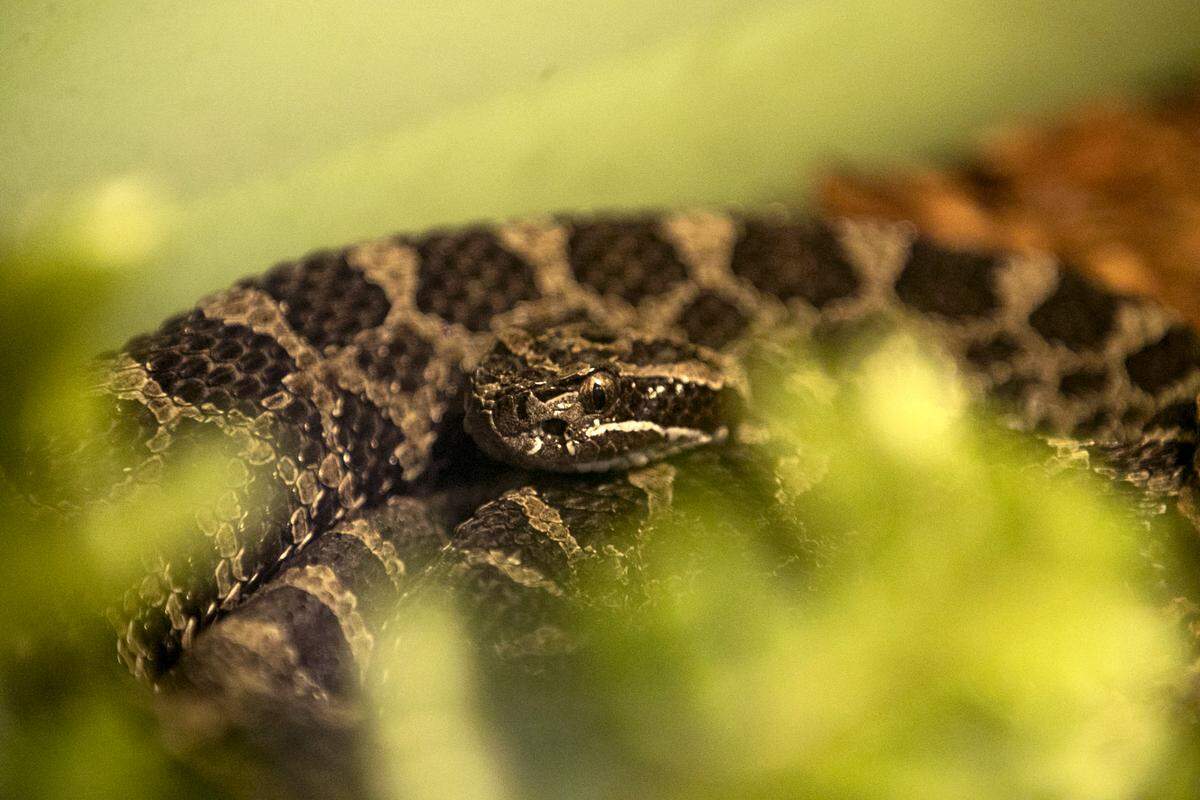
It has a flat, wide head with a heat-sensitive pit on each side. Like the state’s other rattlesnake, the species is active in the day until summer heat becomes too much. When temperatures rise, the Eastern massasauga becomes nocturnal.
What should you do if you cross paths with a snake?
As far as backyard concerns go, Jellen said you would likely hear from a neighbor if copperheads or other venomous snakes are hanging out in your residential area.
“Anybody who lives where venomous snakes are knows that there’s venomous snakes in the area, cause the neighbors say, ‘Oh hey, look out, so-and-so found one,’ or one was hit on the road,” Jellen said.
Although you may know you’re cohabitating with venomous snakes, it might still startle you to stumble upon one. Jellen said to remember most snakes aren’t prone to attack humans unprovoked, and you should never attempt to pick up a snake with your hands.
If a snake makes its way into your garage or living space, the safest way to contain it is by using a trash can and a broom, Jellen said.
The best thing to do when you see any snake or wild animal is to keep a distance of 3 to 5 feet, Jellen said.
“Respect it, respect its life, respect its privacy. Don’t pick it up,” Jellen said. “Most venomous snake bites happen to a person’s hands or fingers, meaning they’re picking the snake up to move it or try to kill it or do something.”
Rather than attempting to pick a snake up or kill it out of fear, take a few steps back, walk around it and leave it alone, Jellen said. Snakes will move on if you do, and they’re probably more afraid of you than you are of them.
“They will avoid confrontation at all costs, they will try to get away and do everything they can to avoid basically a confrontation with a giant,” Jellen said. “I always think that people are like King Kong, right, and the snake is like the human. If I saw some King Kong coming at me, I’d be scared out of my brain, too.”
To prevent snakes from entering your yard, avoid keeping debris and log or brush piles. These attract rodents, which are followed by snakes seeking a snack.
If you’re curious about what kind of snake you found, you can take a picture and send it to a local Illinois Department of Natural Resources contact, which is Scott Ballard for the southern part of the state. He can be reached by email at scott.ballard@illinois.gov or phone at 618-694-3398.
This story was originally published June 16, 2022 at 11:37 AM.