‘Hibernation Zone’ or bitter cold? Farmers’ Almanac has metro-east winter predictions
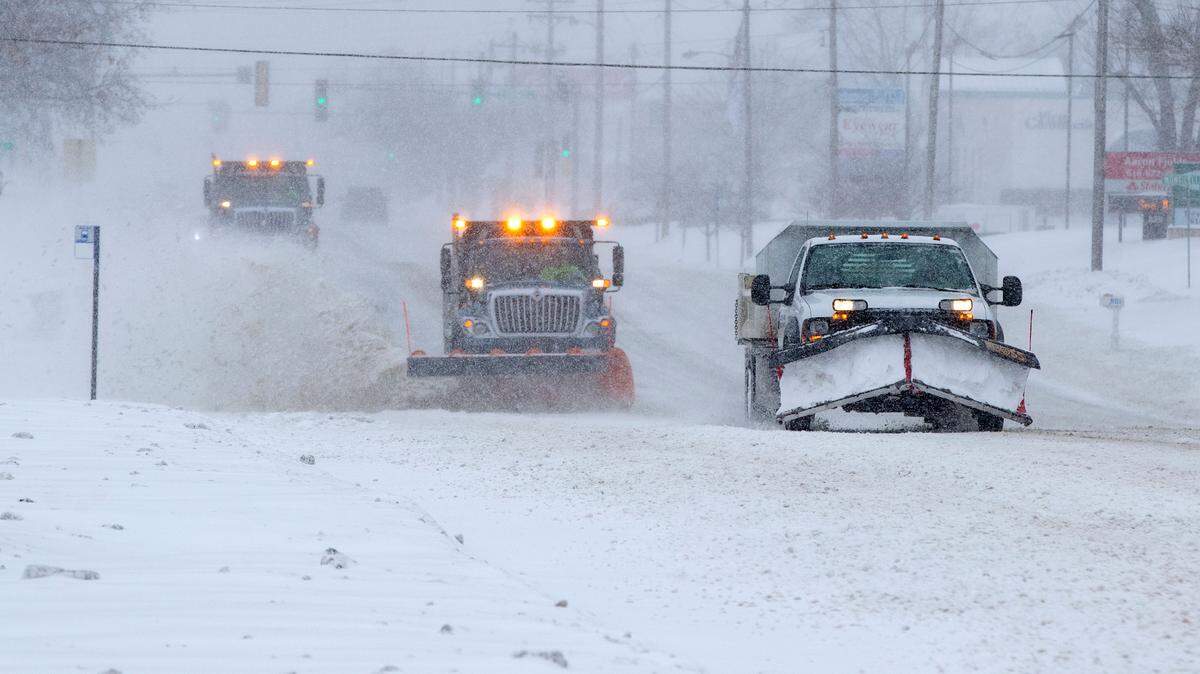
Metro-east residents can expect an especially cold winter this year, according to the Farmers’ Almanac 2022 to 2023 Extended Winter Weather Forecast.
Southwest Illinois is on the border of two regions in the Almanac’s map – the Illinois side is closer to the “unreasonably cold,” snowy region, while the Missouri side is in the “Hibernation Zone,” a glacial, snow-filled section.
“The first bite of winter should come earlier than last year’s. December 2022 looks stormy and cold nationwide with an active storm pattern developing and hanging around for most of the season over the eastern half of the country. (Maybe there will be a white Christmas in some areas?),” the Almanac’s website reads.
The North Central region, which includes Missouri, Colorado, Iowa, Kansas, Minnesota, Montana, Nebraska, North Dakota, South Dakota and Wyoming, will see winter storms bringing snow, the Farmers’ Almanac predicts.
The Almanac says the Great Lakes, Ohio Valley and Midwest region, including Illinois, Indiana, Kentucky, Michigan, Ohio and Wisconsin, will be in the “winter mix zone.”
How does the Farmers’ Almanac predict weather?
The Farmers’ Almanac has provided extended forecasts since 1818, according to its website, and typically projects out further than the National Weather Service.
The Almanac makes predictions based on a mysterious formula that considers factors such as planetary positioning, sunspot activity and tidal action of the moon.
“The only person who knows the exact formula is the Farmers’ Almanac weather prognosticator who goes by the pseudonym of Caleb Weatherbee,” the organization’s website says. “To protect this proprietary formula, the editors of the Farmers’ Almanac prefer to keep both Caleb’s true identity and the formula a closely guarded brand secret.”
Editors of the Farmers’ Almanac “firmly deny” using any type of computer satellite tracking equipment, weather lore or groundhogs. They say they use a specific and reliable set of rules developed in 1818 by the Almanac’s first editor, an astronomer and mathematician named David Young. The rules have been altered slightly and turned into an astronomical, mathematical formula, the Almanac says.
What does the National Weather Service forecast?
The National Weather Service’s Climate Prediction Center provides outlooks up to three months out, and the NWS posted the most recent long-range forecast Aug. 18. It includes information for September, October and November.
Temperature predictions were not immediately available for the three-month period, but the precipitation outlook said the metro-east had a 40% to 50% likelihood of below-normal precipitation September through November.
September’s monthly temperature outlook from NWS put the greater St. Louis area near the border between two zones, one where there are equal chances of above- and below-normal temperatures, and one where there’s a 33% to 40% chance of above-normal temperatures.
September’s monthly precipitation outlook estimated there was an equal chance of above- or below-normal precipitation.