Bright ‘planet parade’ visible from IL with naked eye. Here’s the best time to see it
.jpg "Illinois residents can catch a glimpse of a bright planetary alignment in January.")
Illinois stargazers have the chance to see a “planet parade” this January, with four bright planets to be visible in a single line of sight.
Venus, Saturn, Jupiter and Mars will be visible together all month after dark, NASA reports. The four planets have been visible together since December and will be visible through February, as well. You may also catch a glimpse of Neptune and Uranus through a telescope, but they won’t be shining as brightly.
“These multi-planet viewing opportunities aren’t super rare, but they don’t happen every year, so it’s worth checking it out,” NASA’s website says.
While some stargazers are referring to January’s planetary event as an “alignment,” NASA reports the planets appearing roughly in the same line is not unusual. The more unique factor of this “planet parade,” which is not a technical astronomy term, is four planets will appear brightly and close together, according to astronomy magazine Sky and Telescope.
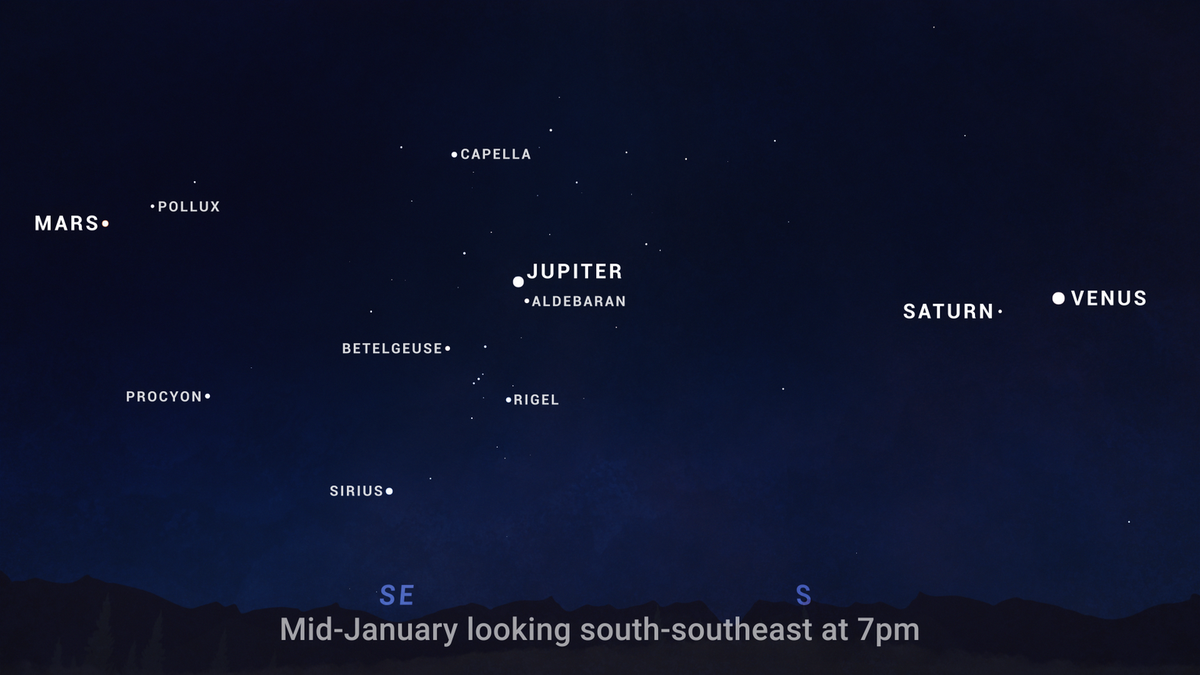
The planet parade will be visible all month, but Tuesday, Jan. 21 will be a particularly good time to see it, according to Forbes. The moon will be in its last quarter phase and will only appear half-lit. NASA reports Venus and Saturn will appear the closest Friday, Jan. 17 and Saturday, Jan. 18.
The night of Jan. 21 will be “mainly clear and bitterly cold” in Belleville, AccuWeather reports. The forecast says temperatures will drop as low as 6 degrees Fahrenheit with a 13% chance of precipitation and 19% cloud cover.
Full moons in 2025
The first full moon of the year peaked Jan. 13, and it’s known as the “wolf” moon. If you missed the wolf moon, you still have 11 more chances to see a full moon in 2025, including three supermoons. Here’s when to look, from Astronomy.com:
Wednesday, Feb. 12: Snow moon
Friday, March 14: Worm moon
Saturday, April 12: Pink moon
Monday, May 12: Flower moon
Wednesday, June 11: Strawberry moon
Thursday, July 10: Buck moon
Saturday, Aug. 9: Sturgeon moon
Sunday, Sept. 7: Corn moon
Monday, Oct. 6: Hunter’s moon (supermoon)
Wednesday, Nov. 5: Beaver moon (supermoon)
Thursday, Dec. 4: Cold moon (supermoon)
The St. Louis Astronomical Society will host a telescope viewing event from 6 to 9 p.m. Friday, Feb. 7 outside the McDonnell Planetarium building entrance, weather-permitting.
The first meteor shower of 2025 was the Quadrantids, which peaked Jan. 3, according to astronomy publication Space.com. The next meteor shower will be the Lyrid shower, which will occur Wednesday, April 16 to Friday, April 25 and peak Tuesday, April 22. At its maximum, the Lyrids could bring up to 18 meteors per hour visible in a clear sky, Space.com says.
Do you have a question about the weather or environment in Illinois for our service journalism team? We’d like to hear from you. Fill out our Metro-east Matters form below.