
Why does the MAGA right hate the word ‘democracy’ so much? | Opinion
If you hang around with MAGA people, don’t say the D word.
Democracy.
They hate it when you do that.
The latest example was earlier this week, when we ran a column on our website from our sister paper, The Sacramento Bee, titled: “Donald Trump’s first 100 days back in office: ‘A path toward authoritarianism.’”
The author criticized a number of actions the president has taken via executive order, and others done by his administration, such as arresting a Wisconsin state judge who let an undocumented immigrant leave her courtroom through the back door while immigration agents waited out front to deport him.
The column was controversial and it got a lot of comments on our Facebook page.
My personal favorite was this one: “The eagle beacon has become a libtard urinal. To the brain dead reporter who wrote this garbage. Hang it up. And go learn something usefull. (sic) Your brain is full of cobwebs as it is now.”
The “brain dead reporter” who wrote the column is Erwin Chemerinsky, the dean and a professor of the University of California, Berkeley School of Law — which U.S. News and World Report ranks No. 13 among the nation’s 198 accredited law schools.
The action line of the dean’s column was this: “The core of the rule of law is that no one — not even the president — is above the law. If the president can violate any law, and even ignore court orders, then we are no longer a constitutional democracy. The word for that is a dictatorship, and it is chilling to realize how close we are to that.”
An appalling lack of knowledge
The surprising thing, or maybe surprising is the wrong word, appalling might work better here, was the number of commenters objecting to the United States being called a “constitutional democracy.”
Some samples:
▪ “We aren’t a constitutional democracy we are a constitutional republic. Big difference.”
▪ “Leave it to the the Eagle to showcase their stupidity on the Constitution, republic not democracy.”
▪ “We never were a constitutional democracy. You’d think professional writers could get that right.”
▪ “STOP WITH THIS BS NARRATIVE. We live in a REPUBLIC , NOT A DEMOCRACY.”
▪ “Constitutional republic ya moron!”
Welcome to journalism criticism in the age of Trump, Dr. Chemerinsky — where any troll with a phone or computer is empowered to lecture those who have spent their lives developing expertise in a particular field. (Don’t feel bad, you should see some of the bad car-repair advice these randos dish out on the daily).
The weird part is we are both a republic and (for now at least) a democracy. Either word implies a government that draws its authority from the consent of the governed.
Here’s how Merriam-Webster defines the difference: “Because democracy is an abstract name for a system and republic is the more concrete result of that system, democracy is frequently used when the emphasis is on the system itself. We could say that democracy is to republic as monarchy is to kingdom.”
But it’s a little more complicated, because of the sheer number of countries around the globe that claim to be a “republic” or “democratic” and really aren’t.
How democratic are we, really?
The Economist Intelligence Unit, a group that advises business and governments on the political climates in nations around the world, publishes a “Democracy Index” each year that scores countries based on how democratic they actually are.
Somewhat ironically, the most democratic country, Norway, is technically the “Kingdom of Norway” with a king, Harald V, and everything. But being king there is merely a ceremonial role and the real power lies with the elected government.
And the least democratic country with a functioning government, the Democratic People’s Republic of Korea, has both “democratic” and “republic” in its name, which sounds nice until you realize we’re talking about North Korea, arguably the world’s most brutal authoritarian dictatorship.
Even the U.S. federal government — ranked 28th in the Democracy Index before Trump retook the White House — has a hard time deciding what it is.
For example, a web publication by the State Department says “While often categorized as a democracy, the United States is more accurately defined as a constitutional federal republic.”
Meanwhile the site for U.S. Citizenship and Immigration Services says: “The United States is a representative democracy. This means that our government is elected by citizens.”
For most of my revolutions around the sun (and I’ve had more than I care to admit), the terms were generally used interchangeably.
No one really knows where the whole “we’re not a democracy, we’re a republic” chestnut began. The earliest example I could find was in an article on Medium.com, quoting a 1955 pro-segregation book called “You and Segregation.”
The idea gained some traction in the 1960s, via the John Birch Society, a national ultra-conservative political advocacy group co-founded by Fred C. Koch, founder of Wichita’s own Koch Industries. Birchers were especially fond of likening democracy to “mob rule.”
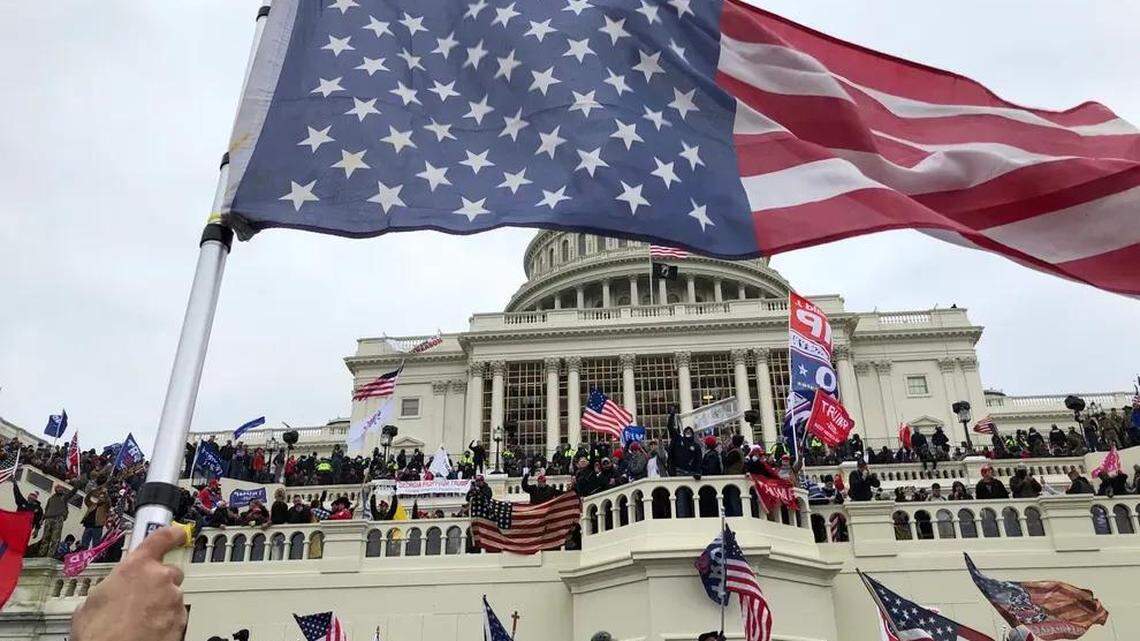
I suppose that could happen, if we elected a president who, just to give a wild example, whipped up thousands of his supporters to, I don’t know, let’s say, invade the Capitol and beat up a bunch of cops because he lost an election. And then we voted that same president back into office and he pardoned everybody involved.
But really, what are the chances of something like that ever happening?
This story was originally published May 2, 2025 at 7:02 AM with the headline "Why does the MAGA right hate the word ‘democracy’ so much? | Opinion."
