High-tech toys give help Cardinals track their pitchers by the gigabyte. Does it help?
As recently as three years ago, any pitcher who invested their time, effort and money into a winter trip to a private training facility would’ve been the subject of significant curiosity and coverage.
As Driveline Baseball exploded into the mainstream and their competitors and imitators grew throughout the game, the novelty around them correspondingly decreased.
To watch the St. Louis Cardinals conduct pitching workouts at their spring training complex is to be surrounded by tens of thousands of dollars of electronic equipment, high-tech cameras and their digital readouts. That equipment is designed to measure the spin rate and associated force of pitched balls down to the most minute measurements.
Seemingly every throwing session generates reams of voluminous data, all of which needs to be distilled into actionable information that makes a player better on the field.
What good are all the toys if teams aren’t able to play with them?
“I’m in constant communication with the coaching staff here,” said Cardinals starter Andre Pallante, who spent his winter working out at his alma mater, the University of California at Irvine. “It’s just constant communication of what I’m able to get where I’m at and send that in, be able to talk about it and see how we can develop.”
As an indication of the ubiquity of baseball’s technological revolution, Pallante said that the UC Irvine facility has “Trackman, they’ve got Rapsodo, they’ve got a bunch of stuff like that.” Those two brands make radar-based products which track ball flight.
Another common device referred to by its brand name, Edgertronic, is a high speed camera which can track a pitcher’s motion nearly down to individual muscles. In doing so, a pitcher can track grip, body placement, and any number of small variations which could alter the efficacy of a pitch.
The end result is literally gigabytes of data created by each player who works through a winter program. It’s left to their teams to pick out the relevant parts of that data and apply it to their ongoing development programs, isolating the important pieces of information and learning how to tune out the noise.
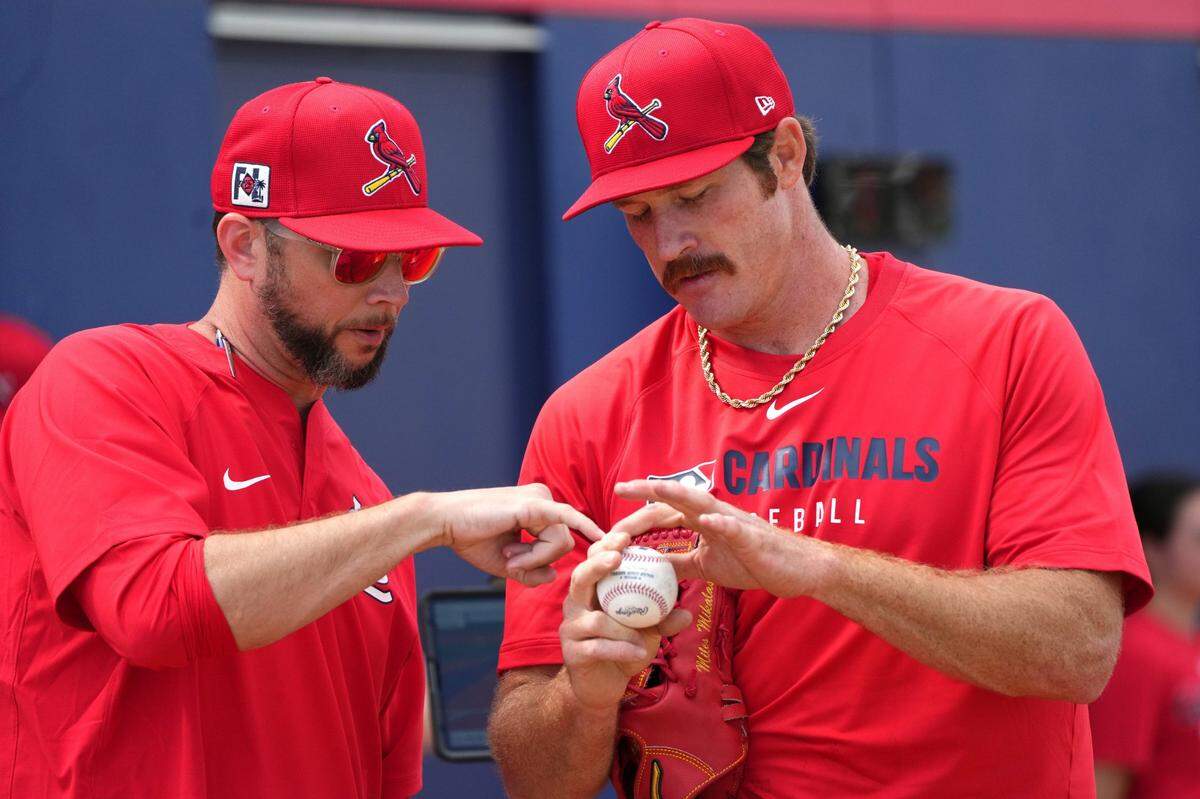
“We’re not gonna clean up their data,” Cardinals pitching coach Dusty Blake said. “What we’re gonna do is get those reports from our players, go through those reports with the context and game plan that we’ve had with them so we can see, once they get there, based on some of the [pitch] shapes we can quantify where we’re at, where we’re trying to go, if we’re on top of that.”
In Pallante’s case, that was a process as simple as taking photos of tablet screens and texting them to Blake, keeping an eye on movement profiles and velocity. That’s also an important check for the team in terms of offseason workload, guaranteeing that players aren’t overloading themselves with high intensity sessions that might prevent proper healing or rest.
Some situations work themselves out into a little more natural oversight. Righty Gordon Graceffo trained this winter at Tread Athletics in Charlotte, NC, near Blake’s offseason home. The facility welcomed Blake in for some of Graceffo’s work, allowing him a much more in depth view of the pitcher’s evolving profile.
“You have to have a conversation with both sides and just kind of think about what resources you have in both places and how you can do stuff differently here, maybe,” Graceffo explained. “I would say most of the stuff I got done there, I can do here, and it’s just a reps thing at this point.”
Blake explained that individual facilities typically have their own software interfaces for player tracking, and that the data generated from workouts may not be perfectly integrated with the Cardinals’ in-house system even if it uses the same technology. While it might stand to reason that one session measured on a Trackman could be uploaded to a cloud server and accessed from anywhere, that sort of end-to-end compatibility doesn’t yet exist.
There’s also a trust factor. As with any radar system, nuances in setup can alter the results. Pitch radars must be regularly calibrated; the Cardinals are able to verify they’ve done so with their own equipment, but cannot when it comes to third party facilities. Lighting conditions might change results. There are seemingly nearly as many variables acting as noise as act as signal.
Reliever Ryan Loutos holds a degree in computer science from Washington University in St. Louis, and contributed some programming to some of the applications used by the Cardinals to track player performance. In his view, that compatibility is, “not, like, a vital, important thing.”
“It’s definitely not necessary,” Loutos said, “because everyone has a good understanding of what they do and their numbers, whether it’s all in one place or not. It’s fine. You can figure it out.”
Blake, too, sounded skeptical of a coming future in which universal access and universal language pervades the pitching sphere. Some of the rationale behind that is technical, but some is practical; pitching facilities are all marketing to the same customer base, and they generate proprietary information that they believe ought not be shared among teams and therefore, by proxy, their competitors.
Player development is the process, but for profit companies are in search of profit. As important as it is for teams to truly understand the ins and outs of their players’ winter work, there is expected resistance which comes when they attempt to dive in too deeply.
And so, cutting against the tide of technological process which has seam shifted so much of modern pitching, the game returns to simple solutions, and Andre Pallante continues to text screenshots to his pitching coach.
“It’s not that high tech yet,” Pallante said. “Maybe at some point, and then save me some messaging data.”