
Who are these Cardinals and how did they fight their way back into the playoff hunt?
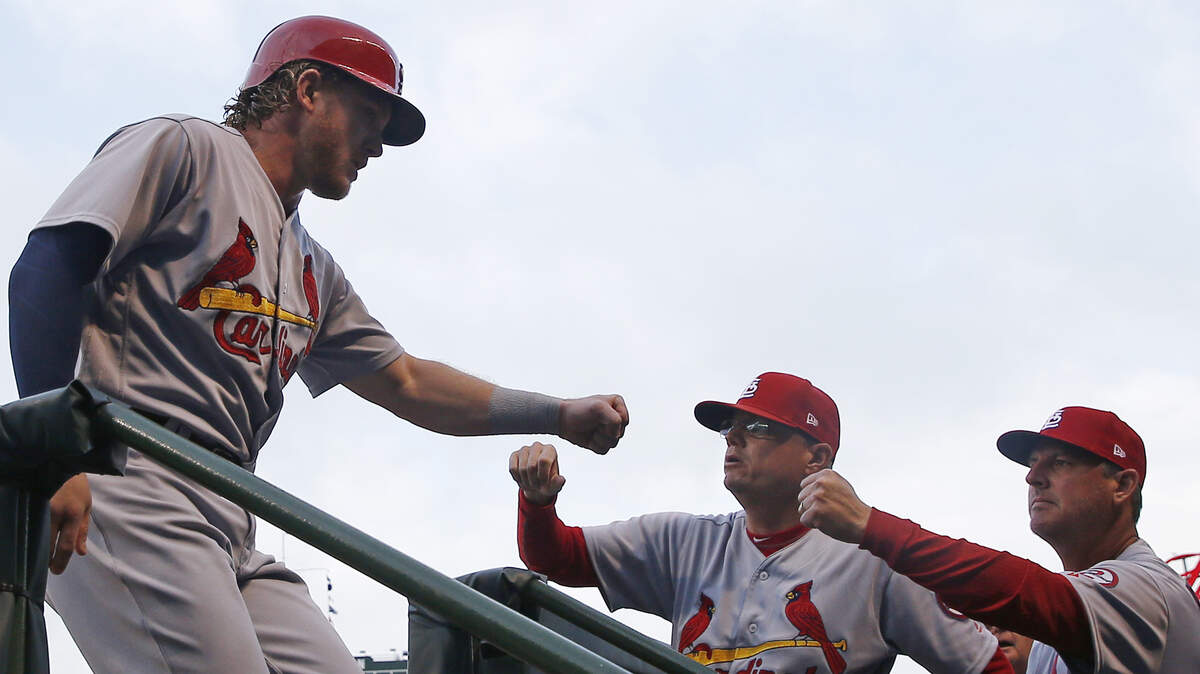
If anybody out there has these Cardinals figured out, give me a holler, will you?
Cause I can’t make hide nor hair of this mystifying edition of the Redbirds.
Left for dead at the All-Star Break, Mike Shildt’s bunch has won nine of its last 11 games, 12 of 16 and five series in a row – a mad dash that has restored the Cardinals to the wild-card race.
Maybe, just maybe, the kids in the lineup and rotation have found their sea legs with seven weeks left in the regular season, a 44-game stretch against 10 clubs — seven of them with winning records.
Not an easy task to face — a playoff berth in the balance for inexperienced players still learning to make adjustments in the big leagues every day. The challenges come at big-league newcomers from all sides — veteran pitchers learning young hitters’ weaknesses and taking advantage of them, even as, on the other side of the coin, young pitchers try to find consistency with every pitch – and that can lead to play that is uneven.
“What makes a big-league player is consistency,” says Shildt, who is 16-9 as Mike Matheny’s replacement. “Becoming a more consistent player, a consistent defender. It’s an evolution — especially for guys who get to this level so quickly — to learn what that looks like, and to do it on a stage like this and (against) the competition we deal with.”
Under Shildt, the Cardinals have scrambled their way back up the wild card standings; when Matheny was fired July 14, the Cardinals were one game over .500 and had the 10th-best record in the National League. Today they are eight wins above the break-even mark and are just 2 ½ games out of the second wild-card berth, a notion that was virtually unimaginable just two weeks ago.
And it wasn’t just the local and national media that had written off the Redbirds at the non-waiver trade deadline. The team’s brass signaled it had given up when it traded or shed veterans to acquire or give playing time to young players who could help in 2019 and beyond.
Gone, among others: Tommy Pham, the team’s best position player last season, and Greg Holland, their worst pitcher this season.
That was then. This is now. And the team is playing with more energy (could it really be the salsa?) since the calendar page turned to August.
And how’s this for irony? In a season marred by injuries, a recent injury may actually help the Cardinals down the stretch. Dexter Fowler’s broken foot means that Shildt can’t be tempted to write Fowler’s name onto the lineup card, in the vain hope he would turn around a season that may be the worst of any Cardinal regular this decade.
Instead of getting Fowler’s .180 batting average in the lineup and into right field, the Cardinals are resorting to power hitter Jose Martinez (.300, 14 HRs, 68 RBI) and Harrison Bader (.278, 42 runs scored), the fastest player on the roster.
Sunny-Side-Up Department 2.0: Matt Carpenter shows no sign of relenting or relaxing as he makes his way into the league MVP conversation, leading the league in home runs (32) and the Cardinals in runs scored (78), doubles (33), on-base percentage (.389), slugging percentage (.595), and a .983 OPS (on-base percentage plus slugging percentage).
Eight times this season, Carpenter has homered to lead off a game, giving him 23 for his career and passing Lou Brock’s franchise record.
“How fun is that when you get the first inning and your guys get a 1-0 (lead), no outs?” Shildt said. “What an amazing compliment (to pass) Lou Brock.
“Special talent, special guy, and I just enjoy having (the chance) to write him into the top of the lineup.”
Carpenter is getting some help: At 36, Yadier Molina is again having one of his best seasons at the plate (.290, 15 HRs, 51 RBI), with substantial contributions from Martinez and Bader. But the offense has been hampered by poor power production from Marcell Ozuna (only 13 homers in 478 at-bats), an injury to Paul DeJong, who missed more than 40 games, and subpar offensive seasons from Fowler and Kolten Wong.
However: The pitching staff, scarred by injuries to Adam Wainwright, Carlos Martinez and Michael Wacha, has been bolstered by Miles Mikolas, 12-3 with a 2.94 ERA in his first year back in the majors after three seasons in Japan, along with kid pitchers Jack Flaherty, 2-0 with a 1.39 ERA in two starts this month, call-up Dakota Hudson (2-0, 0.96 ERA) and the recently acquired Chasen Schreve (1-0,2.45 ERA).
That said, we arrive at a sentence I hardly imagined I’d be writing in mid-August this season.
Here’s what the Cardinals have to do to gain a playoff berth:
Simply put: Win. But it won’t be easy: Of the Cardinals’ remaining 44 games this season, 35 of them are against teams with winning records, a group that is 57 games over .500 collectively.
But at least the Cardinals can have their say in the wild card race: They face three of the four teams ahead of them (or tied with them) in the fight for two wild-card, one-game-play-in spots:
They face Milwaukee six times, a three-game set starting Friday at Busch Stadium and three more at home Sept. 24, a series that opens the last week of the regular season.
They play the Dodgers seven times, with a three-game series starting next Monday night in Los Angeles, and a four-game series at Busch starting Sept. 13.
And they have three games against Colorado, starting Aug. 24 in Coors Field.
The other wild-card hopeful ahead of the Cards at this point? Philadelphia, which is done with St. Louis after splitting six games with the Cardinals earlier this year.
In the Cardinals’ favor: 26 of their remaining 44 games will be at Busch Stadium, including 11 of 17 the rest of this month and 15 of 27 in September.
And that brings us to this: How will the youngsters fare down the stretch? Will they wilt under the playoff pressure? Or are they so young they won’t know the weight of the challenges – or the scope of the opportunities – facing them?
It won’t be easy. But what has been easy for the Cardinals this topsy-turvy season?
This story was originally published August 13, 2018 at 12:17 PM.