
Greatest Cardinals No. 16: LHP Harry Brecheen
NOTE: The BND has endeavored to identify an objective list of the top 100 St. Louis Cardinals players of all time, based on statistical formulas developed through sabermetrics. We’ll count down the list daily, player by player, until April 4, the day of the Cardinals’ 2019 home opener. The running list and player bios can be found at bnd.com.
NO. 16: LHP HARRY BRECHEEN
The Cardinals won four National League pennants and three World Series titles between 1942 and 1946 and, during the same stretch, became the first major league with 100 or more wins in three consecutive seasons.
Still, some tend to minimize the Swifties’ baseball dynasty because of World War II and the suggestion that the selective service watered down major league competition through the draft.
While it’s true that more than 500 professional baseball players left their teams to pinch hit in the war effort, which put a strain on rosters as the war progressed, the attempts to diminish the Cardinals’ achievements of the era are simply unfair.
St. Louis won 98 games in 1941, before the bombing of Pearl Harbor drew the United States into the conflict, and they won 97 games and the title in 1946, when big league teams were flush with returning talent. And it wasn’t like the St. Louis teams didn’t have their own losses to content with — the Cardinals sent 43 players off to military service.
Indeed, St. Louis dominated the decade because of their expansive farm system. Among the bumper crop of pitchers it produced was the 5-foot-10, 160-pound “scrap of meat and rawhide” from Ada, Oklahoma, Harry Brecheen.
Because of a serious boyhood ankle injury and an abnormality in his spine, the selective service rejected him as 4-F. Whatever hindrances those physical maladies may have caused in the service of Uncle Sam did not apply to a big league ball field. Among that stable of young arms, Brecheen proved to be the most consistent.
He was a blue-eyed, blond-haired wisp of a man with a pointed chin, freckles and wide, almond-shaped eyes. It wasn’t his feline appearance, though, that led Hall of Fame sports writer J. Roy Stockton to dub Brecheen Harry “The Cat.” It was the reflexes of the wiry left-hander that allowed him to bounce off the mound and field his position like a fifth infielder. In 1,907 innings, Brecheen was charged with just eight errors.
But it was his pitching that made him the ace through some of the Cardinals’ best seasons.
Brecheen’s left-handed delivery came with a high leg kick and his repertoire was famous for its big-breaking curveball and backwards-breaking screwball. Both pitches were set up by the common understanding among National League batters that Brecheen wouldn’t hesitate to go high and tight with his fastball. He had perfect command as well, striking out three times as many as he walked during his best seasons.
Gas House Gang ace Dizzy Dean, retired to the broadcast booth by injury, was generous with his compliments, mostly to himself. But he was a big fan of The Cat’s, too.
“For a little guy, Brecheen gets a lot on the ball. With the kind of control he’s got, he could thread a needle with the ball,” Dean told The Sporting News. “He’s the nearest thing to Carl Hubbell. … Hub had a better screwball, but I don’t think he threw that fast.”
Brecheen labored long in the Cardinals’ minor leagues before his spot on the big-league staff finally stuck in 1943, when he was 28 years old. Over five of the next six seasons, he’d win at least 15 games and post no worse than a 2.85 ERA.
But Brecheen was at his best when the games mattered the most. Against the New York Yankees in the 1943 World Series — a rematch of the previous season’s Fall Classic — The Cat got his first taste of the postseason with three innings of relief work. In the eighth inning of Game 4, he surrendered a leadoff double to Marius Russo, who was then bunted to third. A sacrifice fly to center by Frankie Crosetti send Russo home with what would be the game-winning run. New York went on to win the series four games to one.
The loss would be Brecheen’s last five World Series appearances.
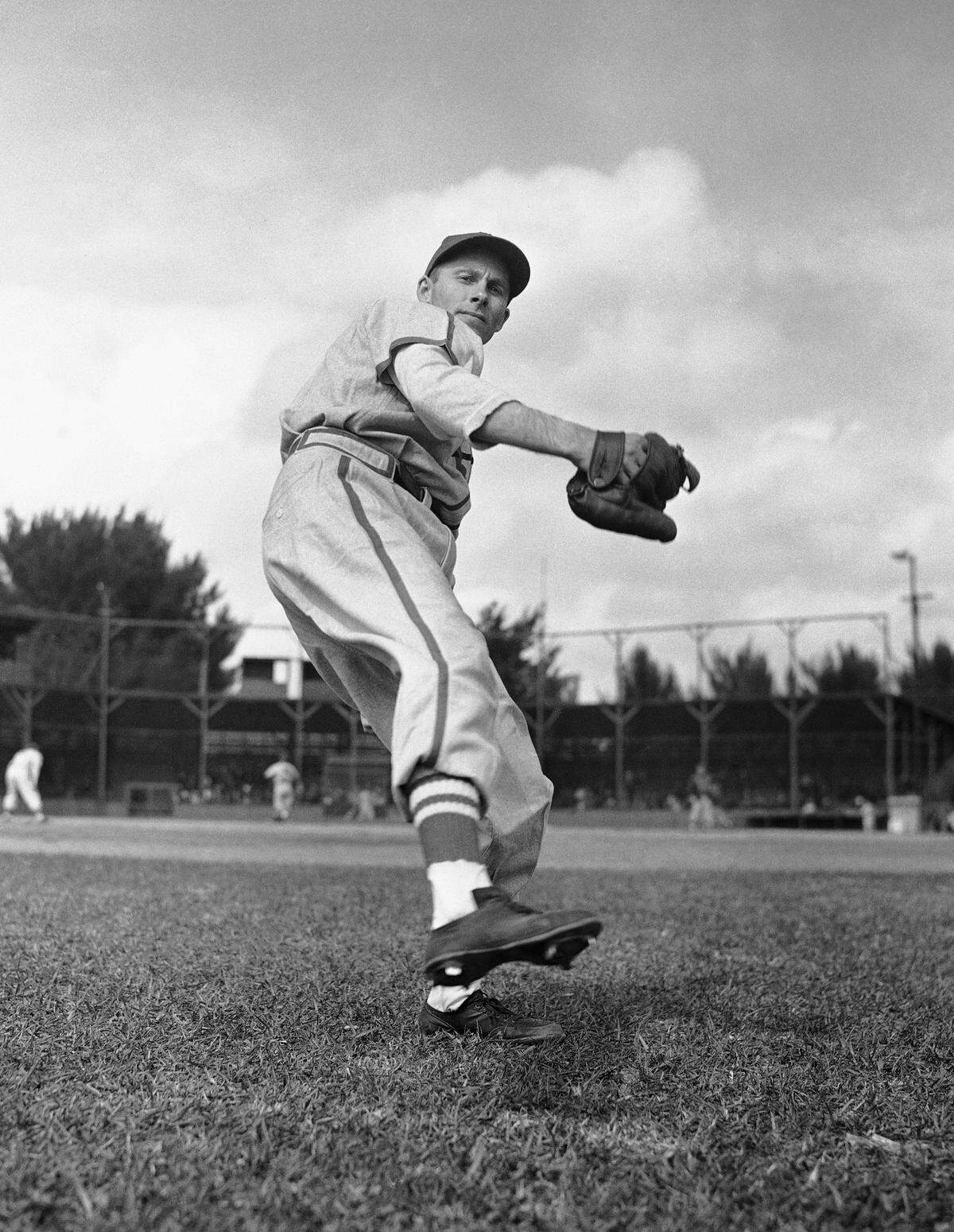
He went 16-5 in 1944, just the fourth most victories on the staff, to help St. Louis to 105 wins and its second World Series championship in three years. The Cardinals finished second to the Chicago Cubs in 1945 to break a three-year pennant streak, but Brecheen had a league-best .789 winning percentage (15-4) and was third in the NL with a 2.52 ERA.
Howie Pollet, a 25-year-old left-hander, returned from a two-year tour in the Pacific to lead the Cardinals with 21 wins. Brecheen, now 31, ran into tough luck all year to finish at a mediocre 15-15, but he’d allowed just 20 wins total in 14 of his losses. He otherwise led the National League with five shutouts, which contributed to a sparkling 2.49 ERA in 231 innings.
Brecheen didn’t need much help his offense in the World Series. He shut out the Boston Red Sox on four hits in a 3-0 Game 2 win. With the Cardinals trailing Boston three games to two, he shut down the Sox again on seven hits to even the series with a 4-1 victory.
In the decisive Game 7, St. Louis starter Murry Dickson held the Red Sox to a single run through seven before allowing them to tie the game with a pair of runs in the top of the eighth. Manager Eddie Dyer called on Brecheen with no day’s rest to get the last six outs.
Harry Walker’s single into right sent Enos Slaughter off into his “Mad Dash” to break the tie and cinch the championship for St. Louis. Brecheen picked up the win to become the first left-hander in history with three victories in one World Series and the first from either side in 26 years.
Over seven career World Series games, Brecheen was 4-1 with a 0.83 ERA, a record currently held by San Francisco’s Madison Bumgarner.
Brecheen’s best single season was in 1948 when he went 20-7 to lead the second place Cardinals. He also was the National League leader in ERA (2.24), shutouts (7) and strikeouts (149).
Over seven consecutive seasons, The Cat finished among the NL’s top 10 in WHIP (base runners per nine innings) and strikeout-to-walks ratio.
A sore arm that had troubled him since 1944 took a toll. Though he won 14 games in 214 innings in 1949, his ERA spiked to a career-high 3.80 the year after which led to fewer innings and more work from the bullpen. The Cardinals gave him his release on Oct. 30 1952 and he signed on as pitcher-coach with the Browns later the same day.
Brecheen moved with the Browns to become a Baltimore Oriole two years later and he stayed on as pitching coach through 1967.
He was posthumously inducted into the Cardinals Hall of Fame in 2018.
SEASONS IN ST. LOUIS: 1940, 1943-1952
KEY STATS
128-79 (.618) in St. Louis | 2x All-Star | 2 WS ring | 39.0 WAR | Cardinals HoF’18
TOP 100 SCORE: 4.36
This story was originally published March 17, 2019 at 4:08 PM.