
Greatest Cardinals No. 1: “Baseball’s perfect warrior, baseball’s perfect knight”
NOTE: The BND has endeavored to identify an objective list of the top 100 St. Louis Cardinals players of all time, based on statistical formulas developed through sabermetrics. We’ll count down the list daily, player by player, until April 4, the day of the Cardinals’ 2019 home opener. The running list and player bios can be found at bnd.com.
NO. 1 STAN MUSIAL
In 1999, to mark the approaching end of the millennium, Major League Baseball turned to its fans to select the 30 greatest players from the previous 100 years.
More than 2 million voters turned in ballots, either on paper or online submission, and barely a quarter of them cast a vote for Stan Musial. Anticipating the likelihood of such a glaring oversight, MLB wisely reserved a few spaces on its All-Century Team for a panel of experts that could right such obvious wrongs.
Still, how could that happen? By the numbers, Musial ranks among the top five hitters of all time. How could he have receded so far from the national consciousness that 1,500,000 so-called fans believed he didn’t belong among the top 10 outfielders?
Had too much time passed since his hey-day? Did 22 seasons in St. Louis leave him too far removed from the spotlight of bigger markets? Could it have been that Musial’s life was just too untainted? Did genuine humility, dedication to family and the lack of salacious controversy make him too boring to a tabloid society?
Whatever the answer, it was the question itself that inspired urgency in the Cardinals’ front office to reintroduce the greatness of “Stan the Man” to a national fan base, especially as Musial approached his 90th birthday.
And what a story they had to tell.
Musial was a two-sport high school standout in Donora, Pennsylvania, a Steel Belt town of about 14,000 people. The Cardinals discovered Musial in 1936 as sweet-swinging, swift-running left-handed pitcher for the Donora Zinc Works team. They signed him two months prior to his 17th birthday.
Inconsistency both on the mound and at the plate made for a slow ascension through the Cardinals’ minor league ranks, until he reached Daytona Beach of the Florida State League in 1940. He started 18-5 with a 2.62 ERA over 223 innings, but on Aug. 11, his budding prospects as a big-league pitcher suddenly came crashing down.
With only 14 players on the roster, Musial was written into the lineup at center field for the second game of a double-header in Orlando. While making a shoe-string catch on a sinking line drive, he tumbled forward onto his left shoulder. The resulting injury knocked him out of the lineup for three weeks and off the pitching staff for good.
At the time, though, the newly-wed Musial also was batting .311 with 10 triples, 70 RBIs and had struck out just 28 times in 405 at-bats. Manager Dickey Kerr had been wondering all the while if Musial’s career interests would be better served in the outfield anyway. So, the following summer, when Musial shredded the pitching in the class C Western League to the tune of a .379 average and 26 home runs, his new identity as an outfield prospect put him on a fast track to St. Louis.
At Sportsman’s Park on Sept. 17, 1941, with the Boston Braves in town for a Wednesday afternoon double-header, the 20-year-old lefty and his odd, peek-a-boo batting stance made their major league debut. Batting third and playing right field in the nightcap, Musial laced a two-out double off Boston’s Jim Tobin to score Max Lanier and Johnny Hopp. He singled his next time up in the fifth as the Cardinals won 3-2.
In 47 at-bats down the stretch of a tight pennant race, Musial batted .426 with a home run and seven RBIs. The Cardinals nonetheless fell short of the Brooklyn Dodgers by 2 1/2 games, which led soon-to-be-traded first baseman Johnny Mize to wonder openly where the kid had been all year.
“Here we’re fighting the Dodgers for a pennant. (General Manager Branch) Rickey said we didn’t have anybody in the minor leagues to help us,” Mize griped. “Then in September he brings up Musial. Why didn’t he bring Musial up earlier? That’s what all the players wanted to know. We might have gone ahead and won the pennant.”
There would be no shortage of pennants for the Cardinals or accolades for Musial in the coming seasons. Nor would 1941 be their last tight race with the rival Dodgers.
Musial was good in 1942, batting .315 as St. Louis won a franchise-best 106 regular-season games, the first of four pennants over the next five seasons, and a World Series title. But he was outstanding in 1943.

Musial won his first of seven career batting titles at .357, while also leading the National League in hits (220), doubles (48), triples (20), on-base percentage (.425), slugging (.562) and total bases (347). At just 22, he was the league’s Most Valuable Player and, in fact, would go on to finish among the top five in MVP balloting each of the next 10 years and in the top 10 each of the next 14.
The Cardinals were champions again in 1944, defeating their stadium landlords, the St. Louis Browns, in the six-game Trolly Series. Musial belted a two-run home run in the first inning of Game 4, a 5-1 Cardinals win. Remarkably, it was the only home run he would hit in 86 World Series at bats.
After giving up a season to paint ships and play ball with the Navy at Pearl Harbor, Musial returned for another championship run in 1946.
On June 22 of that season, the Cardinals visited Ebbets Field in Brooklyn for the second of a three-game series, trailing the Dodgers in the standings by 2 1/2 games. Late in the game, as Musial stepped to the plate with three hits already under his belt, St. Louis Post-Dispatch baseball writer Bob Broeg noticed a murmur in the crowd as it swelled into a chant: “Here comes the man … here comes the man …”
The man? Stan? Stan the Man?
Broeg liked its rhyme and, for numerous reasons, recognized it as the perfect nickname for Musial. In its context, though, the sobriquet was inspired by the way The Man tattooed Dodger pitchers. That season alone, he batted .418 with three home runs and 18 RBIs against them. Shoot, in 621 career at bats at Ebbets Field, he hit .359.
The regular season ended with the Cardinals and Dodgers in a first-place tie and it took a best-of-three playoff to decide the pennant. The Cardinals won in two games, then defeated the Boston Red Sox in a seven-game World Series.
But, Musial recognized that 1947 would bring the likely end to the “Swifties’” National League dominance when the Dodgers signed Jackie Robinson. The Cardinals, meanwhile, were slow to integrate and didn’t sign their first black player, first baseman Tom Alston, for another seven years.
Indeed, they would not be back in the World Series until 1964, the year after Musial retired.
Musial often was singled out by Robinson as one those who fostered the inclusion of black players, even as they battled stark racism from other corners of the game. While he wasn’t outspoken on issues of politics or race, other black stars like Hank Aaron, Willie Mays and Ernie Banks have recalled how Musial would join them in the All-Star Game clubhouse to play cards — the only white player at the table.
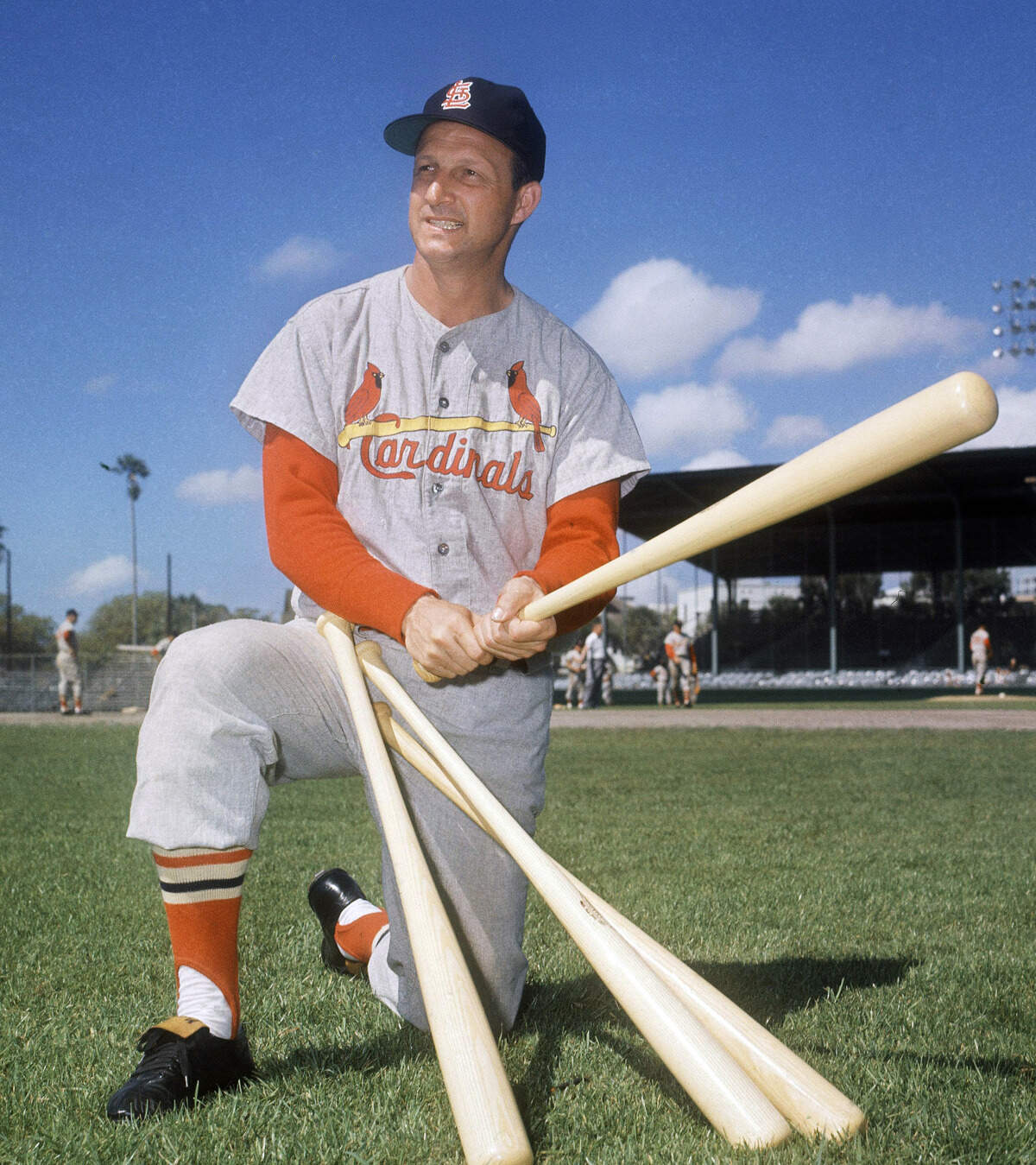
In 1952, the Dodgers sent another black pitcher, Joe Black, on the mound at Sportsman’s Park. Racial taunts were hurled from the home dugout as Musial stepped to the plate — “With that dark background, Stan, you shouldn’t have any trouble seeing the ball,” his teammates laughed. Embarrassed, Musial stepped from the batter’s box and kicked at the dirt until they quieted down. Later, in a corridor under the stadium, he sought out Black to apologize.
“I’m sorry that happened, but don’t worry about it,” he told him. “You’re a great pitcher and you’ll win a lot of games.”
Meanwhile, Musial continued to pound the baseball with drum-beat consistency. His best season was 1948, when he fell one home run shy of leading the National League in every offensive metric but stolen bases, strikeouts and walks. He slashed .376/.450/.702 with 230 hits, 46 doubles, 18 triples, 131 RBIs, 135 runs and an incredible 429 total bases.
Popular legend has it that Musial lost a home run that season when the game in which he supposedly hit it was called due to rain. Otherwise, that 40th blast would have tied Ralph Kiner for the league lead and made Musial the last on the Senior Circuit to win a Triple Crown. Research efforts to turn up some evidence of that home run, though, have failed.
Nevertheless, there were four more batting titles and many milestones ahead of him. The Sporting News, in fact, named Musial the best baseball player from 1946 through 1955, the post-war decade that included the likes of DiMaggio, Robinson, Ted Williams, Bob Feller, Aaron, Mays and others. Stan the Man stood out.
He’d make a final run at a batting title in 1962 when, at age 41, he hit .330. He also became the oldest player to belt three homers in a single game, a feat he accomplished at New York’s Polo Grounds against the expansion Mets — as a grandfather.
Asked once the secret of his longevity in the game, Musial replied: “Get eight hours of sleep regularly, keep your weight down, run a mile a day and, if you must smoke, try light cigars because they cut down on the inhaling … Oh, and make it a point to hit .300.”
By the time he retired, Musial owned 17 major league and 29 National League records. He had amassed 3,630 hits, 1,599 RBIs, 475 home runs, 128.2 WAR and appeared in 24 All-Star Games (they played two per season from 1959-1962).
In 1969, Musial became the first to collect at least 300 votes for the Hall of Fame (though, remarkably, 23 baseball writers still didn’t mark his name on their ballots). The Cardinals, meanwhile, unveiled the statue that remains a landmark in front of Busch Stadium III. Inscribed at its base are the words spoken by former National League President Ford Frick: “Here stands baseball’s perfect warrior … Here stands baseball’s perfect knight.”
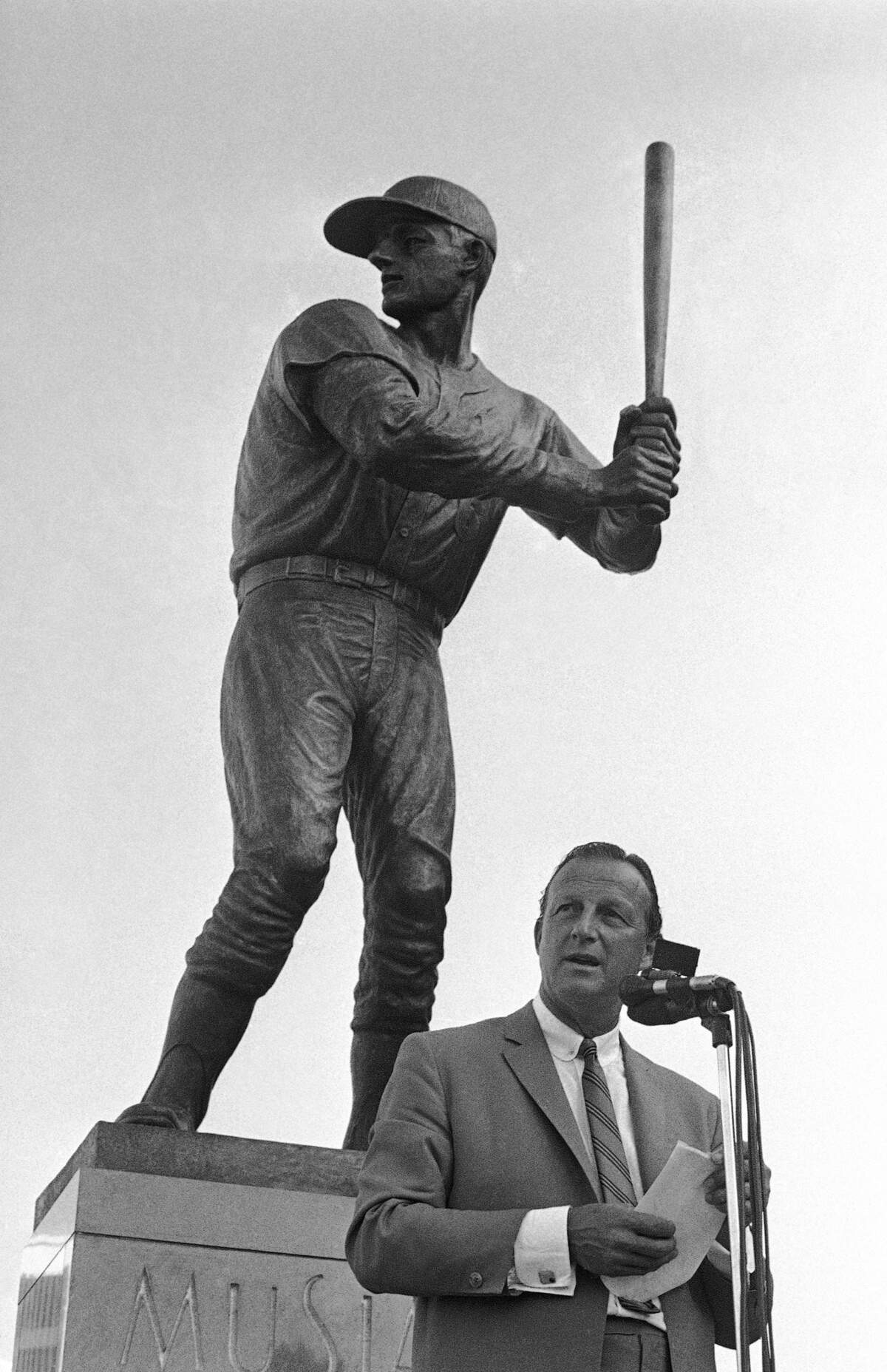
That’s the Stan Musial Cardinals ownership wanted the nation to know in 2010 when it launched the “Stand for Stan” campaign to raise awareness of his legend. When President Barack Obama presented Musial with the Presidential Medal of Freedom in February of 2011, he did so with the acknowledgment of his humanity and citizenship, as well as his outstanding playing career.
“Stan remains to this day, an icon untarnished, a beloved pillar in the community, and a gentleman you’d want your kids to emulate,” he said.
SEASONS IN ST. LOUIS: 1941-1944, 1946-1963
KEY STATS
.331/.417/.559 in St. Louis | 24x All-Star | 7x NL batting champion | MVP’43,’46,’48 | 3 WS rings | 128.2 WAR
TOP 100 SCORE: 10.31
This story was originally published April 4, 2019 at 5:00 AM.