
It’s not May yet, but St. Louis Cardinals already face problems at multiple positions
When in a baseball season is too soon to start considering significant changes to the plan that was drawn up in spring training, and how soon is now?
The St. Louis Cardinals have little to no reason to reach for any sort of panic button in the midst of an entirely cromulent start. Series wins against basement dwelling Cincinnati and Pittsburgh and a hard fought split on the road in Milwaukee have started to shape the contours of a divisional race that seems bound to precisely fit the shape of their club.
Even an early test against the New York Mets, who themselves jumped out to MLB’s best record, doesn’t bring any undue stress. A dominant performance from Max Scherzer on Monday night led to his team winning a 17th consecutive regular season game in which he started, but Miles Mikolas matched his performance and the Cardinals held a lead with two out in the ninth inning before their defense uncharacteristically let them down.
Still, despite solid early results, it’s not difficult to identify areas of concern. St. Louis entered play Tuesday with an on base plus slugging percentage of .672, a hair under the National League average mark of .680. That mark was in part buoyed by the lowest raw strikeout total in the senior circuit, though they’ve played fewer games than any NL team other than Miami.
Very little about the everyday lineup provides for flexibility. Andrew Knizner’s expanded role has created a timeshare behind the plate, and the not-so-strict designated hitter platoon split between Corey Dickerson and Albert Pujols brings some change on a daily basis, but without many places to turn for improvement, attention is bound to fall back on shortstop.
‘We need to see production’
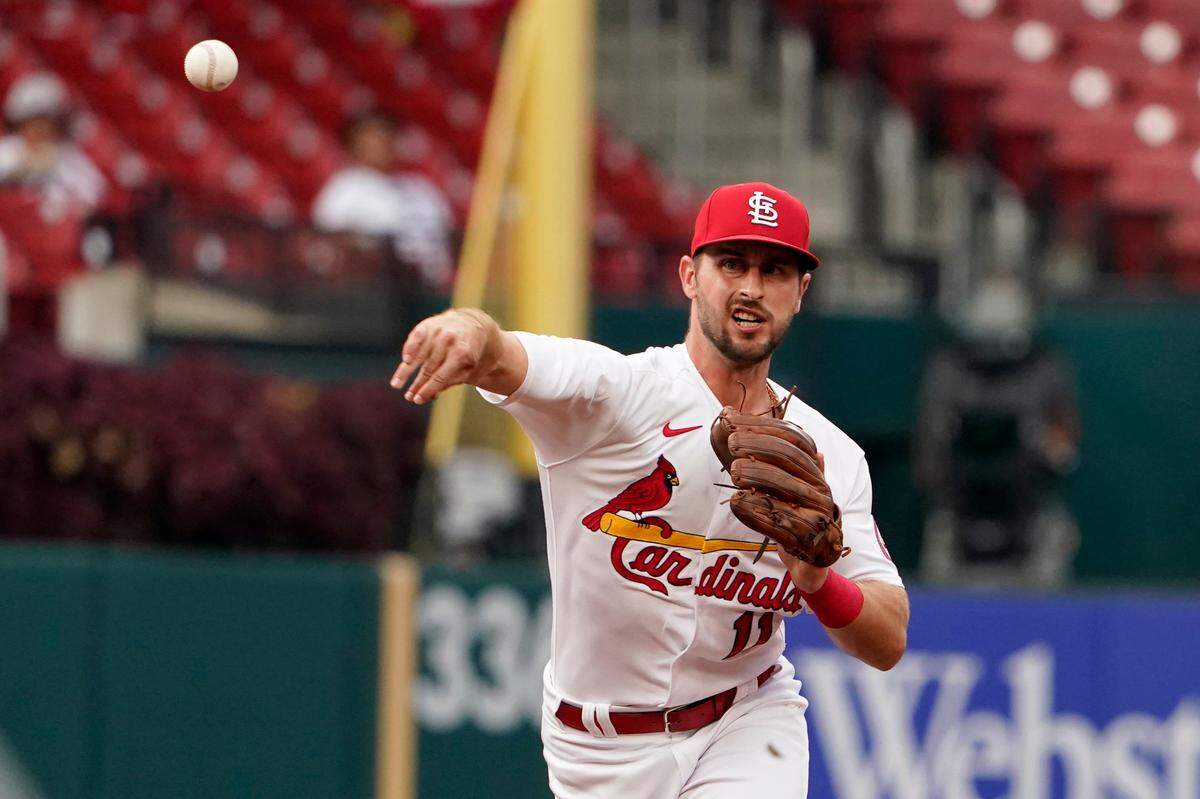
After being supplanted by Edmundo Sosa at the end of the 2021 season, Paul DeJong was reinserted as the team’s primary shortstop in spring training. With a 5-for-36 start to the season, DeJong was given two days off at the start of the week in an attempt to right the ship.
“All transparency, we need to see production,” Cardinals president of baseball operations John Mozeliak said Monday. “We expect him to be that all star-type caliber player. I mean, that’s what we’re hoping to see.
“And so, you know, early on, he’s struggling at the plate, our fingers are crossed. And I know he’s working hard to try to get to where he needs to be to be that player.”
The decision to forgo an historically abundant shortstop free agent market in the winter rests on the front office, adding another kind of need to DeJong’s potential production. After dealing with COVID in 2020 and a broken rib in 2021, Mozeliak pointed to a small sample to start this season in his call for patience and calm.
As of Tuesday, since the start of the 2018 season, DeJong has been five percent below league average as a hitter, measured by OPS+. In more than 1700 plate appearances over that time, his batting average is below .230 and his on base percentage is less than .310.
Gallegos cause for concern?
It’s unclear whether that sample is broadly considered to be fairly representative.
Still, DeJong’s stout defense and power potential provides significant value if he can approach his contact numbers of prior seasons. The limitations on the success of the offense can scarcely be dumped entirely at his feet, and even if they could, a winning team has the luxury of taking as much time as possible to make sure they’re making a dramatic in-season decision correctly.
Nor are some of the early uneven patches for closer Giovanny Gallegos a cause for concern. After professing in spring training that he would prefer to be less scripted in his bullpen roles, manager Oliver Marmol used Gallegos in four consecutive save situations — successfully — before a hard luck loss of his own doing on Monday night.
By failing to cover first base on Dominic Smith’s hard grounder to first, Gallegos gave the Mets life and turned New York’s 27th out into what would be the game’s winning run. Marmol explained Tuesday that Gallegos didn’t need any additional correcting after Monday’s obvious mistake, which Gallegos himself owned in the game’s immediate aftermath.
More thoughts on potential changes
Marmol described some of the team’s algorithmic process for evaluating pitching matchups and explained many branches on the decision tree all lead back to Gallegos, given his diversity of pitches and success against hitters from both sides of the plate.
“Is Gio in jeopardy of losing leverage innings? No, we’re nowhere close to that,” Marmol added.
What feels like picking nits in April can instead look like prescience in August, and a problem that seems clearly on the horizon today can become an obvious unaddressed shortcoming tomorrow. The Cardinals, preternaturally patient in their approach for many years running, are unafraid to let that clock run perhaps longer than many fans and observers would prefer.
As long as they win, the ticking of that clock stays quiet. Whether the volume increases will depend on what they hear when the heat inevitably does.

This story was originally published April 27, 2022 at 9:34 AM.